World Without End
Essays on Apocalypse and After
As a child, Martha Park found it easy to believe in both God and the goodness of the world. “The world was drenched, then, with a presence everyone around me called God,” she writes. “I walked with one hand aloft at my side for him to hold.”
Over time, Park drifted from this assurance of divine companionship, but her sense of belonging to this earth only deepened. When her father retired after decades as a Methodist minister, the last tether to her childhood faith disappeared with him: “My life had been utterly shaped around walking into church and seeing my father in the doorway, and now there was no church, anywhere in the world, where I could find him on Sunday morning.”

Read our latest issue or browse back issues.
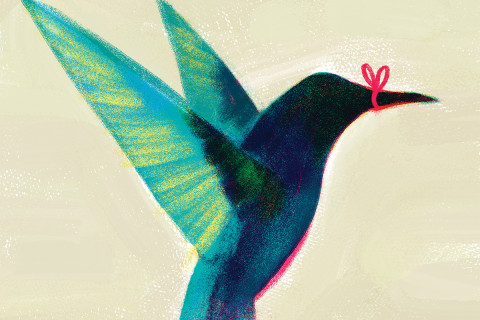
World Without End twines Park’s love for this world with her uncertainty about a world to come. Through personal essays, nuanced reporting, and original illustrations, Park grapples with religious ambivalence and ecological care as she wonders how faith both compels and hinders our love for a planet in peril. The essays explore apocalypses personal and global, present and anticipated. Her writing moves nimbly between climate and religious apocalypses (such as biodiversity collapse and the rapture) before turning inward to investigate her own apocalypses: the loss of her faith, the birth of her son. She contrasts a love for this earth, home to wetlands and infants and roseate spoonbills, with the apocalyptic impulse that sends people into bunkers to prepare for its end.
Park’s essays unearth surprising connections between the natural and the supernatural, the material and the ineffable. “The Life Everlasting,” an essay about the presumed-extinct ivory-billed woodpecker, circles the question of whether Jesus rose from the dead in bodily form. Even in childhood, Park was troubled by the idea of resurrection. “I did not truly expect that the decomposed bodies of believers would one day be reconstituted, nor did I see this as a desirable future for myself or the people I loved,” she writes. But as she grows older and returns to the idea of resurrection by way of a possibly extinct woodpecker, she wonders: “Why did faith matter if it did not transform real bodies, real lives, here on earth?”
Certainty is a central concern of the book, and not only the religious variety. In one essay, Park is a baffled visitor to Ken Ham’s Ark Encounter, a life-sized replica of Noah’s ark and a pilgrimage destination for young earth creationists. In another, she’s an audience member in a reenactment of the Scopes Monkey Trial, wondering about the dangers of a religion that is inseparable from political ideology. And when writing about the Florida Torreya, an endangered tree of mythic quality, Park turns her gaze to the secular fundamentalism that creates divisions among the conservationists and scientists working to protect it.
The landscapes of the American South are both settings and characters in World Without End. These landscapes provide a through line for the book’s ranging essays. Even the final essay, about birth and wound care, is situated in the natural world. The James River offers a metaphor for labor while a summer storm shakes trees outside a hospital window. When Park brings her newborn son home, the Memphis heat turns his skin red within seconds. “I didn’t realize just how permeable he would be, apart from my body, to the world in which we both now lived,” she writes. We are permeable beings, the book reminds us, who share a changing home.
World Without End positions doubt not as faith’s opposite but as its own form of engagement with the divine. Seen in this light, doubt is a kind of good wrestling with God. The certainty that troubles Park is the opposite of permeability: a rigid, binary way of relating to God, others, and the natural world. This certainty “might be a barometer, not for the strength of one’s faith, but for its fragility.”
Park’s thinking joins the same stream as that of Christian Wiman, who writes in My Bright Abyss, “Faith is not some hard, unchanging thing you cling to through the vicissitudes of life. Those who try to make it into this are destined to become brittle, shatterable creatures.” Readers can sense Park testing out a new kind of religious devotion, one whose flexibility and adaptability mirrors at-risk species and places. It’s a faith that is at home with doubt, a faith that can bend without snapping, like a bough in a storm.
From one vantage point, the book reads as a collection of eulogies, mourning Park’s place in a pew at her father’s church alongside losses in our natural world. But World Without End is not only about endings. As the subtitle suggests, it’s also about what comes after. After the extinction, after the birth, after the shift in faith—after all of these apocalypses—what then?
There’s a scene in which Park encounters a Florida Torreya for the first time. She’d hoped to see the tree in its native habitat. But the pandemic and birth mean she can visit one only in an estate garden closer to home, replanted and flourishing in a new environment. Touching the fragrant needles, she reflects:
Before I became pregnant with my son, I worried constantly about my future child inheriting a diminishing world; when I looked around me, all I could see was loss. But once he was born, once he became not a future possibility but a present-day fact, I began to see these unpredictable ways—non-adherent to any baseline or ideal—that creatures find to thrive.
These essays are elegiac, but they are also working—with dexterity, with nuance, with tenderness—to imagine the continuation of this world. World Without End traces Park’s journey toward a faith marked not by certainty but by grappling and beckons toward a future in which creatures of all kinds can thrive.