News

With three people scheduled for execution, southern churches toll their bells

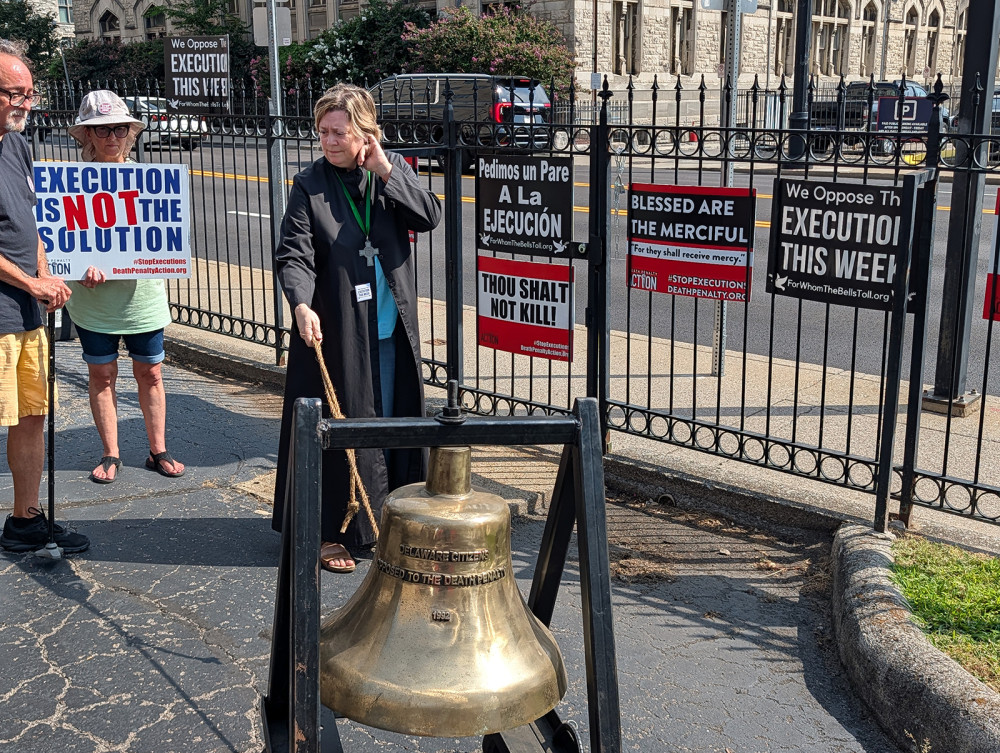
On the first day in 16 years that three people on death row were scheduled to be executed on the same day, faith groups in Tennessee, Georgia, Texas, Kentucky, Wisconsin, and Iowa tolled their bells as part of a campaign led by the Death Penalty Action advocacy group. In Tennessee, they rang for two minutes at 10 a.m. CT that coincided with a scheduled execution in the state.

“ We have to be together in our opposition to executions and in our statement that this is not in alignment with the teachings of our faiths,” said Abraham Bonowitz, the executive director of Death Penalty Action and co-founder of L’chaim! Jews Against the Death Penalty, in an interview. “ There should never be an execution without protest.”

On Thursday morning, Tennessee executed Anthony Darrell Hines and Oklahoma executed Carlos Cuesta-Rodriguez. Alabama executed Jeremy Williams Thursday evening. All three were convicted of murder.


Last year saw a surge in executions, with 47 people put to death, more than any year since 2009. 

The faith-based effort to toll church bells is a revival of a campaign originally inspired by Filipino Cardinal Jaime Sin’s 1983 order that Catholic churches ring their bells to call for an investigation into the assassination of opposition leader Benigno Aquino Jr., which opposition leaders claimed was ordered by President Ferdinand Marcos.

In 1999, Catholic Bishop Walter Sullivan of Richmond, Virginia, asked churches in his diocese to toll bells on the evening of an execution. Faith-based anti-death penalty activists have since used the tactic in various waves, but yesterday was the first widespread bell tolling since Death Penalty Action took up the campaign, Bonowitz said.

In the 50 years since a Supreme Court decision reignited the modern era of the death penalty in the United States, faith-based opposition has been a cornerstone of successful abolition and commutation campaigns—even as religious people as a whole tend to support the death penalty, data suggests.

In addition to the bell-ringing campaign, called For Whom the Bells Toll, Death Penalty Action hosted a virtual vigil, which included recordings of “El Malei Rachamim,” a Jewish prayer for the dead, and Psalm 23 by cantor Michael Zoosman, an anti-death penalty activist.

Last weekend, activists with Death Penalty Action marched from Riverbend Maximum Security Institution, where Tennessee’s men’s death row is housed, to the state Capitol to call for the abolition of the death penalty.

In downtown Nashville on Thursday, First Evangelical Lutheran Church rang a bell provided by Death Penalty Action because the church does not have its own bell. That bell, created by Delaware Citizens Opposed to the Death Penalty, tolled outside during Delaware executions in the 1990s and 2000s, until the state ended executions. Since then, it has been rung in opposition to the death penalty in more than a dozen states, according to Death Penalty Action.

Travis Meier, the church’s pastor, said the decision to toll the bell was inspired by 1 Corinthians  15:26, “The last enemy to be destroyed is death.” Meier said the death penalty is another way “ we have mechanized death as a society.”

Meier entrusted his music director to ring the bell as he went to Riverbend Maximum Security Institution to attend a prayer vigil that local activists hold outside executions.

On Wednesday, Dan Mann, a Christian who regularly visits a man on death row there, said that he planned to be present for that vigil. Mann said that he regularly talks to other men in the visitation room and that he met Hines once.

Of the men he sees more often, he said, “ We tell them about our life and what we have going on. They tell us about theirs. And in all of that, we’ve become very close,” Mann said.

Inspired by Matthew 25, Mann and his wife, Bethany, have been visiting death row since 2010. In years when there are many executions, the prisoners become especially “somber” and reflective about their childhoods, he said.

Growing up a fundamentalist Christian, Mann said he was taught that “ if you killed somebody, you deserved to die.” But he now believes that people on death row “are not the people that were put in there 40 years ago,” leading him to conclude that “there is nobody out of the reach of God’s mercy.”

Today, Mann attends Christ Church Cathedral, an Episcopal church that joined other downtown Nashville churches in asking Gov. Bill Lee to stay Hines’s execution. The governor declined to intervene earlier this week.

Christ Church Cathedral also committed to toll its bells. The five pastors who signed a letter about it wrote, “The bells will toll for mercy, remembering the words of Scripture: ‘Mercy triumphs over judgment.’”

At the vigil outside the prison, after an opening prayer and reading scripture together, the group of a couple dozen waited for news that Hines had been executed, Meier said. During that time, “ I pray, and I walk because I can’t sit still,” Meier said. His prayers are for Hines, his victim and her family, the prison staff, and for a change of heart among legislators.

On Thursday, Meier said, the somber gathering also grappled with “frustration” over Tennessee’s most recent botched execution attempt, during which a doctor spent over an hour trying to insert an IV line to execute Tony Carruthers. Witnesses say the attempt created excruciating pain for Carruthers, who has now been spared execution for a year.

Unlike that last vigil, this time, faith leaders received news that Hines had been executed. The faith leaders sang “Amazing Grace” and prayed the Commendation of the Dying, Meier said.

Meier lamented “the system of death” in the US. “ That three executions can happen in the same day, and a majority of the population have no clue that it’s happening—it’s just so commonplace that nobody bats an eye,” he said. —Religion News Service

Aleja Hertzler-McCain

Aleja Hertzler-McCain covers Latino faith and Catholicism for Religion News Service.

All articles »