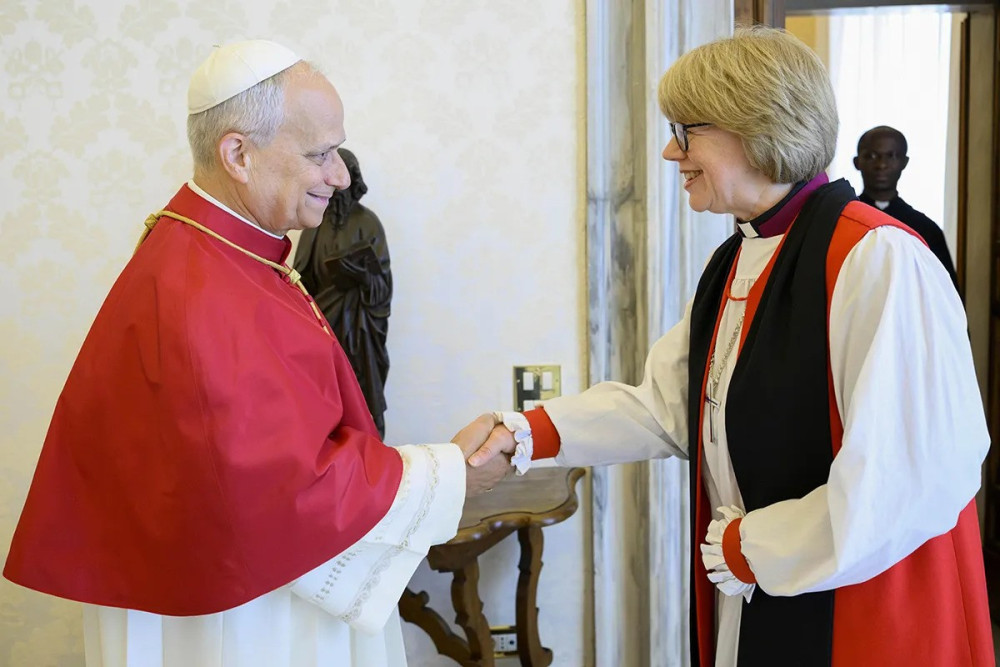
Archbishop of Canterbury Sarah Mullally traveled to Rome this weekend to meet Pope Leo XIV—a visit she called a pilgrimage, akin to the one she took to prepare for her installation at Canterbury.
Her four-day visit included a private meeting with the pope at the Vatican on Monday morning, after which both leaders gave an address and exchanged gifts. Mullally then joined Leo at a prayer service at the Chapel of Urban III where the pope presided and the two said grace together.
Mullally’s visit follows past archbishops of Canterbury who have traveled to see the pope since 1966, encounters that reinvented ecumenical relations between the Roman Catholic Church and the Church of England, as well as the wider Anglican Communion. But what was most remarkable about this visit was the optics: the sight of Mullally, the first woman archbishop of Canterbury, standing shoulder to shoulder and kneeling in prayer with the leader of the Roman Catholic Church, which still maintains a male-only priesthood.
All the signs are that there will be undoubted warmth between the two church leaders. Three Catholic cardinals—Timothy Radcliffe and Vincent Nichols from England and Wales, and Cardinal Kurt Koch, head of the Vatican’s Dicastery for Promoting Christian Unity—and five Catholic archbishops attended Mullally’s installation service at Canterbury. Pope Leo also sent a message of greeting to her.
Mullally herself has said that she is looking forward to working with Leo.
Catholics and Anglicans may also be waiting to see if the visit creates an environment where the two churches might move closer together toward ecumenical progress. When former Archbishop Michael Ramsey, in 1966, was the first archbishop of Canterbury to officially visit Rome since the Reformation, some thought full unity might be achieved. But that hasn’t happened. One of the obstacles has been disagreements about women’s clerical status, recognized in several joint declarations by the two churches in the past 60 years—which is part of why Mullally’s visit to Rome is extraordinary.
Another is the issue of shared communion, a continuing argument over whether Christ is fully present in the Eucharist after consecration, as Catholic teaching states. Finding accommodation on communion would be a remarkable step forward, and one welcomed by many families where parents belong to the two churches.
While Mullally’s visit includes meetings with leading Anglicans in Rome and Anglican Church communities, there is also a focus on talks with the Catholic Church to improve relations and understanding. The statement from the archbishop of Canterbury said this will happen through prayer, personal encounters, and formal theological dialogue. There is also an aim “to affirm a shared witness, and encourage ongoing collaboration at both global and local levels,” according to the statement.
That shared witness and collaboration was seen at the global level when the late Pope Francis and immediate past Archbishop Justin Welby visited South Sudan together to urge peace in the war-torn country. No similar joint visits have yet been announced for Mullally and Leo.
However, Mullally said in her statement, “Our world needs the peace, justice and hope that Jesus Christ brings, and I give thanks that our churches can walk together as we share that good news with the world.” —Religion News Service