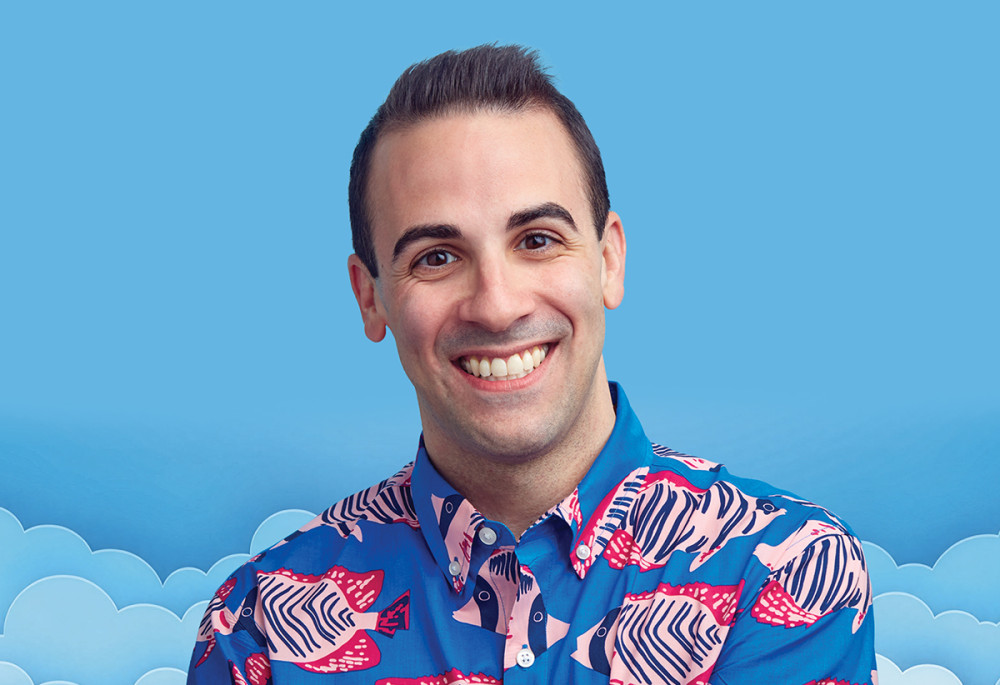
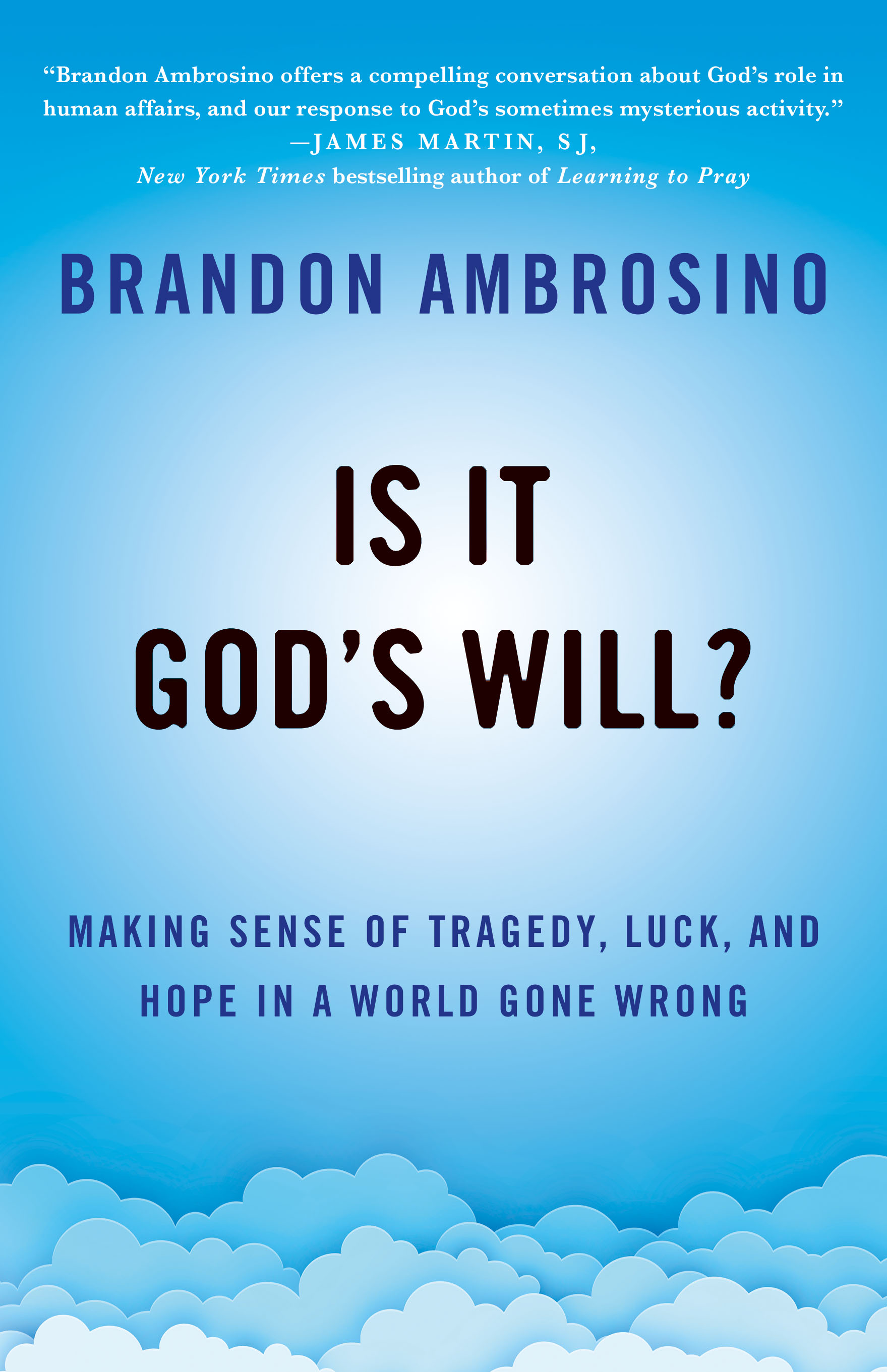
Brandon Ambrosino is an online columnist for the CENTURY and the author of Is It God's Will? Making Sense of Tragedy, Luck, and Hope in a World Gone Wrong (Morehouse). He has a PhD in theology and ethics from Villanova University and an MA in bioethics from Loyola University Chicago.
This book is accessible and conversational, and it seems invested in the question of what it is to be alive and in relationship with God. Who, if anyone, were you imagining as your conversation partner as you were writing?
People like my parents, who have faced their fair share of tragedy and grief. You said “conversational”—that’s not traditionally how theology is theorized. Traditionally, theology preaches. It does not invite somebody into a conversation. I guess I was having a conversation with anyone who doesn’t like preaching.

Read our latest issue or browse back issues.
No one likes a foreclosed conversation, and no one likes being told, “This is the way that you have to think about things.”
At an American Academy of Religion session in honor of Jack Caputo, young people were giving papers on the topic “preaching without preaching,” because that’s Caputo’s thing: God without God, just as Derrida’s thing was writing sans writing. Caputo was not thrilled with any of the papers, so he got up to the podium and said, I don’t think God exists. God insists. I think his problem with those homilies was that people were landing on a point. And I think for Caputo a good homily would just tease everything apart. It wouldn’t end with a period and certainly not an exclamation mark.
As much as I want to say I don’t think books should end with an exclamation mark, I think I would say there is an exclamation mark in my book. Hope. It’s in the imperative voice, you know? Hope, hope, hope!
What’s the difference between God and people? You insist that God is not a thing among other things, right? But you also insist that God is a person.
There are non-resolutions in the book, especially with the God-world relationship. In the first chapter, I try to say I haven’t been satisfied with any of the traditional ways that people have tried to resolve these. I’m OK with not resolving it for right now. Maybe in the future, somebody will give me a resolution that makes sense.
Caputo has a resolution: God empties without remainder into our God talk. I didn’t go there.
The difference between God and us is the difference between a lover and the one finding themself loved. God is the person who provokes me to hope. So, who is God? God doesn’t need to be provoked to hope.
It’s not quite the unmoved mover. God is the unprovoked hoper.
I love that!
The things that God hasn’t done—that are outside God’s abilities or ways of being—get understood best and made meaningful retroactively through the resurrection. How do you see hope come into play in the retroactive meaning making of the resurrection?
All of my theology, every thought I have, proceeds from God raising the crucified Jesus. I have no way of thinking without that event. It’s a first principle. Without the resurrection, I don’t have a book. Without the resurrection, I would not be a theology teacher. There are some theologians who can do what they’re doing without the resurrection, but I can’t.
Love is also a first principle, but it’s resurrection love, because love longs for eternity. I once heard James Martin say that the reason he believes in heaven is because he believes God loves us so much, God will not let a relationship with us go.
God does it to Jesus. Jesus doesn’t intend for his resurrection. Jesus dies trusting the Father. If God doesn’t do something to the rotting corpse of Jesus, then we have no grounds to hope. I really do believe that.
Several times in your book you suggest that God, in a sense, depends on us for a kind of existence—that if we destroy the world in a nuclear or environmental holocaust, and there are no people, that’s the end of God as we have known him and perhaps as God has known himself. In light of that, how do you understand the role of our agency and choice in our relationship with God, the God described in Psalm 82? What must we do in response to the hope that’s provoked in us by God the provoker?
I love Psalm 82. For me, the Christian God is the God of Abraham, Isaac, and Jacob. The Christian God is not this God in himself versus the God for us. These are just theological constructs. But that’s a really tough question: What must we do? I think we must make good on the promise contained in God’s name. We must, like Psalm 82, call on God to arise.
This also requires me to simultaneously arise on behalf of the orphans and widows. In the theopoetics of Psalm 82, I don’t think that I can liturgically call on God to arise but live in such a way that I’m not arising on behalf of the downtrodden. If a homeless person asks me for money and I walk past them, that doesn’t mean God doesn’t exist, but it does mean that in that moment, God did not come to be in my encounter with this person, and for a moment, the world was a little more godless than it might have otherwise been.
It doesn’t seem that God has completely arisen in our country, in our world. Our world feels un-resurrected.
I mentioned Psalm 82 because it seems to be an inflection point for you. It’s like the structure around which you’re hammering the gold to make the shield. It’s key. How did this passage come to take on such importance in your work?
In some of my last years of coursework in my doctoral program, Villanova’s theology department hired its first Jewish professor. I took a class on the prophets with Ethan Schwartz, and then I took a class on the Psalms. Every week, we had to show up to class with our own translation of one psalm, and we just went word for word for three hours.
I had always read Psalm 82 as God taking a stand among the princes and the judges, and I had always read it in the key of monotheism. What was remarkable for me to see is that this psalm flips around the systematic theology I grew up with. That theology was that God’s essence is to be God. His essence precedes his existence, so that he is. All of their ontology begins with God’s very being.
But in this psalm, God only achieves his being because he out-loves every other deity. Did this just demolish every single idol of systematic theology?
What came to my mind was Jean-Luc Marion’s phrase that God loves before being, and I just thought, wow, this is what the Christian claim that God is love means. God comes to be only insofar as God loves. If God does not love as much as God loves, then it might be lights out. Because then maybe some other god will show up and defeat this one.
This really struck a chord with me, and I couldn’t stop thinking about it, and so I wrote a journal article and submitted it to Bible journals. One editor wrote back to me, and all she said was that it was insufficiently scholarly and too confessional. So, I just started a newsletter called Insufficiently Scholarly, Too Confessional.
In one of John Dominic Crossan’s books he says that Psalm 82 is the most important text in the Old Testament because it tells us about the God in whose name Jesus shows up. Jesus comes in the name of God. Jesus performs God. What kind of God? Psalm 82 shows us. Psalm 82 is just a beautiful character description for who God is.
I could write books and books about Psalm 82. I was confined to one chapter. So, that’s how it came to be. I took this wonderful class with a brilliant scholar, and he just encouraged me to read this text queerly. Queerness, to me, is much more about methodology than content.
Revelation is not necessarily linguistic, but our records of revelation are, and the way that we interact with and negotiate our understanding of revelation is. How do you understand the proper use of language—with its capabilities and its limits—as a public theologian? In our present moment when language is really contested, how do you understand how God is working with you, and you with God?
I love words. I love language. But I spent the morning with my four-year-old nephew, running around the gym. We were not necessarily talking, but we were giggling, wrestling, and pretending like we had magic powers. That was all happening beyond language. So as much as I love language, I recognize that a big part of our life cannot be linguistically contained.
Unlike Caputo, I believe that God and life do not empty without remainder into our language. Right now I’m working on another book, and I’m writing this chapter about Jesus’ gestures. I wrote this article last year in The Expository Times about Jesus doodling in the sand. I don’t like thinking that Jesus wrote something. Historically, he probably could not read or write. But, also, why are we obsessed with words and language?
If we think Jesus is the image of the invisible God, then that means when Jesus is giggling with children, when Jesus is pushing Peter’s head under the water—if we look at that, we see God, and we’re capturing something vital about who God is, and God’s relationship with us.
This article was edited April 15 to clarify Ambrosino's statement about John Crossan's view of Psalm 82, which was garbled in our interview transcript.