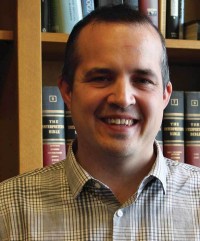


Todd Lippert is a lead organizer of the Palm Sunday Path, a series of mass actions being planned by a coalition of clergy, churches, and other faith-based organizations across the United States. An ordained minister in the United Church of Christ, Lippert has served in congregational ministry and as a state representative in Minnesota. He is now a rural organizer at ISAIAH, which does faith-based organizing for racial and economic justice in Minnesota. He spoke to the Century in mid-January, amid a flurry of organizing in response to the US Department of Homeland Security’s escalating violence in and around Minneapolis.
What’s your view from Minnesota as ICE doubles down?
It is hard to overstate how much of a turning point the murder of Renee Nicole Good has been for Minnesota. It feels like a completely different world from 2025. The Trump administration’s spectacle of cruelty is heartbreaking and infuriating. But the faith community has responded powerfully, with clear demands for this moment. Our congregations know that now is the time we need to act.
Read our latest issue or browse back issues.
How are you and the people around you holding up?
We are not afraid. We are standing with one another. We are rooted in the bedrock of our faith, that every child of God has worth and deserves dignity and that we are called to love our neighbors.
Tell me about the Palm Sunday Path. What are its goals?
To confront rising authoritarianism and counter White Christian nationalism. The centerpiece is a set of shared actions on the afternoon of March 29, Palm Sunday. But this will be part of a path that moves toward a larger action in Philadelphia on July 3, the eve of the 250th anniversary of the Declaration of Independence.
We need to shift the conversation about the values at the heart of our public life. We want it to be rooted in neighbor love, in Matthew 25 values—healing the sick, feeding the hungry, welcoming the stranger—rather than in the values of greed and hate, where political leaders turn groups of people against one another for political gain. We know that White Christian nationalist voices and values have the most prominent public voice right now, and we feel called to step in with our voices more powerfully than we have before.
Who are some of your key partners in this project?
The conversation started with Minnesota clergy who do organizing work with ISAIAH. We felt like if we weren’t acting now, when would we? And we were asking: Is this our Confessing Church moment? Is this our March on Washington moment? We decided that it is—that we need to act and to share that path with others across the country.
There are efforts going on within the Black church—JaNaé Bates Imari, ISAIAH’s co-executive director, has been talking with prominent Black clergy across the country about the Palm Sunday Path. I’m leading within the mainline Protestant denominations and working on organizing there. We’re working with denominational leaders and networks across the country, we’re networking with state-based power organizations, and other faith-based organizing groups are involved as well.
ISAIAH is an interfaith organization. Are there partners from other faiths that are involved with the Palm Sunday Path or with parallel efforts built around their own traditions?
A Muslim power hub is working on what they call Super Eid: their goal is 500,000 to 1 million Muslims in prayer on Eid al-Adha—that’s May 27—across ten states. They’ve done this before in Minnesota, with 40,000 Muslims praying together in the Vikings stadium. They gather in the center of American culture to say, We are here, we belong. I think there are efforts to put a parallel Passover Path together as well—I’m not at the center of those conversations.
There are many different efforts coming together, with an awareness that there’s a lot at stake in the next several months in our country. Is caring for one another, honoring the dignity and worth of our neighbors, going to be at the heart of our public life? Or are we going to take a completely different direction as a country?
Community organizing has a rich history in and around the Twin Cities. Is it a particularly good place to launch this kind of campaign?
It’s because of that strong base of organizing that the Palm Sunday Path has been able to launch. We know that unless this project is really strong in Minnesota, it won’t spread.
Last August, we were talking with our clergy, asking how they were feeling about this moment. We had just seen the occupation of Washington, DC, by National Guard troops. Trump had called on the Texas state legislature to redraw their maps, and we were recognizing what was happening with the big bill—the transfer of a trillion dollars from Medicaid to tax cuts for millionaires and billionaires.
And so this group of clergy decided, OK, now’s the time for us to act. Some of them had been doing organizing with us for a long time, while others were new to it. They started clearing time in their schedules to call other clergy and invite them to an emergency meeting in St. Paul in September. We ended up having 250 Christian clergy there, in addition to 50 leaders from other faith traditions. That kind of turnout doesn’t happen unless there’s a deep web of relationships and a culture of organizing.
So that’s at the center. But we know that to meet this moment, the project needs to be broader than just Minnesota, so we want to be inviting others in.
What opposition to the Palm Sunday Path have you faced?
So far we’ve been mostly in the planning stage. But we’re working with a lot of clergy not just in metro areas but in rural areas too. They’re hungry to act, and they have church members who are also desperate to act out their faith in this moment. But they also serve in politically divided contexts.
I heard from one pastor recently who said she mentioned the kidnapping of Maduro in her sermon, and two people got up and walked out. But she believed she needed to do it. The clergy I’m working with know that faithful action will lead to more tension and conflict in many of their congregations; they’re resolved to be on that path anyway.
A Lutheran bishop here in Minnesota, in a very rural synod, said to his pastors, “I am committed to leading on the Palm Sunday Path. I think this is important. It’s up to you to determine what leading on this path might look like for you and whether you will do it. If you choose to lead, I can’t tell you that your people won’t get mad at you. But if they do, I’ll be there to defend you.” Another bishop in Nebraska said basically the same thing to his clergy.
What challenges do you face in your organizing among liberal Protestants themselves? As in, distinct from the challenges of political division within a church?
Two things come to mind. I’ve served in rural communities, and sometimes in a congregation, people are somewhat of like mind, but the wider community around them is very conservative. So they might feel scared to speak out.
Today I live in Northfield, Minnesota—a small town but also a college town. In that sort of setting, people might be generally on the same page as far as political beliefs. But while people are used to taking individual actions, it can be more challenging to pull people together into collective action. They might be more resistant to coming together, especially if we start working with a coalition where some people may be a little bit different from us and we have to negotiate with one another.
Over the last year, I’ve noticed a shift: there’s a sense of resolve, a sense of the seriousness of the moment and of the stakes. People understand that we need to act—regardless of the challenges.
You’ve been a pastor, a legislator, and an organizer. What are the common threads in your vocation?
I grew up in a town of 700 people, and I loved and cherished my time there. But I also saw how hard things were for people in our community, and I noticed that any town that was bigger had more stuff, more opportunities. I decided to go into rural ministry; my call was rooted in that experience.
In my ministry, I was continuously called to the intersection of faith and public life. I started organizing with ISAIAH. But as the MAGA movement started its rise, I was deeply pained by the ways it was contradicting everything I was trying to teach each week: we love our neighbors. We welcome strangers here for God’s creation. There’s enough when the bread’s broken and shared. And I could see this movement persuading friends and family of mine. So I was wrestling with the question of what was called of me in that moment—and I felt called to run for office. So I ran, on a campaign of strengthening the common good, meeting the needs of rural communities, and seeing the needs we share in common.
I learned a lot in the state legislature, and I’m proud of what I accomplished there. But I was also face-to-face with how much work needs to be done politically, and it became clear to me that in order for our politics to start shifting, more organizing has to happen on the ground.
Some commentators have framed the emerging fault lines of US politics as urban versus rural. You’re a rural organizer for progressive causes—what’s your reaction to that?
It pains me. That division is there, and it pains me—because urban and rural people have shared concerns.
As you listen to people in rural communities, you hear what they need. They need access to affordable health care, and they’re losing that. If you go into the city, any area that isn’t wealthy is losing that access, too. In rural areas we have property-tax-poor communities that can’t afford to pay for their schools. The same thing happens in any urban area that doesn’t have a wealthy tax base. And like cities, so many rural communities have been transformed by the arrival of people of different races and of immigrants and refugees. We share so many challenges, and yet our political leaders try to turn us against one another.
Our economic system in this country has been extracting wealth and resources and people from rural communities for a long time. That’s the heart of the problem. Now we have a billionaire in the White House surrounded by a circle of billionaires in the cabinet. It’s the people against the billionaires right now—that’s the challenge we’re facing. But instead, we’re turning on one another across geography. It’s heartbreaking.
That’s why it’s so important to hold churches together across geography and to act together, rooted in bedrock Christian values that are unimpeachable: We feed the hungry. We welcome the stranger. We tell the truth. We honor people’s dignity. That’s what we do; it’s who we are. Everything is a partisan signal now, but if people can step back from the heat of that situation, we should be able to have a conversation about how these values are deeply Christian, deeply biblical. And hopefully staying rooted in these values can open up more space for us to hold more people together across our divide.
How can people get involved with the Palm Sunday Path?
We just did training on an organizing tool kit people can take to their congregations. We have a new website: palmsunday2026.com. People can also contact me directly through the ISAIAH site for more information. We need to act now, and we invite other faith communities across the country to join in action with us. It’s time to shift the conversation about our values. The months ahead are absolutely critical.