At a conference on irrigation in 1893, John Wesley Powell, second director of the newly formed United States Geological Survey, prophetically remarked, “Gentlemen, you are piling up a heritage of conflict and litigation over water rights, for there is not sufficient water to supply the land.” Powell was calling attention to something that Indigenous inhabitants of western North America have known for thousands of years: Outside the rainy Pacific Northwest coast, the American West lacks adequate water to support either agriculture or people. This has become abundantly clear in the current era of climate change and drought.
Despite this fact, Euro-American settlers have continued to migrate to the region and to attempt to alter the land and water to their benefit, at the expense of the land’s original inhabitants and the ecosystems that have supported them for millennia. One legacy of this manifest destiny has been the construction of 92,000 dams in the United States, almost 20,000 of which are large dams located in western states. The peak of this dam construction occurred between 1950 and 1980. During this period, more than 40,000 dams were built across the country, primarily for hydropower and irrigation.
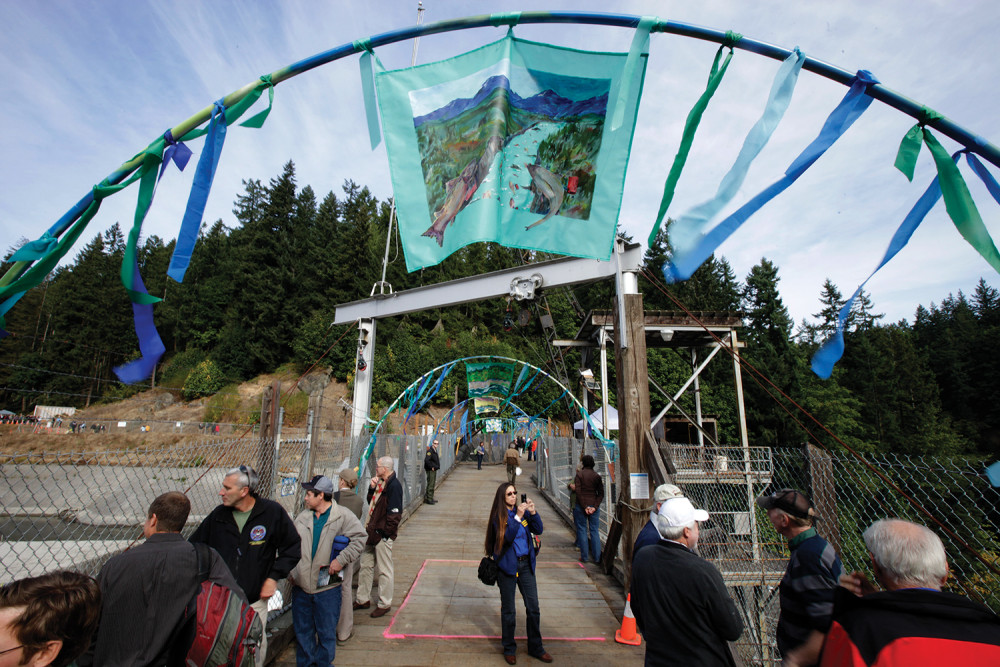
Since the removal of two dams on the Elwha River on Washington’s Olympic Peninsula beginning in September 2011, an era of dam removal appears to be in its early stages. Four more dams on the Klamath River in southern Oregon and Northern California were removed in 2023 and 2024—the largest dam removal in history (see “When stagnant waters become fresh,” December 2023). The effort is driven and led by Indigenous tribes and their allies as a means of restoring their traditional lands and lifeways. As such it serves as a primary example of restorative justice.
To appreciate the significance of dam removal for the people of the region, it helps to know something about the biology and life history of Pacific salmon, their main source of food. As journalist Timothy Egan once wrote, “The Pacific Northwest is simply this: wherever the salmon can get to. Rivers without salmon have lost the life source of the area.”
There are seven species of Pacific salmon: chinook, coho, chum, sockeye, pink, masu, and amago, the last two of which are found only in Asia. (There is only one species of Atlantic salmon.) Steelhead trout are often grouped with Pacific salmon, but unlike salmon they are capable of repeat spawning and do not always die after laying and fertilizing their eggs. Chinook are the largest and most highly valued of the Pacific salmon. They are also the primary food source for southern resident orcas, which have been listed under the Endangered Species Act since 2005.
What all Pacific salmon and steelhead have in common is their life histories: they are anadromous (“running upward”). Females lay their eggs and males fertilize them in the same fresh water in which they were born, often in the upper watersheds that drain into the Pacific. Depending upon the characteristics and morphology of their home waters, they are naturally selected to adapt genetically to the rivers and streams in which they were born—living examples of evolution in operation over many generations. After transitioning from the fresh water of their birth to salt water, they often travel thousands of miles for up to five years in search of food.
Then, by some inner timetable that scientists don’t completely understand, salmon begin their pilgrimage back to the waters of their birth. Species by species, they show up in their home waters and travel to their natal streams, where they spawn and die, returning life-sustaining nutrients to the ecosystems where they originated. Their return takes place throughout the year, with heaviest concentrations being in the spring and fall. Because Indigenous people depend upon them for sustenance, the arrival of the “first salmon” is greeted with great ceremony and celebration by the people. Salmon are key to their religious and cultural life—the “life source,” as Egan puts it.
With the arrival of White settlement—and subsequent economic development based on an alien worldview—the decline of the salmon has been precipitous. For example, before contact with the settlers, the Columbia River carried up to 16 million salmon. Today, it has fewer than 2.3 million, 80 percent of which come from state, federal, and tribal hatcheries, according to NOAA Fisheries. This means that instead of the gravel beds of their home rivers, they begin their lives in the concrete runways of fish hatcheries and return to them at the end of their lives. Biologist Jim Lichatowich has called them “salmon without rivers.”
Billions of dollars have been spent on efforts to make dams more fish friendly. But dams are especially lethal to salmon, because they block both upstream and downstream passage. Dam removal is the best and often the only way to save salmon, and it has been the main strategy of Indigenous people and their allies. But dam breaching or removal is controversial in a region that has relied on affordable hydropower and abundant irrigation to fuel its rapid economic growth.
The removal of two dams on the Elwha River in 2011 and 2014 are often presented as examples of successful projects. The source of the 45-mile Elwha is in the mountains of Olympic National Park in northwestern Washington State. Its watershed is relatively small at 321 square miles, but it is home to ten anadromous fish runs. Chinook in the Elwha were legendary and sometimes grew to 100 pounds. Most importantly, the Elwha watershed is the traditional land of the Lower Elwha Klallam people, who depended on the river’s abundant fish runs to sustain them.
In the early 20th century, two dams were added to power the region’s economy. They were built without fish passage, in violation of state law. The dams choked off the river to anadromous fish, drastically depleting the historic salmon runs that provided sustenance to the tribe and were a key component in its religion and culture.
The passage of the federal Elwha River Ecosystem and Fisheries Restoration Act in 1992 kicked off two decades of painstaking negotiation and planning, resulting in the removal of the Elwha Dam in 2011 and the Glines Canyon Dam in 2014. At the time, these were the largest dam removals in US history, and they inspired several similar efforts
elsewhere.
Since then, salmon and steelhead have moved into an upstream habitat that was devoid of anadromous fish for over a century. The ecosystem of the entire watershed has been transformed, and the place where the Lower Elwha Klallam believe the world was created has been restored. By any measure, the removal of the Elwha River dams has been a success for Indigenous people and for the environment. Its historic and environmental impact has been precedent setting. This dam removal has benefited everyone, both tribal and non-tribal people, and serves as the model and inspiration for similar efforts throughout the region—including on the Lower Klamath River.
The Klamath and its tributaries in southern Oregon and Northern California were once among the largest producers of salmon in the Lower 48 states, surpassed only by the Columbia and Sacramento Rivers. The Yurok, Karok, Klamath, Modoc, and Shasta tribes all depended on the annual fish runs of the Klamath to sustain themselves, as well as to provide religious and cultural meaning to their existence.
Between 1918 and 1962, the four dams of the Klamath River Hydroelectric Project were built on the main stem of the Klamath to generate electricity and provide minimal flood control. They also blocked fish passage to the upper watershed and cut off the tribes from their life source.
Although dam advocates characterize potential removal as an “environmental disaster,” the four dams were removed in 2023–2024. After some early difficulties, mostly due to sediment that had accumulated behind the dams, the Klamath now runs free, and the salmon are returning to their historic spawning grounds. According to Joseph Bogaard, executive director of Save Our Wild Salmon, within weeks of the removals, more than 6,000 salmon swam past old dam sites to their historic spawning sites, stunning the biologists who counted them.
Not all efforts to remove dams have been successful. The removal of four dams on the Lower Snake River in Washington State has been especially contentious, with actions by the current presidential administration generating more heat than light. The debate has primarily centered on the negative impact of the dams on endangered salmon and steelhead. Thirteen runs in the Columbia-Snake system are currently listed as threatened or endangered under the ESA. But salmon restoration is coming up against the economic and infrastructure implications of dam removal. The old adage that “whiskey is for drinkin’ but water is for fightin’” certainly holds true on the Snake.
Removing dams is the best and often the only way to save salmon, and it has been the main strategy of Indigenous people and their allies.
The four dams in question—Ice Harbor, Lower Monumental, Little Goose, and Lower Granite—were built between 1960 and 1972, near the end of the dam-building era. Although they contribute to irrigation and generate a small amount of hydroelectric power (3 to 4 percent of the region’s needs), their main purpose has been to provide a transportation link between Lewiston, Idaho, Portland, Oregon, and the Pacific coast—mostly for wheat, fertilizer, and wood products. Barge traffic, however, has been in decline for several years.
In 2023, after three decades of litigation and two years of negotiation, a group known as the Six Sovereigns—the Nez Perce (Nimiipuu), Umatilla, Yakama, and Warm Springs, all members of the Columbia River Inter-Tribal Fish Commission, and the States of Oregon and Washington—were able to reach a groundbreaking agreement in a case challenging the federal government’s operation of the Columbia-Snake River hydropower dams. “The parties agreed to stay the litigation for five years,” the Natural Resources Defense Council wrote in a summary,
in exchange for a set of commitments by the US government:
• To restore abundant and harvestable levels of salmon
• [To] build out at least ten new tribally sponsored clean energy projects and stand up a first-of-its-kind Tribal Energy Sovereignty program
• To invest an amount that, when combined with other recent funding, will commit more than $1 billion to improving watershed quality, hatcheries management, and habitat for salmon and other wildlife
• To pave the way for lower Snake River restoration and dam removal
Last year, the Trump administration withdrew from the agreement. Since then, several of the tribes have given notice that they intend to begin litigation once more. It’s not clear what lies ahead. What is clear is that this decision by the administration represents a colossal retreat and the breaking of yet more promises made to Northwest tribes and to all people in the Northwest.
On the other hand, the dams on the Elwha and the Klamath have been removed, and they will not be rebuilt. And the positive impacts for salmon, their ecosystems, and the people who depend upon them continue to accumulate.
In The Wretched of the Earth, Frantz Fanon famously describes decolonization as “the urgent need to thoroughly challenge the colonial situation. Its definition can, if we want to describe it accurately, be summed up in the well-known words: ‘The last shall be first.’ Decolonization is verification of this . . . any decolonization is a success.” Fanon is, of course, quoting Jesus (Matt. 20:16). He goes on to say that “decolonization reeks of red-hot cannonballs and bloody knives. For the last can be the first only after a murderous and decisive confrontation between the two protagonists.”
Yet one remarkable thing about dam removal is that it has been achieved through nonviolent means, even though Indigenous people have been victims of manifest destiny and genocidal White supremacy. Treaties, the court decisions that uphold them, lawsuits, patient negotiation, a commitment to process, and legislation—these, not weapons, have been the tools used by the tribes. In that sense, dam removal may better exemplify restorative justice than decolonization, though the two have similar aims.
Restorative justice is defined as a system of justice that focuses on repairing the harm caused by a crime or conflict. Rather than focusing solely on punishment, it emphasizes bringing together those harmed, those who caused the harm, and the wider community to address the impact of the offense and find solutions for healing and accountability.
No fair person could argue that Indigenous tribes in the Americas have not been criminally harmed by Euro-American expansion and colonial invaders over the past 500 years. The legacy of land acquisition by force and fraud, outright genocide by occupying armies, and destruction of sources of Indigenous life and culture—including buffalo and salmon—are by now well-known. Efforts by members of the dominant culture to deny or put a positive spin on these facts would be laughable if they were not so deadly serious. Colonialism and its legacy of evil continues today. The church’s support and outright complicity should be cause for serious soul-searching and repentance. Instead, as Mose Allison once sang, “Everybody’s cryin’ mercy when they don’t know the meaning of the word.”
Fanon’s “red-hot cannonballs and bloody knives” offer one approach to decolonization. But Jesus seems to have had something else in mind.
The main principle of restorative justice involves making the offender—in this case, those who continue to benefit from the current regime of water control on western rivers, or what historian Richard White has called the “organic machine”—take responsibility for damage done to Indigenous people and the environment. A second principle is a commitment to rebuilding diverse, equitable, and inclusive communities in the embattled watersheds of the American West. A third is to encourage reparations to the victims of the colonial project. These principles are not so different from “confession, repentance, and amendment of life,” the precursors for forgiveness in the classic Christian understanding.
It’s impossible to predict the future, and we are regularly reminded that those who refuse to learn the lessons of the past are condemned to repeat them. Still, a glimmer of hope has begun to shine in the North American West, through the efforts of Indigenous tribes and their allies to remove dams that have blocked their native rivers and to bring the salmon home. Paul Schell, former mayor of Seattle and son of a Lutheran pastor, was once asked by a reporter what the listing of so many stocks of Pacific salmon under the ESA might mean for the people of the region. He responded, “Ironically, as we work together to save the salmon, it may turn out that the salmon saves us.”