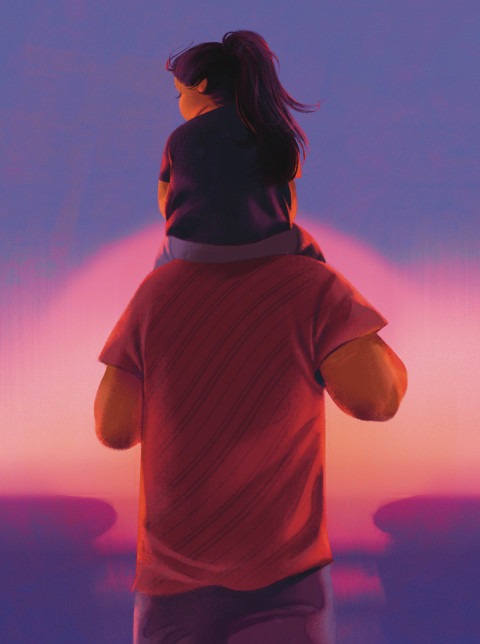
I met my daughter for the first time just after midnight on December 16, 2021. The Beatles song “Here Comes the Sun” rang out in celebration over the intercom, announcing her birth to an otherwise cold and quiet hospital. I remember I wanted to seem approachable, in case she had any questions later, so I began our introduction with a bright “Hello.” She’d seen so little of the earth, and I hoped my husband and I could be the ones to help guide her over its rough terrain and equip her with a spelunking spirit.
But to start, I was a visitor, as it said clearly on the badge stuck to my shirt. We were here at the invitation of her birth mom, who had asked us to come quickly, overnight from North Texas, for the birth, and also if we’d commit to be there for life as the parents of this child.
Read our latest issue or browse back issues.
I never expected to be a dad. However much I’d have liked to, being openly gay foreclosed that route, at least according to the map charted by my Assemblies of God upbringing. Friends of mine in Texas who lived queer lives long before Obergefell v. Hodges legalized same-sex marriage knew that any chance to raise a family was bound to the closet. I was unable to stomach presenting as straight, but I remained trapped in that vapor, wondering what I’d do next.
In the meantime, I was glad to be distracted by one guy’s funny texts. In the summer of 2015, we quickly fell for each other, and a new world cracked all the way open. In 2018, we married in a garden in Fort Worth.
Ryan and I shared a dream to grow our family. Our first attempt was stymied during the pandemic when the agency we’d been working with for two years dissolved its adoption program. Starting over from scratch, we wondered aloud if our longing for a child came from love or from fealty to a story that is fundamentally homonormative—that is, a story that adopts heteronormative standards as a way for LGBTQ people to demonstrate our own respectability. But we found another agency to work with, and soon we received a phone call from a mother in Missouri. With miraculous trust, she asked us the question we had been preparing ourselves to answer, calling us into the life of our beautiful little girl.
My daughter is a gift I never expected, her arrival a surreal resolution to years of worrisome wandering. As our lives braided together, I felt I was finally being made whole. God has brought laughter for me, I thought, and everyone who hears will laugh with me. I’d come to believe that the struggle to reach this new place had been duly endured, and that now, as a dad, I could march ahead with purpose and potential. But when we decided it was time to grow our family again, I was reminded of my dustiness.
On Ash Wednesday 2024, on a midday Zoom call with my urologist, I learned that I have Sertoli cell-only syndrome. This means that the germ cells in my testes don’t work. Despite producing typical levels of development hormones—and despite already being a father—I’m infertile. Following months of fruitless tests to identify potential genetic and chromosomal causes, the doctor explained that my case was idiopathic, congenital. The cause is unknown.
This matters because this time, instead of adopting, we were attempting pregnancy via in vitro fertilization and gestational surrogacy. My sister-in-law, in an act of monumental kindness, offered to donate the egg, which meant that I would have to give the sperm to make an embryo. So, after passing a lot of formal tests to reach fatherhood again—a home study, background check, financial assessment, psychological evaluation—the news of my infertility made me feel like I’d neglected to include my name on an exam I otherwise would have aced.
At least one in eight couples of reproductive age in the United States experience infertility, and male infertility accounts for around half of these cases. Still, I felt alone in my unseemly diagnosis. I suspect the reluctance of men to discuss their testes or their potential failure has been so potent as to inhibit andrology from developing as a field of reproductive medicine until recently. My initial impulse was to withdraw and ignore my disappointment until I’d refashioned it as a milestone to something good and uplifting, to fold my failure into a story of success, to skip Lent and go straight to the resurrection. But I felt lost and broken, reminded again of my disqualifying body.
As a queer dad in Texas, I’m already on shaky ground that keeps me hypervigilant and weary. Alongside the indignation I feel toward the exclusion of LGBTQ Texans from public life is an overwhelming ache to feel at home. Losing another chance to become familiar, I felt foolish and ashamed. Scars I’d almost forgotten, cut by the conviction that I’d failed God’s design, opened again, seeping corrosive doubts about virility, procreation, and succession. The story I thought I’d been given to tell—of God’s love made manifest in my queer family—was being rewritten.
Who else, I wondered, had seen their expectations evaporate, even the ones that seemed to them assured and divine? I thought of Mary and the disconsolate feeling of failure she must have experienced at Jesus’ crucifixion. “She smells [Jesus’] blood, longs to dry his sweat and take his place,” writes Christiana Peterson in Mystics and Misfits, “and wonders how it could end this way.” Mary’s love transforms, however, and she goes on to realize—in addition to her crucial place in Jesus’ biological lineage—an extra-genealogical dimension of
mother-hood, mothering a house for the lost and weary.
In The Queer Art of Failure, Jack Halberstam describes how
de-linking the process of generation from the force of historical process is [really] a queer kind of project . . . [in which] we may want to forget family and forget lineage and forget tradition in order to start from a new place, not the place where the old engenders the new, where the old makes a place for the new, but where the new begins afresh, unfettered by memory, tradition, and usable pasts.
Halberstam looks to queer art for work on the subject of failure, in order to spend time among “underachievers’’ and expose the false dictates of success. He discusses Tracey Moffatt, who took photos of Olympic athletes who dolefully came in fourth, athletes who “[lose] today by a fraction of a second, a centimeter, an ounce, and who tomorrow [are] lost to anonymity.” Embedded in what he labels “an art of unbecoming”—acknowledging the radical truth in our “narrative without progress . . . [that] turns on the impossible, the improbable, the unlikely, and the unremarkable”—is a habit of forgiveness that can enable daring acts of imagination. These anti-parable moments resemble the gray water I’ve been struggling to ford.
As I muddled through Lent last year, it was yoke-breaking to discover these fellow artists who work, according to Halberstam, “in a mode of negativity that lays claim to rather than rejects concepts like emptiness, futility, limitation, ineffectiveness, sterility, unproductiveness,” who “strive to establish queerness as a mode of critique rather than as a new investment in normativity or life or respectability or wholeness or legitimacy.”
I can’t honestly proclaim to my daughter that there’s a clear path to a bright, better future ahead. Yet, cleft from normativity and shrouded in insoluble haze, I can still whisper, “I am not, and never will be, alone.” Jesus felt as blind and despairing as I now do. Jesus did not know what to expect. Jesus grappled with fear and isolation amid a desolate, trying landscape. Jesus experienced hope lost and became hope gained. Even in death, Jesus knew well where I am.
I began to understand the power of standing in suffering with God. As someone who hadn’t grown up observing Lent, I didn’t know what the ashes meant. It felt like pessimism; I didn’t get the point of feeling so bad. Now I see the practice of Lent as a way to find purchase in rocky terrain, to keep taking steps in God’s presence even when failure is certain.
In the fog of the news I received that Ash Wednesday, I drove my daughter to church. I was supposed to sing in the choir, and I looked forward to the consolation and refuge, but a scheduling mishap meant we didn’t have childcare that night. I’d have to forgo singing in order to be there with my girl. I admit I was sulking a bit. I set down my music and went off with her to find some toys. She was just learning to talk then, and with her earnest new voice, she turned to me and asked, “Papí, color?” We lay on our bellies with a pile of crayons and tried every hue. She smiled at me while, down the hall, the choir sang songs I’d forgotten.
My daughter had found a source of water on our rocky path, I thought to myself. And like the eunuch in Acts 8, I wondered, What’s to prevent us from being baptized? I let my toddler lead me to the water, and like two dogs we splashed there for a while.