I stood at the Macy’s jewelry counter, selecting a wedding band for someone else’s fiancé. The clerk displayed ring after ring, wanting to know if I preferred platinum to silver, 18 karats to 24, tungsten (there was a sale!) to titanium. Each sparkled conspiratorially, promising that it would not fracture or tarnish. It would stand the test of time.
But there was no time. That was the essence of the problem—there was no more time.
Eighteen months earlier, my friend Ryan—the bride-to-be—collapsed on a Manhattan sidewalk on the night of my wedding. In the last photo I have of us before doctors carved out her reproductive organs and diagnosed her with stage 3 ovarian cancer, we are twirling on a dance floor. The satin of my wedding gown snaps around my legs. The sequins on my dress wink. I was newly ordained at that time, and I’d micromanaged the ceremony to the point that I’d tested out various communion bread recipes for the least crumbly one, but in that photo I am also a bride in a dress that resembles a meringue, carefree and hopeful. So many identities—friend, minister, wife—wrapped into one as my hands grip Ryan’s, our elbows locked, our hair whipping the sides of our faces.
Read our latest issue or browse back issues.
Ryan and I met in our college glee club a decade prior, and our friendship solidified after we were assigned to be roommates on tour. She possessed a hearty beauty—round face, wide smile, riotous laugh—and in short order, we were the kind of friends that Thomas Aquinas described as idem velle, idem nolle: wanting the same things and rejecting the same things. At 20, we ate cheap pizza and bonded over our shared belief that we were too pessimistic to be in a glee club. We discussed Middlemarch and our various romantic exploits, cutting our talk with the occasional joint, the one-off shot of absinthe. She struggled with depression, and I struggled with anxiety, but over time we managed to get our acts together. We both moved to Boston. I began a doctorate in theology, got ordained, and started dating my future husband. Ryan started a master’s in library science and started dating Ben, the teddy bear of a man who’d been in love with her since they met in preschool.
Then I got married, and then Ryan collapsed.
When Ryan and Ben got engaged a few months after her diagnosis, I was thrilled, though I sensed the odds. Although I was still relatively new to being a priest, I’d become as intimately acquainted with death as I was with Ryan. I knew what the hand of a corpse felt like as it cooled. I could remember the weight of human ashes in my empty palm. I was on a first name basis with the hearse drivers at the local funeral home; they let me ride in the front seat so I didn’t have to fight for a parking spot at the cemetery.
So from Ryan’s first surgery on, I understood that time would not be a friend to us. Still, it wasn’t until the day when every conventional treatment had been tried and every clinical trial exhausted that I brought up her wedding. Ryan and Ben had been engaged for at least a year at that point, but there’d been no dress shopping, no cake tasting, and I’d never asked why, because I knew why: because wedding vows are promises for the future, and it’s impossible to plan a future when your days are numbered.
“I was finally happy,” she said. “I should have known it would end here. Now you will have to live for both of us.” In the days that followed, another priest asked me whether I comforted Ryan by telling her that rewards awaited in heaven. I hadn’t. Because what she wanted most was Ben, and Ben wasn’t headed to heaven any time soon.
“I can marry you,” is what I did say. The words were reflexive, instinctive as a mother who runs toward her child who has fallen off the monkey bars. I wanted to protect her, both because I was her friend and because I was a priest.
Ryan used whatever muscles were left in her arms to push herself up to a seated position. “But someone has to arrange a service. Someone needs to buy the rings. Someone has to invite my parents—”
She paused, because we both knew her parents were on their way to the hospital. They were coming to say goodbye.
“I’ll take care of it,” I said, and within two days, I did. I communicated with a few close friends about readings and music. I took my own wedding bulletin and reformatted it. I found a cake recipe and baked it. I bought the most expensive wedding band at Macy’s.
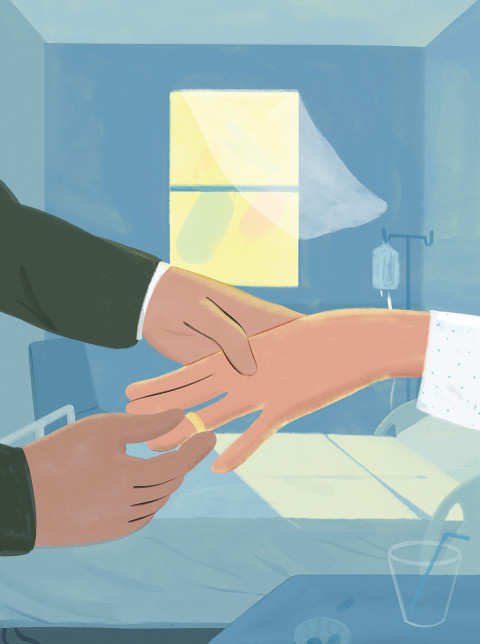
“It’s perfect,” Ryan said from her hospice bed, rotating the band I’d bought for Ben between her bony fingers. She smiled. “How much do I owe you?” I refused to take her money and went to confirm that the hospital chapel was available for the service.
I’d always thought that wedding vows were about making promises for the future. But Ryan and Ben weren’t doing that.
After I secured the chapel, I went home to my apartment, where I microwaved marshmallows and kneaded them with powdered sugar to make homemade fondant. Was I conjuring this wedding on a wing and a prayer so Ryan would have something to celebrate in her last days? Was I doing it to give Ben a lasting memory of their relationship? Or was I staving off my own grief to prove that even in the face of the most horrific evil, there is a way of fighting back?
Probably, it was all three.
To be clear, all of this was unconventional. I had done no premarital counseling because there was no time for it. I was functioning in not one but two roles—priest and best friend. Today, I work as a pastoral theology professor, and I caution my students against these kinds of blurred boundaries. They confuse situations, muddy the question of who’s on the giving end of spiritual care and who’s on the receiving end of it. At worst, they enable abuse.
Still, there are times when boundaries are fluid but ethical. Some pastors perform their parents’ funerals. Others officiate their children’s weddings (after their children do their premarital counseling with a different minister). Their ministry at those times is often deeply meaningful to everyone involved, because on occasion, the pastoral rightly trumps the procedural. When discerned in good faith, these are often the most important moments in a care seeker’s life, and as long as the needs of the care seeker remain first and no doctrine is violated, they are often the most meaningful in a minister’s as well. They’re the ones that we ponder in our hearts for decades, whispering only to our most trusted clergy colleagues because they’re so complicated, so vulnerable, so holy. You hope and pray that what you’re doing is right, because it sure as hell isn’t easy.
The next day in the hospital chapel, someone—I don’t remember who—wheeled Ryan down the aisle. Ben stood at the front of the chapel, sturdy in a suit as his bride appeared. Though this was long before the age of Zoom, we figured out a way for another of Ryan’s close friends to join virtually from his home in Scotland. Readings were read, songs were sung, and then it was time for vows to be exchanged.
I stood in front of Ryan and Ben, clad in my collar, my alb, my stole. “The union of husband and wife in heart, body, and mind is intended by God for their mutual joy; for the help and comfort given one another in prosperity and adversity.”
For a second, it seemed as if we were all acting a scene, dressed in costume, reciting lines instead of living them. Although in retrospect, I see now that I was probably coping this way because I was having a hard time holding onto the truth amid the cognitive clutter. I was losing my best friend, even as I was officiating her wedding. What it meant to be a priest at that moment felt simultaneously confounding and clarified. It meant honoring her dignity. It meant helping her be who she was called to be, even as she approached her death. I wanted very much to do that for her, even as I hated that it had to be this way.
“Will you have this man to be your husband?” I asked Ryan. “Will you love him, comfort him, honor and keep him, in sickness and in health; and, forsaking all others, be faithful to him as long as you both shall live?”
“I will,” Ryan answered without hesitation, and for a moment her voice was strong and vibrant. I handed her the ring I’d purchased. She slipped it onto Ben’s finger.
I’d believed until that point that wedding vows were promises for the future, hypotheticals that life would test. My job as a priest was to create a space for the blessing of these promises, even though their fulfillment was never assured. After all, there’s no currency in a promise that’s guaranteed. Promises are matters of faith—and unjustifiable faith at that, because the idea that two people could believe in their relationship enough to foretell that it will survive unknown adversities defies logic. No wonder that witnessing the exchange of vows tends to grow the heart of every Grinch and defrost the soul of every Scrooge.
But Ryan and Ben weren’t making promises for the future. They’d already proven their love countless times, not by slipping rings on each other’s fingers but by holding hands before every surgery, crying together after each post-op appointment, and wrapping their arms around each other following every hopeless medical update. It was almost as if they didn’t need to promise to be faithful to one another through sickness and in health, until death parted them, because they’d already done it. Or maybe it’s that, at some level, their vows became empty because they’d already been fulfilled. They knew that marriage meant not just eros but endurance, not just love but loss. They understood what I didn’t back then: that marriage isn’t only about committing to buy a home and birth children and build a nest egg together; it’s also about accepting, from the start, that death is always a moment away.
Over the years I’ve often wondered whether I did anything of consequence in that wedding. I know that rituals matter—I teach this to my students. I’ve even written an academic chapter on the value rituals provide for liminal times. But at a personal level, I’ve struggled to believe I did anything of consequence for Ryan and Ben by baking a cake, buying a ring, printing a bunch of leaflets. I didn’t protect anyone; I didn’t change the ending of the story.
When I find myself thinking this way, I remind myself that the best priests aren’t problem solvers but ministers of presence, people who accompany and witness, who sit with the suffering in the same way that Jesus sat with the afflicted. That means they have the great privilege of experiencing the joys of the people they serve—and the heartaches, too. It means they must, at some point, reckon with the reality that not all stories have a happy ending. Or maybe a better way of saying it is that we don’t get to witness every resurrection. If we’re lucky, though, we might catch a glimmer of hope, a sliver of meaning, a little sign of what’s to come. If we are careful enough to notice these glimpses, they can be manna in the wilderness.
Ben called me five days after their wedding. “Can you come?”
Ryan was sleeping when I arrived, the death rattle settled in her lungs. Ben and I sat on either side of the bed, our silence punctured by whispers that it was okay for her to go, that we would be okay, that Ben would be okay. We said these words as much for ourselves as for her, because if we only promised them, then maybe they would be true for all of us.
I was the last to leave the hospital after Ryan died. I put my head in my hands. I prayed. I cracked the window, because I read that this is what Swedish people do to free the spirit of the dead. I liked that symbolism, and I hoped it was true.
For as long as time would let me, I held Ryan’s hand in mine as it cooled, the wedding ring still on her finger. Fresh air swept into the antiseptic hospice room as I lay my head on her shoulder. Maybe it was the Holy Spirit—ruach hakodesh—encircling us, allowing us just a few more moments as friends. I like to think so, though I can’t be sure. There is so little we can be sure of when it comes to this life of faith. The promises we make, the vows we take, the ones we exchange in private, the ones we keep despite what we see—they’re as liminal as they are holy. Still, they’re enough. They’re what we hold onto as a reminder that we want the same things and reject the same things as the One who made us.