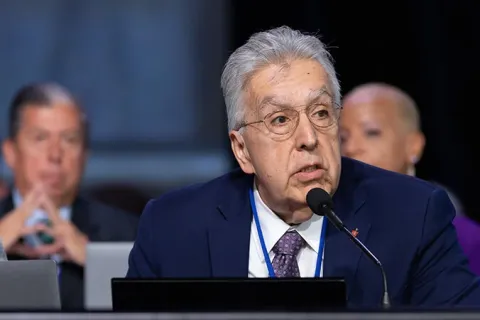
In a recent interview with Tucker Carlson, Mike Huckabee, the Trump administration’s representative in Israel, was cross-examined as to what Israel expects to gain from its various wars. Carlson asked Huckabee, an ordained Southern Baptist minister, how he interprets Genesis 15:18, in which God promises the descendants of Abraham the lands from the Nile to the Euphrates—an expanse which covers the present state of Israel plus Jordan and parts of Syria, Saudi Arabia, Iran, and Egypt. When pressed on whether Israel has the right to all of that land, Huckabee quipped, “It would be fine if they took it all.” The implication seemed to be: God promised all that territory, and you can’t argue with God. Carlson was flabbergasted. Was Huckabee being serious? Apparently yes.
But Huckabee was way off base. Does he not realize that God, the Jewish God of the Bible at least, can change his mind? Early in Genesis, God even expresses his disappointment in creating humankind (6:6). So is it any surprise that he changes the borders of the land of Israel to suit the changing situation on the ground?
It is probably true that something like the greater Israel to which Huckabee alluded existed in the time David and Solomon, but that was an exception to the rule. Theirs was a maximalist situation even more extreme than the one proposed by the Zionist ideologue Ze’ev Jabotinsky in the early 20th century, with his famous cry for “both sides of the Jordan.”