Books

A vampire and a Lutheran pastor in Blackfeet country

Stephen Graham Jones’s theologically inflected horror novel just might be his masterpiece.

Stephen Graham Jones, an enrolled member of the Blackfeet Tribe of Montana, is one of the most prolific, award-winning, and admired horror writers working today. While I haven’t read everything he’s written, I devoured The Only Good Indians, all three installments of the Indian Lake Trilogy, and I Was a Teenage Slasher. His talent for writing inventive mainstream horror with disaffected, misunderstood teenage heroes is salve to my Gen X childhood wounds. Jade Daniels, the heroine or “final girl” of his Indian Lake Trilogy, is an Indigenous girl, and that historical, generational trauma bears on the narrative—but she’s also an instantly recognizable iteration of the underdog characters I tend to admire. Jade is an outsider, a lonely rebel, a lovable loser who somehow survives on her own wits, strength, and spirit.

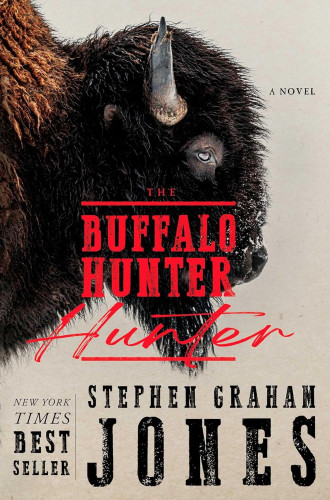
So when I heard Jones was working on a vampire novel about a Lutheran pastor, my horror-loving heart skipped a beat at the convergence of my special interests as a religion nerd and SGJ fangirl. But The Buffalo Hunter Hunter upended my expectations. This is the only Jones book I had to read twice—not for pleasure, but because I realized that I hadn’t quite understood it the first time.

Jones and I were born a few years apart and share a reverence for the horror fiction and movies and the heavy metal of the 1970s and ’80s, and I had grown accustomed to his rock and roll style. But there are no Mötley Crüe references in this book, and after puzzling over the first hundred pages, reading and rereading sentences and entire paragraphs and coming away with only a vague sense of what was happening, I realized I was out of my depth. The Buffalo Hunter Hunter is a vampire novel, but it is also much more, and my ignorance of the history and language of Blackfeet culture and the real history of the American West made it almost incomprehensible to me on my first pass. By the time I finished, I wondered if this was intended. So I did something I almost never do and immediately started the book again, this time doing a lot more Googling as I read.


The narrative frame is accessible enough: an academic is transcribing the decaying journals of her great-great-great-grandfather, a Lutheran pastor in Miles City, Montana, in the early 1900s. Etsy Beaucarne (yes, that translates to “beautiful meat”) is an adjunct professor in a precarious position, and she hopes this project will lead to tenure. So far, relatable. But the tale that unfolds from the pen of her ancestor is equal parts western, gothic horror, and a historical novel that requires frequent Wikipedia consults. I found myself thinking this is not the same universe as Tolly Driver’s (the antihero of I Was a Teenage Slasher). But of course it’s the same universe. It’s America—but an America I don’t know. Etsy’s ancestor, Pastor Arthur Beaucarne (please don’t call him Father; it makes him uncomfortable) claims he wants to write this history down before it is lost to time, but his motivations become less trustworthy as the story proceeds.

Lutherans came late to Miles City, well after Jesuit missionaries, and the Indian population had been ruthlessly suppressed by the time of Beaucarne’s first entry in 1912. He describes the Blackfeet as the conquered “savages” of the region’s past, though he says many of his flock have lived long enough to remember the days before the Indian was, as he chillingly puts it, “tamed.” Beaucarne, too, is of a dying kind, at least by today’s standards, which are Etsy’s standards—he’s a genteel, Yale-­educated minister who prides himself on secular rationality, overindulges in food and communion wine, and is very much in love with the sound of his own voice. In the first half of the book, he seems to stand in for the reader’s ignorance of the brutal fate of the Blackfeet in the Montana Territory during the Indian Wars. But he isn’t as innocent of this history as he’d like us to believe. Spoiler: he turns out to be a rather unreliable narrator.

Beaucarne’s journal includes the “Dark Gospel” of the one he calls the Nachzehrer—the Pikuni man known to the Blackfeet as Weasel Plume, and later as Good Stab, and still later as Takes No Scalps and the Fullblood. A Nachzehrer is a revenant in German folklore. I Googled that, impatiently, only to find it is later (much later) revealed in the book by one of Beaucarne’s German parishioners who still believes in the old ways. This is the way of the book: Jones front-loads information with little explanation, inviting us into a narrative that we only partially understand. If I didn’t already know Jones’s capacity for committing to the bit, I might think this folkloric element was merely a metaphor for what he calls the “worst dream America ever had,” about “the Indian who can’t die.” But Jones is anything but subtle, and I love him for it.

The Nachzehrer swishes into Beaucarne’s church in 1912 wearing Jesuit robes and dark-tinted glasses, ostensibly to ask for absolution—though his tale begins much earlier than his crimes, with the massacre of his people. “In all humbleness,” Beaucarne writes, “I hope only to record Good Stab’s tale, as I feel it my duty as an American to attempt to capture these last exhalations of a people who won’t be seen again in the world.” Beaucarne’s self-importance aside, he isn’t wrong that these details are evaporating “into the mists of history.” The events of the book unfold in such a mist, the accumulating versions of history adding detail, dimension, and perspective. Beaucarne might be commenting on this aspect of the book when he observes, writing in his diary after scarfing down German sausages from the church ladies, that the grease has made the paper translucent, “admitting the previous page’s words through into this one, which is emblematic of the past rising, pushing through, insisting on making itself apparent to all.”

Good Stab (who, again, has no fewer than five names) uses the old Blackfeet names for people, animals, and locations. These aren’t immediately legible to Beaucarne or to the reader, and context clues don’t always help. Beaucarne’s language can also be difficult to track; his word choices are deliberately antiquated, and his prose tends toward the tortured and purple. The man goes on for paragraphs about cake and eats so much pease porridge that he makes himself sick. He and Good Stab—who is, yes, both an Indian and a vampire—are not so different in that regard. If Good Stab overdoes it when drinking from his victims, their blood gruesomely bursts forth from his side. (If you are squeamish, beware that Jones has a rare gift for inventing ever more disgusting ways of killing and dying.) Both men also seem to delight in obscuring meaning from each other, and Jones draws the reader into this game. This swirl of cultural confusion makes it difficult to get one’s bearings, but it’s fitting given that the historical events depicted have also been obscured by confusion, betrayals, and outright lies.

For example, the Nachzehrer’s tale begins with the tragic Marias Massacre of 1870, when US Army troops attacked the camp of Pikuni chief Heavy Runner. Within the first two pages of this account I learned more Indigenous history than in years of public school. The victims of this massacre were mostly women and children suffering from smallpox; all the able-bodied men were out hunting. Chief Heavy Runner was shot and killed even as he waved the papers proving he was friendly to the US government. The US soldiers then killed the sleeping Pikuni in their tipis, burned their camp, and stole their horses.

This really happened, and Jones’s rendering of it is brutal. But it is also just one of many narrative threads he braids into the story of Good Stab’s revenge. His other beef is with the fur traders and trappers who are slaughtering the buffalo for their hides, in effect starving the Pikuni. Then there’s the matter of the Cat Man, discovered imprisoned in a cage after Good Stab and his companions survive a skirmish.

Jones invents some new vampire lore for his tale, and we learn it alongside Good Stab as he discovers what the Cat Man has made him. He dreams the dreams of the animals he feeds on. He can live for months on a single feed. He can heal from any wound. He doesn’t have exceptional strength; he simply doesn’t feel pain, which means he will continue to fight as his body breaks apart. He can no longer smoke tobacco or enjoy “real meat” (buffalo meat). He is doomed to watch from the shadows, feared and despised, as his people are exterminated.

Some of the images are immediate and arresting. Jones has written for Marvel Comics, and it’s easy to imagine Good Stab standing at the horizon of Miles City, wearing those dark, round spectacles to shield his eyes from the sun, his Jesuit robes whipping around his feet. But the images accumulate so quickly that it can be hard to process what they signify. Entire chapters slipped away from me, especially on first reading, like a dream I was struggling to remember.

Good Stab kills humans with abandon, but when he is forced to kill animals to stay alive he does so with grief and shame. When he sees the fur traders killing off the buffalo for their hides and leaving their carcasses to rot, he is filled with rage and fury, and the story becomes a revenge tale. His murder spree is no longer about his own survival; it’s about avenging the calves who bawl for their mothers on the prairie, which stand in for all the injustices and torture inflicted upon the Pikuni. The heads of the former herd are mounted all over town as “assurances of the eradication of the Indian menace.”

The book ends in more familiar territory, in the present day, with an almost absurdist, surreal climax that seems inevitable in a Jones novel but is all the more satisfying for having been so thoroughly owned. After my multiple reads, I came away feeling convinced that Jones has written his masterpiece, a theologically inflected horror story about the deadly sin of gluttony, about monstrous men who always want more—more food, more land, more blood—but can never quite bring themselves to see their own villainy. Pastor Beaucarne ends his tale feeding the dogs off the porch. Given what has happened over the course of the novel, he can no longer eat more than his fill. Watching them, he tells himself, “They are the sinners, choosing their own gluttony over decent behavior to their fellow man. Them, not I.” 

Jessica Mesman

Jessica Mesman is a senior editor at the Century.

All articles »