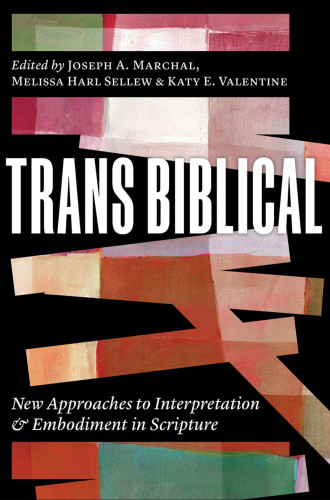
Trans Biblical
New Approaches to Interpretation and Embodiment in Scripture
Sometimes when I engage biblical scholarship, a silent cynical voice in my head whispers, “So what? How does this effort-laden erudition serve a hurting world?” Those questions never crossed my mind as I read this collection of essays exploring the Hebrew Bible, New Testament, and other early religious writings through a transgender lens. In a culture of increasing hostility, Trans Biblical offers a much-needed resource of scriptural support to embrace and affirm trans people.
The editors, Joseph Marchal, Melissa Harl Sellew, and Katy Valentine, provide context with a short introduction to each article, a review of earlier trans scholarship, and an explicit statement of the book’s purpose:
Our collection represents a historic effort to expand and elaborate upon the sometimes-disparate trajectories of trans biblical interpretation, intensifying and enlarging the set of biblical texts and interpretative approaches, relevant histories and theories, conversation partners and force multipliers in order to question, qualify, challenge, and ultimately alter the conditions of our time and place.
Read our latest issue or browse back issues.
By the end of the book, this dense, ambitious goal is achieved.
Some overarching conclusions emerge. First, unexamined assumptions about gender should be questioned. Gender fluidity interweaves with the human condition in ways more common—and ancient—than most of us realize. This recognition carries a caveat: The authors caution against facile mapping of modern sexual identities onto biblical characters. Then as now, people who trouble the gender binary are often threatened or harmed by cultural condemnation, prohibitive legislation, and individual degradation from those who seek to subdue or destroy the outward expression of another’s inner identity. To present as trans can be dangerous; several of the essays recount violence against trans people, along with attempts at self-harm. This book offers hope: Perhaps surprisingly, the Bible can help.
The Gospel of Thomas’s anti-materialist ideology allows for bodily transformation in an imperishable spiritual self.
While most of the chapters engage individual texts directly, the first two essays offer more macro perspectives. Max Strassfeld explores rabbinic references to mixed sexuality (e.g., koy [mixed species animals], androgynes, and hybrid animals), contrasting these religious sources with modern transphobic legislation that denies and punishes gender ambiguity. Joy Ladin shares strategies for trans biblical hermeneutics: recognize trans experience, focus on the plain sense of the text, then identify and interpret trans experience in the text.
The book then pivots to specific biblical passages, beginning with two essays on the Hebrew Bible. Aysha Winstanley Musa argues that Jael is a “biblical nonbinary mother” who embodies false motherhood to Sisera. Esther Brownsmith suggests that Mordecai, along with other biblical characters, can be effectively read through a nonbinary lens to upend androcentric presumptions.
The next six essays focus on the New Testament. Justin Sabia-Tanis contemporizes Jesus’ insistence on radical inclusivity through a parable of a parable, casting a Black trans woman as the good Samaritan. In perhaps the most controversial essay, Katy Valentine maintains that Mark’s account of the transfiguration (9:1–9) may portray the metamorphosed Jesus as a woman (“Jesus becomes ‘she,’ and ‘they’”). Minenhle Nomalungelo Khumalo and Eric Thomas read John’s Gospel as joyful, queer, Black and Brown scholars who refuse to let the sodden weights of intersectional oppression dampen Jesus’ repeated bold, grace-filled affirmation: “I AM.” Rebecca Wiegel first grounds her discussion in theory and then explores the gender transitions of eunuchs in Matthew 19 and 1 Corinthians 6–7. Jaeda Calaway shares her journey to becoming a trans woman in conversation with Paul’s writings about bodily transitions. Joseph Marchal brings further dimension to the Pauline focus by examining passages on captivity, enslavement, and imprisonment.
Melissa Harl Sellew extends the conversation to the noncanonical Gospel of Thomas, noting that its anti-materialist ideology offers opportunities for bodily transformation in an imperishable spiritual self. Critical questions around gender concepts ground Ky Merkley’s engagement with Tertullian’s De Pallio, in which the early Christian writer judges sartorial performances according to his gender framework. A comprehensive bibliography and two indexes (cited texts and subjects) offer helpful resources.
Trans Biblical is essential reading for scholars of queer biblical interpretation. Unlike some academic books, it is priced to be accessible to students, pastors, trans people and their loved ones, and other interested readers. However, the scholarly tone can leave the uninitiated feeling like an outsider. Gender theory language still unfamiliar to readers like me (e.g., transcestor, genderfluid, neutrio, two-spirit, trans*) might have been explained in a glossary of relevant terms. I found most moving the parts of the book where the academic veil is lowered: Ladin receiving a disarming lecture question; Sabia-Tanis hearing an elderly man plead for help for his transgender granddaughter; Calaway describing the pink, sparkly scarf she received from a colleague upon transitioning; Khumalo thanking Thomas for support during the writing of their joint article. Toward the end of their essay, Khumalo and Thomas offer a powerful reminder central to this book: “The duty to transform biblical narratives and biblical attitude is, as it has always been, a matter of life and death.”