Strange Worship
Six Steps for Challenging Christian Nationalism

How to End Christian Nationalism
In 1943, the French philosopher-mystic Simone Weil was working in London with the Free France resistance movement. Although she wanted to be on the front lines of the Second World War, she was assigned a desk job. Among other projects, she produced the manuscript we know as The Need for Roots, laying out a plan to rebuild a just France after the Nazis’ defeat.
I have been rereading this book not just as a scholar of Weil but as an American Christian living in Canada and “bent on fathoming what it means to love my country,” in the words of poet Adrienne Rich. Bewildered and grieved, I have been seeking wisdom in Weil’s honesty. Her country had capitulated to Hitler; the question of how she could love it was not hypothetical. Tracing how France arrived at its Nazi collaboration, Weil repeatedly criticizes Hitler’s concept of “greatness,” a thirst for imperial power she connects to political idolatry. France is guilty of embracing Hitler’s murderous passion for greatness, she writes, including in its own violent colonial project, and must reject this vision altogether to be a just society. Weil was also painfully aware that religions could participate in totalitarian power-mongering. Although she had experienced a series of mystical encounters with Christ, she argues passionately against Christian supremacy.
Read our latest issue or browse back issues.
These insights feel uncannily prescient, yet perhaps the most compelling to me right now is Weil’s vision of how to love a country that has been hijacked by injustice. She writes, “the world needs a new patriotism. It is at this time, when patriotism is causing bloodshed, that this effort to invent a new form must be made.” Against Hitler’s obsession with greatness, Weil suggests a patriotism motivated by “compassion for one’s country.” By compassion, Weil means a love that is tempered by sorrow and critique. To be clear, she’s not calling for compassion for corrupt leaders or abstract ideas but rather for a populace, for a collective with a particular relationship to a land and to each other in the group project of good governance. “A patriotism inspired by compassion gives the poorest part of the population a privileged moral position,” she writes: it centers their flourishing rather than the comfort of the richest and most powerful.

Applying Weil’s compassionate patriotism to our current moment means admitting that the United States has never yet lived up to its premise that all people are created equal, nor to its promise to protect everyone’s rights to “life, liberty, and the pursuit of happiness.” But to tell this truth is not to say that there is nothing worth preserving in the American experiment, and watching the Trump administration abandon freedoms and protections clarifies how important—and vulnerable—they are. I have been reminded, these past months, how deeply I value freedom of religion and of the press, protections for trans people, public education, and publicly funded scientific research, climate treaties, national parks, and international aid—all imperfect and nevertheless worth preserving.
In their obsession with “greatness,” supremacist nationalisms fear the truth about a nation’s flaws and vulnerabilities. Compassionate patriotism, by contrast, is secure enough to tell the truth about both flaws and gifts. In Weil’s vision, this security also opens paths of international collaboration for the sake of a justice that transcends national affiliation.
It’s a beautiful vision, and one so far from the hearts of our current leaders, including many Christian leaders, that I have wanted to distance myself from anything resembling their religious coercion. I live in Canada, now under threat of an aggressive trade war and even annexation. What can it mean to call myself an American now? What can it mean to call myself a Christian?
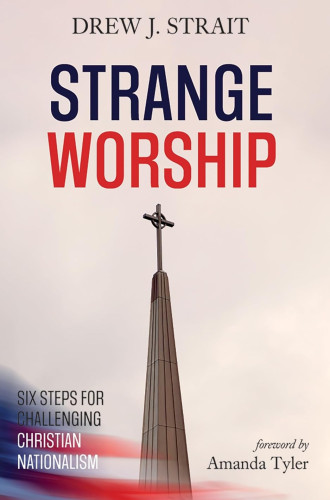
Two recent books, both published in 2024, have challenged me on these questions: Amanda Tyler’s How to End Christian Nationalism and Drew Strait’s Strange Worship: Six Steps for Challenging Christian Nationalism. Together, these books suggest I have a responsibility to engage more fully specifically as an American Christian, and to do so with both humility and a bold reclamation of these identities in the public sphere.
In Strange Worship, Strait, who teaches New Testament and Christian origins at Anabaptist Mennonite Biblical Seminary, draws from an impressive range of research in sociology, history, biblical studies, theology, social psychology, and peace studies to offer both a summary of how the United States has arrived at its current crisis and a practical guide to what we might do about it. Strait argues that the answer to violent Christian supremacist movements is not abashed silence but a winsomely impassioned public commitment to the way of Christ. Against a cherry-picked biblicism, Strait advocates for centering Jesus’ “whole life,” including a fulsome engagement with his teachings, which overturn any celebration of violent power.
One of the gifts of pluralist democracy is a capacious appreciation for the many paths of resistance to tyranny. But those of us who are Christians, Strait writes, should work from within the church by telling the truth, practicing lament, educating ourselves about what’s happening, calling out Christian nationalism as an idolatrous love of power, and proclaiming the fullness of the Good News manifested in Jesus’ subversively humble and welcoming love. Rooted in our faith, we can seek to address the loneliness epidemic and the polarization wrought by our captivity to attention-stealing technologies, and to build both horizontal and vertical capacity to collaborate in our work toward a more perfect union.
Whereas Strange Worship emerges from Strait’s work as a biblical studies scholar and seminary professor in a peace church tradition, How to End Christian Nationalism arises from Tyler’s work as an attorney, executive director of the Baptist Joint Committee for Religious Liberty, and lead organizer of Christians Against Christian Nationalism. Tyler and Strait both write explicitly to Christians, invoke their own experiences as believers, invite contemplation of scriptures, and cite experts in various fields. They both point to the research by Samuel Perry and Andrew Whitehead to emphasize the “accommodators” and “resisters” of Christian nationalism who are the most likely to shift their position based on our efforts to invite them into the more humble and loving way of Jesus.
Tyler’s book, however, focuses more on legislation, litigation, and public action, and it is centered especially on the value of democratic pluralism and religious freedom. She stresses the importance of “basing our activism in our faith” while also “taking action to defend religious freedom for all.” To this end, she outlines eight steps, beginning with understanding Christian nationalism and the love of God, then moving to denouncing violence, committing to the separation of church and state, and acting through both organizing and advocating for change at local, state, and national levels, while also seeking to protect religious freedom in places like public schools.
One of the strengths of How to End Christian Nationalism is its presentation of both US history—to correct the widespread mythology of a “Christian nation”—and concrete examples from state legislation and court cases. Tyler cites not just printed work but her interviews with experts like Anthea Butler, author of White Evangelical Racism, and Robert P. Jones, author of White Too Long, giving the book the dynamic tone of a conversation among folks who are working together. This sense of accompaniment is both accessible—the interviews are more conversational than quotations from published books—and also hopeful, reminding readers that there is already significant work underway that we can join in on.
These two books work as companion pieces—in fact, Tyler wrote Strait’s foreword—and I’m very glad to have read both. They join a growing discourse across the disciplines, like historian Kristin Kobes Du Mez’s Jesus and John Wayne, Pamela Cooper-White’s The Psychology of Christian Nationalism, and religious studies scholar Matthew D. Taylor’s The Violent Take It by Force. Both Tyler and Strait root their discussions in wide-ranging research, but they add the important focus on concrete and actionable advice. I hope to see both books embraced by pastors, reading groups, adult Sunday schools, university chaplains—really, anyone bent on fathoming what it means to love.
Reading Tyler and Strait, I wonder if we could extend Weil’s compassionate patriotism to a compassionate Christianity—by which I mean both a Christianity that centers neighbor love and one that openly laments the tradition’s vulnerability to cruel distortion and works to reclaim it for the common good. A compassionate love for country or faith tradition isn’t love for an ideal but for people—beautiful, complicated, particular humans.
Leaders like Weil and Tyler and Strait remind us not to give in to the lie that love is weak. Instead, as Valarie Kaur powerfully insists in See No Stranger, “love is a form of sweet labor: fierce, bloody, imperfect, and life-giving.” A clear-eyed compassion invites us to tell the truth in all its fullness, even as we keep the faith that there’s still so much here worth saving.