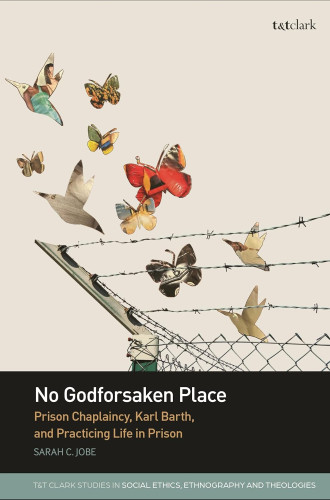
No Godforsaken Place
Prison Chaplaincy, Karl Barth, and Practicing Life in Prisons
The most difficult aspect of being a full-time chaplain in any modern institution is the role’s liminality. In theory, chaplains’ most essential contribution is their procedural separation: the ability to stand both within and apart from a care environment and, at their best, to speak on behalf of care recipients whose inherent value or voice is being stifled or disregarded. Yet employed as they are, chaplains remain answerable to the institutional cogs that grant them access to spaces most will never enter, with limited say over what transpires in them.
No Godforsaken Place takes seriously the sickening reality of modern-day prisons and presents prison chaplains as both needed and called to move within prisons so as to be with human beings the state has marked for punishment and often as worthless and irredeemable. Cognizant of the vile history and daily harms set in motion by such designations, Sarah Jobe—a career prison chaplain herself—opens with the claim that prison chaplaincy is death work. Based on her interviews with prison chaplains across the nation, she asserts that the role is also “life-in-death work” as well as “life-in-the-face-of-death work, life-after-death work, or wake work.”

Read our latest issue or browse back issues.
Theologically, for Jobe, such work fits within what the Christian tradition has long called salvation or atonement, which she defines as the ongoing “revelation and enactment” of the principle that there is no God-forsaken place or person. In their brutality and constraints, prisons test any moral claim about life and death. Jobe begins by asking whether Christ’s death at the hands of the Roman state can speak at all to the regularity of cruelty and death in prisons, and what it would mean to insist on life after it.
Over six chapters, Jobe places chaplain testimonies in conversation with one of the most significant Christian theologians of the 20th century, Karl Barth. Thinking with Barth, Jobe convincingly suggests how carceral suffering shapes Christian doctrine and how doctrine, if it is honest, must answer to an endlessly maintained carceral order. While Barth does not foreground his own criminal justice encounters or later prison ministry in the texts she most often turns to, the Church Dogmatics, Jobe argues that the prison is the backdrop of his reconciliation writing. She uses that theology to press whether resurrection makes any difference in the face of the suffering that the state sanctions in prisons at such scale.
The book’s latter half deepens that inquiry by rupturing its chapter flow with an interlude of harrowing reflections on carceral deaths that forces readers to dwell with what the system produces before turning to “wake work” as a life-after-death counterpractice. Here and throughout, Jobe does not use theology to do apologetic work for the carceral system but rather to indicate the absolute necessity of theological response in a place riddled with so much grief and loss.
In the first two chapters, Jobe builds on a foundation laid by Winnifred Fallers Sullivan, the law and religion scholar who popularized the phrase “ministry of presence” in her 2014 study of how chaplains in various contexts describe the core of their role and the extent to which they are, in many ways, shaped through regulation, credentialing, and church-state law. Following Sullivan, Jobe insists that “presence” is not passivity; in prisons it simply cannot be. It means staying with care recipients when there is no quick remedy in reach but a response must be made, at times in the severest of situations.
Reflecting the words of her interviewees and her own experiences, Jobe is very clear that, over time, spiritual care at this acuity level takes its toll. After a day witnessing suicides, fights, and executions, chaplains—like all prison staff—must find a way to code switch to be present for ordinary life beyond their work. By way of several testimonies, Jobe invokes this whiplash. Her aim is neither to heroize chaplains nor to banalize what is extraordinarily inhumane but rather to stress how routinely prison chaplains are brought into proximity with state-facilitated death and asked to offer something religion-like to the very bodies on whom such violence is enacted, only to clock out moments later under the weight of it and return home.
Responsiveness to profound suffering appears most directly in the book’s persuasive contention that the chaplain’s role is not any kind of sentimental abstraction that some have used the phrase “a ministry of presence” to imply. Chapter 3 brings the reader into ecumenical prison worship spaces, where chaplains must be keenly aware of the stark racial divisions and White supremacist religious formations that are always present. “Keeping chapel” can mean prison chaplains strategically lowering their voice when others go loud, keeping their bodies nonthreatening when fists clench, and quite bravely stepping in—sometimes minutes before a fight—to reduce pressure before someone is hurt. Jobe is careful here not to devalue prison worship, nor to reduce imprisoned people to a political point. Rather, she emphasizes the fraught conditions of modern prisons under which prison chaplains must make decisions, in real time, and the labor of living with their consequences. These are conditions under which everyone inside must continue to calibrate themselves in order to survive its brutalities.
Jobe’s concluding claim that “all systems . . . must be saved” is not an appeal to divine authority but an act of ethical resistance against allowing the beneficiaries of harsher prison conditions to determine, alone, who is worthy of life and justice. Indeed, she does not shy away from pointing to the ways chaplains, leveraging thousands of years of institutional histories that engender trust and subversive power, can become a balm used by a callous system to make its machinery seem more human amid budget cuts and worsening staff morale. She sits with that middle ground of the chaplain’s role without explaining it away, returning instead several times to one of her opening questions—“What do those carceral lives, deaths, and freedoms mean for the whole of the cosmos?”—to keep the reader’s eye on the lives at stake. Jobe wisely resists offering a tidy answer to such mystery.
No Godforsaken Place is field-making. Jobe redraws the boundaries of prison research by offering the first nationwide, peer-reviewed, interview-led study of prison chaplaincy and by identifying the issues of practice and definition that continue to orient the profession in one of its most understudied sites. Her mostly Christian data reflect the predominant makeup of prison chaplaincy and support her call for ethnographies of other religions, especially as chaplain education and the American religious landscape continue to shift. Not only chaplains but any clergy person or spiritual leader ought to read this book. It uncovers a severe example of an ethical problem all religious leaders face: how to care for the person opposite you while institutions (re)organize themselves around efficiency. The interlude alone is worth the price of admission.