
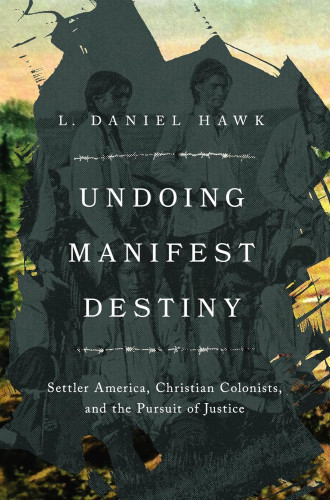
Undoing Manifest Destiny
Settler America, Christian Colonists, and the Pursuit of Justice
Last October, the Trump administration sought to reclaim and revitalize Columbus Day by situating Christopher Columbus as a virtuous man of faith rather than a person whose legacy is tied to programmatic mass genocide in the West. This effort reimagined settler violence as good and holy through the promotion of a falsified memory. In his new book, biblical scholar Daniel Hawk encourages readers to unmask the structures that uphold such settler narratives and to seek ways to engage in decolonial efforts at the local level. Undoing Manifest Destiny is a compelling and accessible model for Christians who seek to work toward decolonizing the settler mindsets they’ve inherited.
This work for Hawk is not detached or nebulous. Each chapter begins with an examination of the history of Ohio. In this way, Hawk creates a dialogue between the localized history of his area and the larger narrative of North American coloniality—and emphasizes the importance of interrogating one’s own community of origin. Hawk uses Ohio history as an inroad to engage mythologies of “the savages in the west,” the use of Indian caricatures as sports franchise mascots, and Christian participation in the programmatic dehumanization and forced assimilation of an entire people. Ohio, as Hawk explains, is not unique; it is merely a snapshot of the banality of settler participation and complicity that can be found in the communities of nearly any reader.
Read our latest issue or browse back issues.
Hawk’s keen awareness of his social location and his audience informs his historical reconstruction and keeps his intentions clear. He is writing to and for “settlers,” which for him acts as a “shorthand for White Christian settlers, that is, for European colonists and their descendants”—
a group to which he belongs. Hawk’s work tasks readers to interrogate the narratives they have grown up with, the stories they tell themselves, and the memories their communities have collectively chosen. He appeals to what he describes as an “obligation to dismantle the sinful structure that our Christian forebears established and that persists to the present day.” Toward this end, he marches through histories that have often gone untold or have been actively suppressed. Each chapter concludes with thoughtful discussion prompts, making this an excellent text for the church or classroom.
A key strength of the book is Hawk’s use of his own personal history as a case study for the application of the national colonial project. By anchoring each chapter with “local iterations of a national narrative,” he personalizes his analysis. And by illustrating the influence of the settler mindset on his own upbringing in a particular community, he avoids directing blame at his readers. Instead, he uses himself as an example of someone who was formed from childhood by settler narratives and depictions of history that mask “memories of settler perfidy, violence, intimidation, land theft, and Indian hating.” In this way, he shows that demystifying colonial narratives involves not only interrogating the particular history of the land around us but also turning inward for self-examination.
Early in the book, Hawk demonstrates that the colonial project in North America is a distinctly Christian endeavor. Through the ideological processes of both the doctrine of discovery and the creation mandate (Gen. 1:28), Christians convinced themselves that the work of colonizing was divinely ordained. Hawk carefully articulates the ways the settler mindset connected the notion of civility with Christianity through the use of mythic constructs that positioned White settlers in stark opposition to Indigenous people. He devotes several chapters to explaining the methods through which this religious colonial program was transformed into legislation that allowed for the seizure of land, violent displacement, and culturicide.
Hawk is a scholar of Old Testament and Hebrew, with previous publications focusing on the book of Joshua’s relation to the scripts of manifest destiny and the American colonial project. In Undoing Manifest Destiny, he devotes a lengthy chapter to Joshua and its interpretations. While direct references to Joshua are limited in early colonial writing, Hawk explains, the scripts of the Canaanite conquest and those against the Indigenous people of North America are nearly identical. For example, both narratives outline an invasion under a divine mandate, the use of mass violence against Indigenous peoples, and the reshaping of the land with new boundaries and memorials after it is emptied. Both narratives feature outsiders who play the role of Indigenous helpers. (In the American story, we have Pocahontas and Sacagawea; in Joshua, there is Rahab.) In both accounts, any remaining Indigenous populations that do not assimilate ought to be removed or relocated in order to safeguard settler populations.
Hawk describes Joshua as a polyphonic text with three distinct narrative voices: the Theologian, the Historian, and the Humanist. These voices are woven together, creating an intertextual dialogue that, when read alongside American settler myths, deepens understandings of how historical narratives shape specific interpretations of the past. Hawk demonstrates in this chapter that reading Joshua as a mirror of the American colonial program can help us decolonize both narratives by revealing the mythic histories that underpin them and confronting the violence they contain.
Undoing Manifest Destiny invites readers to investigate their own lives for colonial narratives and the structures they support. The hope for a book like this is that it will inspire readers to embark on a journey of awareness, reeducation, and decolonial efforts. Hawk has produced an excellent resource for anyone eager to undertake the work of decolonial reeducation but unsure of how to begin. It is also a significant scholarly contribution. As an Indigenous scholar of the Hebrew Bible, I look forward to seeing future publications that adopt Hawk’s model and expand it into more specific areas of settler participation and complicity, such as the history of biblical scholarship or of environmental degradation. By questioning European Christian settler narratives, resisting the glorification of the nation’s past, and confronting the realities of colonial violence, Hawk encourages all of us to pursue justice, peacemaking, and reconciliation with Indigenous peoples.