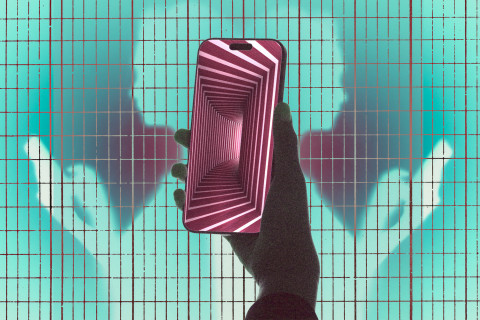
New discoveries and technologies often outpace our ability to describe them accurately, let alone contextualize their implications and theorize about their future. Yet even by these standards, artificial intelligence is developing in directions that all but defy our capacity to fashion aesthetic and ethical frameworks to comprehend it.
In contemporary art, it is unclear whether AI is merely the latest extension of conceptual art or something fundamentally new. If someone instructs an AI system to produce a work of art by following a prompt or tinkering with parameters, does that make that person an artist? Or, more theologically, how do we apply notions of inspiration and presence to the use of generative AI? Is there a (holy) ghost in the machine? Artists are wrestling with these questions in real time, testing the limits of an emergent technology that even its own creators do not fully understand.
One of the most insightful people working with AI is Michael Takeo Magruder. The Japanese-American artist has worked across a range of media, including real-time data, digital archives, virtual reality, and, recently, AI processes. Whereas many artists have jumped into the deep waters of AI with reckless abandon, Magruder has waded in judiciously, preferring a human-in-the-loop approach that emphasizes the sui generis insights of human judgment. It is no coincidence that a decade before the ubiquity of generative AI, Magruder had already collaborated extensively with theologians and undertaken major projects such as De/coding the Apocalypse (which includes both The Horse as Technology and A New Jerusalem), in which he speculated about the potential impact of unbridled or un-principled uses of digital technology.