Online Columnists

Rockwell the activist

The US government is deploying Norman Rockwell’s paintings of idealized American life as propaganda. Those who are preserving his legacy are not happy.

Last Thanksgiving, incumbent Vice President J.D. Vance posted the Norman Rockwell painting Freedom From Want to his social media accounts. In the holiday scene, three generations of a White American family gather at the dining table for a midday feast. Grandpa stands at the head of the table behind an aproned grandma, who holds out a whole roast turkey on a platter for the family’s approbation. Except Vance photoshopped Trump’s face onto grandpa’s shoulders. He had also replaced the turkey with a nearly all-red electoral map of the United States. Vance’s own smiling face replaced Grandma’s.

Freedom From Want was originally commissioned by The Saturday Evening Post and appeared on the cover of its March 6, 1943 edition, illustrating President Franklin Delano Roosevelt’s 1941 State of the Union address, “The Four Freedoms.” (The other freedoms: freedom of worship, freedom of speech, and freedom from fear.)

Even then, Rockwell’s paintings were emblems of state propaganda. FDR’s military used them to sell the war bonds to fund America’s part in World War II. Now, with Trump and Vance in the role of familial patriarch and matriarch, the meme seems to be selling the notion that America will never go hungry again. Or perhaps it’s a coded message to Republicans: We served up this juicy electoral win on a platter. You’re welcome! Or it might be a winking reference to MAGA’s sentimentalized 1950s Americana, with White men at the head of the table hosting an all-White family for a holiday meal. Is the implication then that non-White Americans have no place at the Trump/Vance table?
Whatever the Vice President’s meaning, crass trolling has become the norm for Trump and his cabinet. During the No Kings protests in October, an AI-generated video of Trump—bedecked with a crown and piloting a fighter jet—showed the President dumping poop from the guts of the plane onto the crowds. Now they’re sharing Rockwell’s paintings with provocative captions.

On September 29, the Department of Labor shared another Rockwell image from the Freedom Series. Freedom of Speech is an image of a White man in canvas and flannel rising from a pew to say his piece at a town hall meeting. “American Jobs should go to American Workers,” reads the caption. Meanwhile the Department of Homeland Security has become the main offender of Rockwell copyright infringement, having posted three different Rockwells to its feeds. On August 20, the account reposted a patriotic scene of an American flag waving in front of a crowd of mostly White Americans (the face of the single Black boy in the image is partially covered by the flag). The crowd stares into the far distance with expressions bordering on reverence, their hands held over their hearts or saluting, or in the case of one toddler, pointing at the fluttering fabric. One man to the left of the flag appears to be singing, mouth open, lips shaped. You can practically hear the anthem blaring from the marching band. The captions read, “Protect our American way of life” and “‘Salute the Flag’ – Norman Rockwell”.

On September 29, DHS posted And Daniel Boone Comes to Life on the Underwood Portable, which depicts folk hero Daniel Boone and a young White boy at his desk before his typewriter, presumably fantasizing about Boone’s mythos. The caption reads, “Manifest Heroism” before crediting Rockwell for his work.

But the most troubling DHS Norman Rockwell edit appeared on September 29: A crew installs the Statue of Liberty’s torch, still a work-in-progress in Rockwell’s painting. The caption includes a prickly Calvin Coolidge quotation: “Those who do not want to be partakers of the American spirit ought not settle in America.” Then, in all caps, DHS added, “BECOME A HOMELAND DEFENDER TODAY” and “PROTECT YOUR HOMELAND DEFEND YOUR CULTURE” [sic]. Rockwell is not credited, but there is a link to join US Citizenship and Immigration Services, which commissions ICE officers.

Those tasked with preserving Norman Rockwell’s legacy have noticed the deployment of these images by the current US government—and they are angry. On November 2, USA Today ran an op-ed by ten of Norman Rockwell’s relatives, including his son, grandchildren, and great-grandchildren, titled “We’re Norman Rockwell’s family. Trump’s DHS has shamefully misused his work.” They write,

“From 1916 to 1963, [Norman Rockwell] regularly painted covers for The Saturday Evening Post, which by and large depicted only White people. The scarcity of people of color in Rockwell’s paintings has led those who are not familiar with his entire oeuvre to draw the conclusion that his vision was of a White America, free of immigrants and people of color. But nothing could have been further from the truth.”

In fact, Rockwell’s seventies marked a shift in both his politics and art. In the 1960s, at the age of 69, Norman Rockwell became an artist-activist.

Rockwell was vanilla in every respect, and that included abiding by the strict “color line” mandated by his longtime employer.

No one would have charged Norman Rockwell as “Thomas Jefferson with a paintbrush” in his early days, according to art historian Deborah Solomon in her biography of the painter. He remained private about his political leanings until the 1960s, but the fact remains that when he began working for The Post in 1916, he voted in lockstep with his mentor, editor-in-chief George Horace Lorimer. Lorimer had fan-boyed for Calvin Coolidge’s “business first” moderate agenda within the pages of the magazine. Rockwell registered as a Republican in 1926, the first year he could, and he voted red down the ticket.

Those who knew Rockwell throughout most of his career might have described him as a symbol of the nice White male of the American suburbs. He cleaned his paint brushes with Ivory soap, once telling a reporter that he disliked “the culinary fashion for parsley” (too spicy, perhaps?), and his favorite ice cream was vanilla.

In other words, Rockwell was vanilla in every respect, and that included abiding by the strict “color line” mandated by his longtime employer, The Saturday Evening Post. Rockwell began painting covers for The Post at age 22 in 1916, his dream job. He also painted Coca-Cola advertisements, Boy Scouts of America calendars, and commissioned portraits for politicians and celebrities. But Rockwell became known for his 323 Post covers. Over 40-plus years they established him as the painter of nostalgic White America, and the “predigested emotion” of Rockwelliana came to define low art for the bottom-rung cultural consumer.

Rockwell’s paintings did not depict the reality of American democracy in turmoil that he and the country experienced during his tenure at The Post. He did not paint, for example, the Great Depression, the brutality of either world war, or the societal divides between Black, Brown, White, and immigrant residents of the United States. In fact, whenever he had tried to experiment—for example, when he presented his boss with abstract covers, in vogue with the modernist abstract expressionist movement of the day, or when he included Black characters in his works in nonservile roles—his covers were either edited or rejected outright. In fact, the Post refused to consider “the race problem” in the United States in its first 50 years of publication. Upton Sinclair considered the owner of The Post to be “the great central power-plant of Fascism in America,” and its long-running editor-in-chief, Lorimer, to be “the great literary Fascist” because of the authoritarian and oligarchical vision of America they portrayed within the magazine’s pages. (Jan Cohn’s Creating America: George Horace Lorimer and The Saturday Evening Post offers a revealing portrait of both editor and publication.)

This editorial bias was, perhaps, the greatest force shaping Rockwell’s work. Yet he also contributed a healthy dash of wish fulfillment to his canvases. Rockwell’s own family life became dysfunctional. His own parents remained emotionally distant; he had two unhappy marriages (and one companionable one); and he perpetuated a distracted (if not neglectful) relationship with his three sons. His longtime therapist, Erik Erikson, joked that Rockwell’s was perhaps the most therapized family in America. His sons regularly joined their father’s sessions with Erikson, and his second wife spent many stints in residential mental health facilities.

The elaborately staged scenes Rockwell painted had nothing in common with his own ordinary, troubled life. He admitted that he aimed to paint “pictures that didn’t disturb anybody, that I knew everyone would understand and like.” He found models wherever he went, asking them to pose in his studio in costumes and with props he collected. He visited and photographed the settings he proposed to paint. He saw his role as a storyteller first, recreating scenes of human feeling for commercial purposes—compelling enough to catch a reader’s eye on the newsstand, a visual story unto itself. He meant it as a kindness, a way to make others happy.

Yet Rockwell doubted himself. He knew critics mocked his literalism, though he couldn’t seem to escape it. In 1962, nearly at the end of his career, he told Esquire that he understood his illustrations to be popular but unfashionable. The Post seemed to feel the same way. Behind the scenes, the once-ubiquitous magazine struggled to maintain its relevance in the mid-century media landscape, and Rockwell’s covers began to feel outmoded. A new art director informed Rockwell that his role would be changing—he’d no longer be the cover artist but an interior illustrator, and in particular, a portrait artist to the rich and famous.

Unwilling to play painter to the stars, Rockwell quit The Post in 1963 at the age of 69.

 In his post-Post years, Rockwell shifted from private conservative to, as he told a reporter in 1962, a “moderate Republican who voted for Kennedy.” 

In 1965, Rockwell painted Civil Rights workers in the moments before their deaths. Murder in Mississippi (Southern Justice) was based on a real event from the summer of 1964. During Mississippi’s “Freedom Summer,” two White college students (Andrew Goodman and Mikey Schwerner) and one Black college student (James Chaney) went missing while volunteering to help Black Mississippians register to vote. After visiting a rural church in Philadelphia, the three men did not return to their dormitories in Oxford. Forty-four days later, the FBI discovered their bodies buried on the property of Herman Tucker. The murders had been the work of Klu Klux Klan members, including several members of the Neshoba County police.

Rockwell, like the rest of the country, followed the story. As he had explained to a reporter in 1962, “I was born a White Protestant with some prejudices that I am continuously trying to eradicate. I am angry at unjust prejudices, in other people and in myself.” Elsewhere, he said simply, “Times are changing now, and people are getting angry. I’m beginning to get angry too.”

Murder in Mississippi became too raw, even for Look, which had published an early sketch. In the finished painting, a White man stands, his eyes fixed on the shadows of figures out of the frame, his white Oxford shirt stained with the blood of his Black compatriot, whose hands grasp his shoulders. The bullet has hit the Black man’s shoulder, which weeps red. They resemble renaissance martyrs framed by darkness and shadow. The headlights from the executioners’ cars wash the color from their faces. At their feet lies a White man, collapsed, face in the dirt. The canvas is as dark as a Rembrandt, except for the bright red of fresh wounds.

In this painting, Rockwell finally shows “America as it is, not as we wish it,” Stephanie Plunkett of the Norman Rockwell Museum explains. That includes murder. Where his older work reinforced “a culture of restraint that guarded the ‘Negro Problem’ as a kind of colossal secret,” as art historian Jennifer A. Greenhill puts it, here Rockwell renders an image that continues to scandalize, even through a screen. Faced with the violent truth of White supremacy, Norman Rockwell did not blink.

Why does it matter that one man changed his mind?

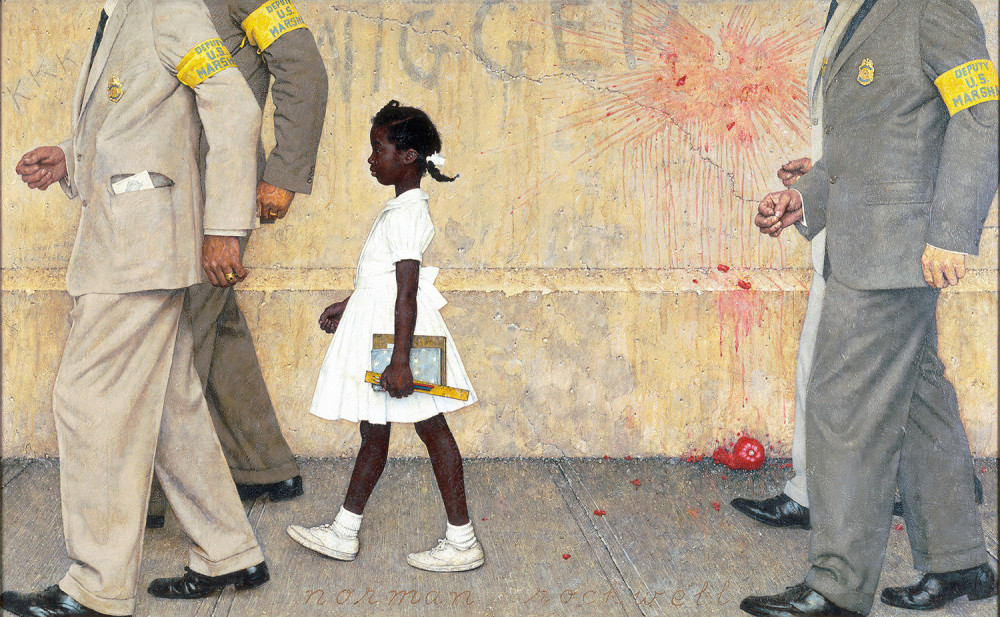
I can only answer for myself: I’m struggling to hope that any American can change their mind about politics. As I witness the cruelty of politicians in power toward the hungry, the immigrant, and the ill, I despair. Some will say that you can’t argue with “people like that,” people who voted for this. But no person is static. The story of Rockwell could not be clearer in this regard: a man who once idolized the politics of privacy and conservatism spent his influence in his late years rallying for Civil Rights, for nuclear disarmament, for the eradication of poverty. And he paid a cost for his activism (though not as steep a cost, perhaps, as he would have if he had pivoted left earlier in his career). Further, his shifting politics helped some people to change their minds. In response to the The Problem We All Live With… one viewer wrote: “Thank you for showing this white Southerner how ridiculous he looks. The truth is hard to take until we get it from a Norman Rockwell.”

For those of us who doubt that anyone can return from the precipice of Trumpian politics, Rockwell’s late activism might give us hope. Rockwell changed his mind. It can happen. It happens every day.

********************

The Century's community engagement editor Jon Mathieu engages Liz Charlotte Grant in conversation about the stunning shift in Norman Rockwell’s politics and his late career as a painter-activist.

oEmbed URL

Liz Charlotte Grant

Liz Charlotte Grant is an online columnist for the CENTURY and the author of Knock at the Sky (Eerdmans). 

All articles »