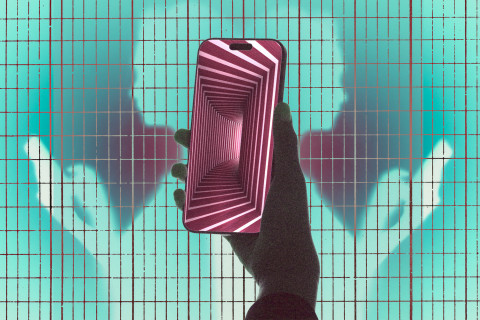

In a world of deepfakes, AI-generated images, optical illusions, altered photos, and heavily edited videos, it is increasingly difficult to tell what is real and what is not. This raises a troubling question. Can we really believe what we see? The most honest answer may be: sometimes. And that uncertainty can feel unsettling. The saying often attributed to Benjamin Franklin, “Believe nothing of what you hear, and only half of what you see,” reminds us that skepticism about appearances is not new. A healthy measure of doubt can protect us from manipulation. But there is an important difference between being thoughtfully skeptical and distrusting our own senses altogether.
When we refuse to believe what we clearly see with our own eyes, we risk overriding our own internal capacities for perception and judgment. Our senses do more than gather information; they help us interpret the world and guide our actions. Learning to trust ourselves, to believe that what we see and hear is part of reality, is essential. Yet building that trust is not easy when we are flooded daily with a deluge of images and videos designed to provoke, persuade, distort, or deceive.
The familiar phrase “seeing is believing” is being challenged more and more often and in new ways. It’s one thing to know that images can be manipulated. It’s quite another to witness something directly and then be told that what you saw is not what you saw. In his novel 1984, George Orwell describes a society where history and reality, and ultimately truth itself, are controlled. The ruling authority demands that citizens “reject the evidence of your eyes and ears.” When people are trained to doubt their own perceptions, they become easier to control. Self-doubt opens the door to manipulation.
These tactics of visual manipulation, however, are not just the stuff of sci-fi—nor are they a modern invention. Images have always shaped what people believe. Long before digital manipulation, visual messaging carried power. In the ancient world, merchants sometimes used rigged scales or deceptive weights to increase profits. Greek architects subtly curved and tilted columns so that temples would appear perfectly straight from a distance. Roman triumphal arches depicted wars as clean victories, visually erasing the defeats, destruction, and death that certainly occurred. Sculptures of rulers were carved larger than those of others to signal power and hierarchy. None of this required Photoshop. It only required an understanding that what people see influences what they accept as true. Images are effective teachers and powerful tools. They communicate messages, shape perception, and influence belief. And as we now know far too well, they can function as instruments of social control.
Given this long history of deception, it is not surprising that the New Testament writers repeatedly warn believers not to be deceived. In Galatians 6:7, Paul writes, “Do not be deceived for God is not mocked, whatever one sows that will they reap.” Earlier in the letter, he asks, “Who has bewitched you?” Paul reminds the Galatians that Christ was vividly presented to them, so clearly proclaimed that it was as though they had seen it with their own eyes. Yet they were drifting away under the influence of other teachers. The danger was not simply false teaching. It was the erosion of confidence in what they had already witnessed and understood. Reading this letter today, we are invited to consider who is trying to deceive and bewitch us. In what ways are politicians, media personalities, or faith leaders attempting to manipulate our sense of what is true?
Throughout the New Testament similar warnings appear: “Do not be deceived.” “Be vigilant.” “Grow up in discernment.” “Test what you hear.” These admonitions were not about paranoia; they were about maturity. Early Christian communities were urged to test teachings carefully, to guard against manipulation, and to remain grounded in truth. Discernment is a disciplined refusal to let manipulation override what is evident, embodied, and known. This is where the biblical call to vigilance meets our present moment.
We are surrounded by images that can mislead, obscure, or inflame. The solution is not to abandon our sense of sight; it is to learn how to see faithfully. In an age of distortion, we must practice discernment together. Discernment does not mean rejecting clear evidence—it means evaluating it carefully and honestly. This will probably require us to slow down our consumption of images. This gives us time to verify that something is accurate before sharing it. Time to listen carefully to credible witnesses, especially when harm and injustice are at stake. And perhaps most importantly, discernment means building communities that help us interpret what we see instead of navigating our confusion alone. Truth is not only something we perceive; it is something we protect.
When we take these steps, it is like beginning to use corrective lenses. If you wear contacts or glasses, you know their immediate benefit—the way they alter your vision so that you can see more clearly. It does not change what is there in front of you; it just enables you to see it clearly, to distinguish between manipulation and testimony, spectacle and truth. This helps build our confidence that what we see with our own eyes is real, lest we enter the dangerous territory of the Galatians and allow ourselves to be manipulated into denying what we plainly see.
The need for discernment was present in biblical times and has been with us throughout US history. Television changed the course of the Civil Rights Movement. When people could see water hoses and dogs weaponized against peaceful protestors exercising their First Amendment rights, they were awakened to the injustices of segregation and Jim Crow laws—despite the deceiving words of politicians. Today our access to visual evidence from phone cameras and social media is higher than it’s ever been, but so is the political rhetoric of manipulation. This year we have seen at least two videos of state-sanctioned murders. We beheld the horrifying truth with our own eyes. Seemingly within minutes of each video’s release, officials began smear campaigns against the victims, calling them domestic terrorists or would-be assassins. Analysts were trotted out to draw our attention to debates about the angles of car tires or cell phones. But we watched nonviolent protestors being shot down. We saw it with our own eyes.
Language itself reflects the connection between seeing and knowing. In English, we say, “Do you see what I’m saying?” to mean, “Do you understand?” In Greek, the word oida (“I know”) is related to the word for “I have seen.” Seeing and knowing are meant to be deeply intertwined. When we do the work of discernment and see faithfully, sight creates knowledge—and knowledge is powerful. It can expose lies. It can resist manipulation. It can call us toward truth.
And truth, as we’ve been taught, can set us free. Truth-telling opens the possibility for repair and change. It refuses to accept distortion as reality. It will not allow us to remain complacent about the world as it is but insists that we work with each other and the Divine to create a better one. To see and tell the truth is to resist deception, name what we witness, and stand with those whose testimony is distorted, ignored, or dismissed.