Last year during an in-flight interview, Pope Leo XIV addressed a question about homosexuality:
“We tend to think that when the Church is talking about morality, that the only issue of morality is sexual. And in reality, I believe there are much greater, more important issues, such as justice, equality, freedom of men and women, freedom of religion, that would all take priority before that particular issue.”
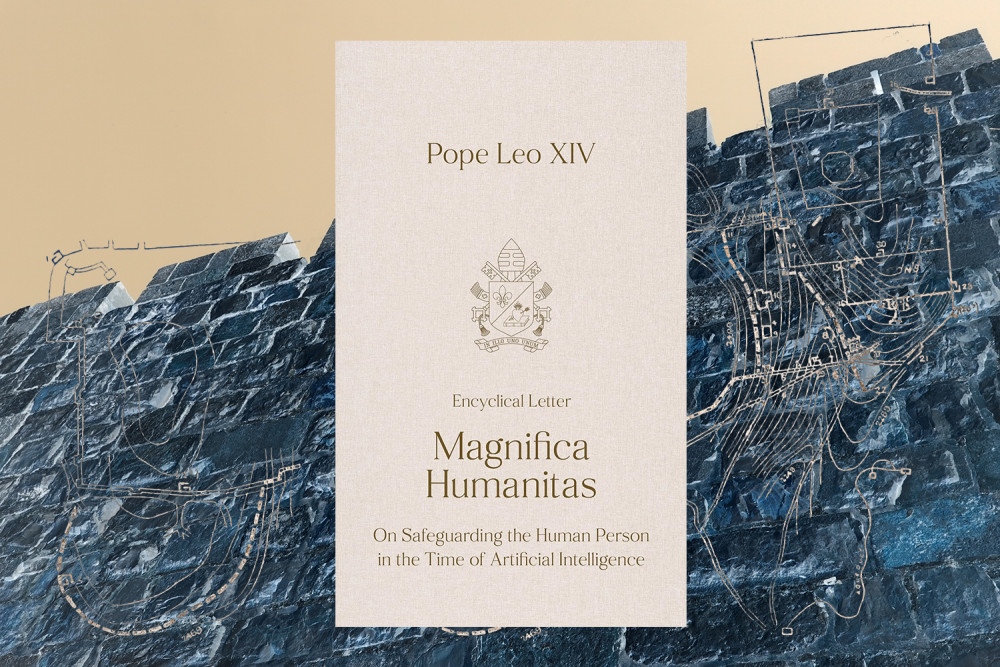
Echoing his predecessor, Leo reminded Christians that the Church’s moral vision ought to be capacious and not limit itself to one or two dramatic political issues. His first encyclical, Magnifica Humanitas, reminds us of the staggering breadth of the Christian imagination.
The encyclical is ostensibly about safeguarding the dignity of humanity in light of artificial intelligence. But as other commentators have noted, the document is better seen as a summary and exposition of Catholic social teaching.
While the principles undergirding CST are scriptural, rooted in Jesus’ ministry to the poor and marginalized, the official teachings were formalized in the late nineteenth-century when Pope Leo XIII issued the encyclical Rerum Novarum (On the Rights of Workers). In the wake of the challenges arising from the Industrial Revolution, Leo XIII sought to carefully “define the relative rights and mutual duties of the rich and of the poor, of capital and of labor.” He sought, in other words, to remind people to keep their eyes on the common good, which is a shorthand for our collective flourishing where “our” includes all of us. In addition to the common good, CST is organized around three other principles: human dignity, solidarity, and subsidiarity (the idea that problems are best solved locally).
When I tell folks I’m a Catholic ethicist, they begin to drill me on “issues.” What does the Church say about abortion? What does the Church say about gay marriage? What about immigration? I remind them that the Church has spoken and continues to speak on these issues, and that, as they might not know, there are a variety of Catholic voices addressing these topics in different ways. But I try to steer the conversation away from “issues” because our primary task as Christians isn’t to speak to particular topics, but to speak about God. And this speaking is always already a response to what God is up to in the world. Christian ethics, then, is all about discerning what God is up to and figuring out how we might collaborate with him. This will certainly require us to address timely issues, but the goal should be to connect these issues to Jesus’ proclamation of God’s kingdom. The problem plaguing the history of Christian ethics is that it has too often neglected to do that.
Pope Leo tries to overcome this limitation by grounding his moral vision in the incarnation: “it is only in the mystery of the Word made flesh that the mystery of humanity becomes clear.” The primary ethical question for Christians is not “What should I do?” but “Who should I become?” And the answer to that is clear: we should become like Jesus, who has become like us. The first step for moral deliberation should be to remember God’s entanglement with our messy world. “There is no moment or human situation that is not worthy of God,” writes Leo.
The Pope introduces the themes of his document with two biblical images: the Tower of Babel and the wall that Nehemiah rebuilds around Jerusalem. To Leo, these two stories show us two different ways of building the future. The project at Babel “was conceived without reference to God, supported by a uniformity that eliminated diversity and chose homogenization over communion.” Nehemiah’s project, in contrast, “shows how the city is reborn, not through the initiative of one man, but through the shared responsibility of all.” Will the future be constructed by self-sufficient, powerful men, or by “a people who work together in the presence of God to rebuild the walls of fraternal coexistence?” Or, as he puts it elsewhere, there are two paths of development set before us: “a progress that serves individuals and peoples, or a progress that subjects them to the mentality of power.”
Some scholars have criticized Leo’s interpretation of Nehemiah, but the Pope’s reading sets up nicely the existential questions driving his encyclical: What kind of world are we building? At whose expense? Whom does this world serve? Whom does it overlook? In other words, Leo’s eyes are squarely on the whole: not only this or that issue, but on the world within which these issues interact with all other issues and thus come to mean.
See, for instance, how he talks about slavery. “In continuity with the tradition inaugurated by Leo XIII, the Church renews her firm condemnation of all forms of slavery, trafficking and the commodification of persons.” It is the vocation of the Church to call the world in the direction of freedom. For that reason, says Leo, Christians must condemn new forms of slavery and colonialism, such as data extraction, exploitative digital infrastructures, and various attention economies which offer big payouts to those who control the algorithms. Our increasingly technologized world offers a few folks at the top the “power to profile, predict, and influence behavior,” which risks “undermining freedom and discriminating against the most vulnerable.” In this way, Leo connects the dots between chattel slavery and exploitative contemporary technologies by noting that both are made possible by a “mindset of extraction” — what can we take from those whose lives we’ve decided don’t matter?
Leo brings up other issues requiring our careful attention, such as the transformation of work and education in digital environments. These are not, as he reminds us, “isolated phenomena,” but rather “reflect a common underlying issue — namely, that if technology becomes the ultimate criterion, the human person risks being reduced to data, a cog in a machine, or a commodity.” The issue, once again, isn’t merely “the issues” but the world that we are building. Leo is encouraging us to move beyond a myopic act-centered approach to ethics to a generous world-centered ethics that constantly challenges itself to grow its field of vision.
In a section discussing developing ethical frameworks for AI, Pope Leo reflects critically on “the moralization of machines.” But we might also reflect on the machinization of morality, which could easily describe many Christian approaches to ethics: rote, predictable, uncreative, mechanical. As Leo says during a discussion of artificial moral agents, “moral judgment cannot be reduced to calculation.”
There are many reasons why Christianity has lost its moral authority in the eyes of popular culture: various abuse crises, its history of white nationalism, its too-easy transactional relationship with state power, etc. But one reason no doubt is its off-putting hyper-fixation on a handful of issues: abortion, sex, LGBTQ rights, etc. Rather than first offering the world a broad ecological vision, and then allowing the clarity of that vision to sharpen our convictions about certain issues, we merely started with the issues themselves, and then stayed there stewing in our rage. As Leo makes clear, we don’t have to stay there. It’s possible for Christians to articulate a robust moral vision that refuses to fixate on isolated issues, a moral vision that is capacious and ever-widening. By positioning different contemporary problems within a “situated anthropocentrism” (i.e. the view that humans are part of an interconnected web of relationships), and reminding us that no single issue should be analyzed outside of an ecological framework, Magnifica Humanitas shows Christians how to do ethics incarnationally.