Juliana dos Santos is a visual artist, researcher, and art educator who was born and raised São Paulo, near some of the city’s oldest samba communities. Her practice spans painting, installation, performance, photography, and video, often investigating the limits and possibilities for Black women artists in Brazil. Her work has repeatedly challenged Eurocentric and colonial traditions of perception, asking what is activated when seeing exceeds sight.
For Dos Santos, this question became embodied through an unexpected encounter with the color blue. Years ago, while participating in a Tibetan Buddhist meditation practice, she experienced, with her eyes closed, what she describes in her dissertation as a beam of blue light. It was not exactly something she saw in the material world—it was more of a sensation, a synesthetic experience that may have unsettled the supremacy of vision, opening doors of perception to another register. Soon afterward, Dos Santos encountered Clitoria ternatea, an intensely indigo-violet flower, and became fascinated not only by its color but by how it responds to environmental elements such as light, moisture, temperature.
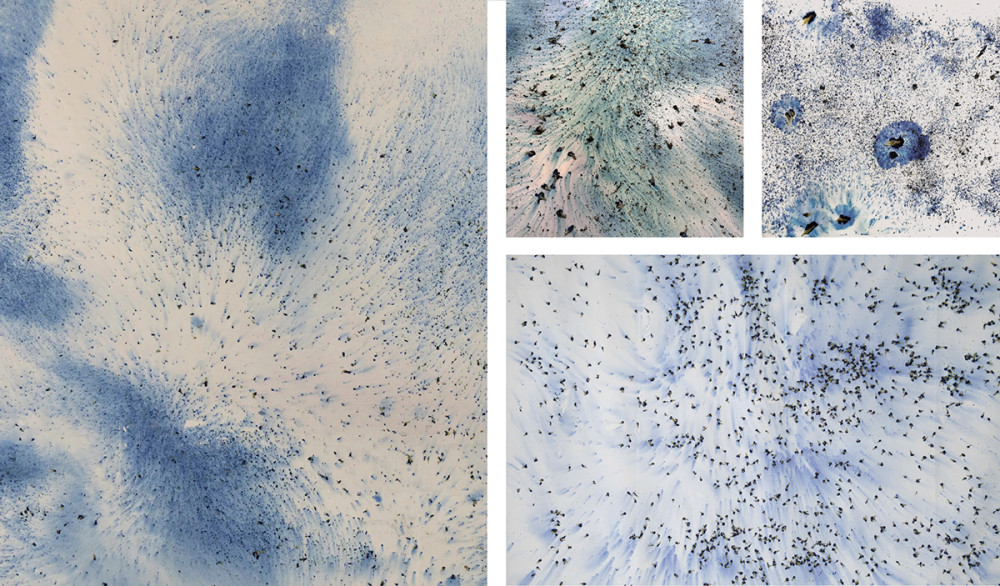
In Sopro/aragem/viração, Dos Santos roasts the flowers, grinds them, and then blows them across wet surfaces so as to stain them. The artwork emerges through breath, water, pigment, and the artist’s movement. “Perhaps, I don’t paint,” dos Santos said in an interview last year, “perhaps, I sow.”