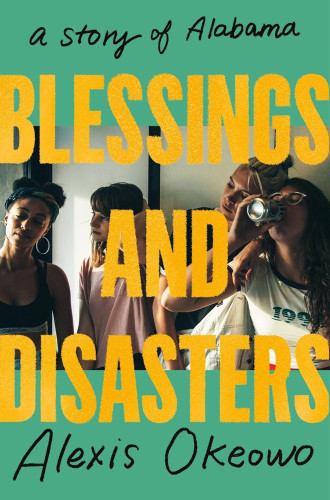
Blessings and Disasters
A Story of Alabama
In 1860, the captain of the slave ship Clotilda conducted an illegal trade for 110 enslaved people on the West African coast. He brought them to a plantation owned by the Meaher family at Magazine Point in Mobile, Alabama. Five years later, this last group of involuntary immigrants to the United States from Africa was emancipated. Lacking the resources to return home, they founded a free community in 1866, Africatown, less than two miles from Magazine Point. In 2019, the Clotilda was found at the bottom of the Mobile River, and today, the Africatown Heritage House offers tickets and school tours to see the remnants of the ship.
In Blessings and Disasters: A Story of Alabama, Alexis Okeowo writes that “the story the state started to tell about itself began in the aftermath” of the Civil War. Their book—a blend of Alabama state history, reporting on its current issues, and memories of their life growing up in Montgomery as the daughter of Nigerian immigrants—tells a new story. More importantly, it reminds readers that how one tells the story of home involves choices that have real and profound consequences.
Read our latest issue or browse back issues.
Love for Alabama’s land and its diverse people seeps through the pages of this book in rich variegation. The land, Okeowo writes, “is made up of layers of soil tinted red and brown and black, enriched with clay, sand, iron, and the remains of whoever lived on and fought to stay on it at the time.” Historically, it has been called the “Black Belt,” a reference to its dense, dark soil, which has “persisted through plunder and upheaval. The green is the sign of our survival, that we made it, and will keep making it, past what keeps seeming like the worst.”
Okeowo turns over Alabama history as one might dig through the layers of a land plot, rooting around for nutrients. History is seemingly everywhere in the state, particularly in the form of Confederate monuments and museums: “The past is so present that it overpowers it, certainly by design.” This might explain why, in recent decades, many Americans have been disoriented by claims that true stories about the American South are not well known. Okeowo navigates and charts their own confrontation with Alabama’s past masterfully, revealing throughout the book the proximity between the state’s false narratives and its revelatory ones—stories as close as Africatown and Magazine Point. Alabama’s real story, Okeowo suggests, is in the liminal parts of the present and the past, the “imaginative place between who Alabamians are and who they could be.”
They interweave snippets of the histories of the enslavement and emancipation of Africans and their descendants, Indigenous tribes’ loss of sovereignty, the hard-fought survival of the Poarch Creek tribe, Reconstruction, and the civil rights movement with profiles of contemporary Alabamians. We read about the director of Confederate Memorial Park coming of age at battle reenactments in the 1980s and ’90s. His narrative is intertwined with that of a longtime, undaunted civil rights activist whose parents hosted members of the Student Nonviolent Coordinating Committee in their home when she was a girl. A good portion of the book profiles Tina Johnson, one of the women who accused Roy Moore, former Alabama Supreme Court chief justice and a 2017 US Senate nominee, of sexual assault when the Me Too movement began. Okeowo shows how Alabamians have made their way through and played crucial roles in various social movements over time. Accordingly, they have rewritten the history and possible futures not only of their state but of their country.
Alabama might have surprises in store, Okeowo suggests, because its past is full of them—like the 2,600 Alabamians, mostly farmers who owned land but no people, who fought for the Union Army. Because they were “neither Confederates nor abolitionists, they’re a footnote to the story,” and most students in Alabama’s schools learn little to nothing about them today. Okeowo argues that the existence of people like the Alabama Unionists (denigrated as scalawags during and after the Civil War) should not be surprising at all. Rather, their stories should be “amendments” to the dominant narrative the state has told about itself since the 19th century. Too few Alabamians—and far too few Americans—know about the 1868 state constitution, which protected voting rights for all, guaranteed public school funding, and enshrined married women’s property rights. (Democrats trashed those laws in 1875.)
American schoolchildren in the most progressive social studies classrooms often hear that “history is written by the victors.” Sometimes, however, history is written by the losers, and their version, indicated by all those Confederate monuments and museums, is not necessarily closer to the truth of the past. History is written by humans, Okeowo compellingly argues, and perhaps if we say so, Alabama might play a different hand. “It depends on who is doing the looking,” they write. “Whoever is telling a story has the power to distort it, will usually distort it for their own ends. But at least we can admit it.” Okeowo offers not so much a counternarrative as a fuller narrative of Alabama’s past, one in the service of its complicated, but not preordained, present.
Today, Africatown is “a place of crumbling houses and a green so untamed that the grass and bush are retaking abandoned lots and little-trafficked streets.” Poverty, environmental devastation, and cancer rates abound, largely due to asphalt and paper manufacturing on lots leased by the Meaher family—the descendants of the Clotilda’s owner.
Okeowo has reported on conflict and human rights from Kampala, Mexico City, Nairobi, Lagos, and London. They write that upon their return to Alabama, “everything was familiar, but nothing was for certain.” Their book should be read as a call for communion with the unfamiliar in our home states’ stories, as well as a reminder that the past and the present are, and will be, uncertain.
This review was produced in partnership with the Narrative Project and Sacred Writes.