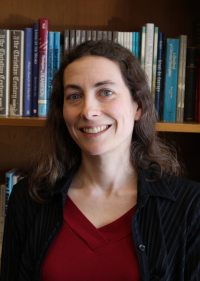


Liz Bucar is a religious ethicist who teaches at Northeastern University, directs the Sacred Writes program, and writes the Religion, Reimagined Substack. Her 2022 book Stealing My Religion examines the ethical complexities around people adopting religious practices from faith traditions they don’t belong to. In her new book, Beyond Wellness, Bucar approaches the same questions with a constructive aim, delving deeply into seven popular wellness practices to show how understanding their religious roots can help the nonreligious people who practice them do so more honestly, more communally, and more ethically.
I’m excited about Beyond Wellness, which is your first book written for a popular audience. Tell us about the book’s main argument and what you’re trying to accomplish with it.
In part, this book comes out of my frustration with the idea that you can be spiritual but not religious. I just think that’s false. It’s like you’re dabbling in religion without being respectful of the communities, the traditions, the texts, the obligations, the discipline, the devotion. All of those things are important.
And the wellness industry keeps trying to sell me things which look like religious practices, and they’re saying it’s not religion. And I get it; I understand the impulse not to get involved in the messiness of religion. But these practices come from religious traditions. Yet I’m being told that I can engage them apart from their metaphysics, their cosmology, and their ethics, and still they will heal me and work for me and make me well. You can’t just extract the rituals and the techniques and get the benefit.
You write about specific practices that nonreligious people commonly adopt, such as yoga, meditation, and psychedelics. How does knowing about the religious roots of these practices make them work better for people?
I approach that question in a couple of ways. First, if these practices already work for you, they’ll work better if you understand some of the context and the content that you’ve left behind. Because so much of the history of religious engagement in the United States is a history of Protestantism, these practices have been reshaped over time to be comfortable for Protestant Americans. This reshaping has been so prevalent that we often forget that it’s there. I’m not suggesting adopting a romantic or pure or premodern version of a practice’s original religious roots. Depending on which practice and which community you’re looking at, there could be many different ways of restoring some of those roots so you can embrace a deeper, fuller sort of practice. You may love this thing, but maybe you could love it even more.
Secondly, by putting the religious content and context back into these practices, you can start to combat some of the hyper-individualism and optimization peak performance baloney that we’re all chasing as part of finding wellness. Those things don’t make for a good human life. If you go by biomarkers, I’m doing pretty well. I’m 52, but my bloodwork is good, my bone density is good. But those numbers don’t tell you that I’m living the most robust human life I could live, right?
I think wellness is too low of a bar. I don’t want wellness; I want well-being.
I love that.
I mean, it’s also a little sneaky religious studies, right? There’s a theorist in each chapter, and there’s a little bit of religious history or American history in each chapter. But this book is meant for a broad audience, so in every chapter I try to take off my teacher hat and put on my personal hat to explore the bigger takeaways, like, What does it mean to be a deep listener? How could I show up in my relationships differently if I were to really think about sacred sound and let that change how I think about listening and sound in general?
I really like the parts of the book where you nerd out about history, and it makes me wonder if something else you’re doing in the book is showing (rather than telling) that history matters. When we do something in the present, whether embodying a wellness practice or making a political decision, we aren’t acting in a vacuum. We’re participating in an ongoing story that’s created by the acts and decisions and rituals of people who came before us. And there’s value in knowing and naming the details of the earlier parts of the story that we’re now living. Is that a fair assessment?
Yeah, I think that’s spot on. A colleague who’s a historian once said to me, “You’re not a historian, Liz, but you like to get a running start.” I’m really interested in what’s happening right now, but getting that running start is helpful because I always find things in the history that I didn’t know, things that make me a little uncomfortable, things that have been erased. Sometimes I realize that something I thought was science or medicine or cultural history is actually religious history too.
Can you share an example of that from your research?
Sure. My favorite chapter of the book to research was the fitness chapter. I went in thinking that fitness was something that medical practitioners in the 1950s decided we should all do since bone density and cardio and muscle tone matter for health. But today’s spiritual fitness industry can be traced to the muscular Christianity movement, which came to the United States from England in the 1890s and became institutionalized in the YMCA. This was an evangelical Protestant movement rooted in the concern that Christianity was too feminized. The goal was to make men more masculine and more muscular through fitness training, and this training was viewed as an extension of the church—and all of this was connected to empire.
It always blows my students’ minds when I tell them that basketball is a sport that was developed by the YMCA to cultivate Christian virtues. They find it unbelievable that basketball or volleyball could have this hidden religious purpose and logic, because to them it’s just a sport. I have to remind them: “No, it’s not. Nothing’s just a sport, right?” That was a really fascinating history to uncover and share with my students.
It’s fun to imagine you teaching. We’ve known each other since grad school, but I’ve never asked you what brought you to religious studies. What’s your background; how did you end up being a scholar of religion?
I never studied religion in college, so the fact I have a graduate degree in it is a little bit weird, right? I was baptized Catholic and raised in a Congregationalist church, but from my young adult life on, I never considered myself a Catholic or even a Christian. But after college, working in advocacy in DC, I came to realize: Whoa; religion is in the room, to quote journalist Liz Kineke. If I want to understand what’s happening with reproductive health in South America, I’ve got to think about the Catholic Church.
And at first, religion seemed like a problem to be solved in my advocacy work. But very quickly it became a resource for advocacy. I worked for a group, Catholics for Choice, which was thinking about religion and contraceptive health and safe motherhood and responsible parenthood in ways that were different from the Vatican. I started graduate school with the sense that religion is an amazing resource for the advocacy work I care about, so I should learn about it.
A lot of my early career involved looking at religious communities of others—people I’m not a part of—in places like Iran, Turkey, Indonesia, South America, Spain, and Italy. But with this new book and the new public voice that I’m finding in my Substack, I’ve started to realize that I’m not studying religion as an outsider. Studying religion for so many decades has really changed who I am. Even if I still don’t claim a religious identity or belong to a religious community, I now think of religion as a kind of thought partner. It’s more than a resource to marshal when I want to advocate for something. Religion has changed how I think about a good life, flourishing, ethics, life, death, politics, everything.
It sounds like religion is, for you, almost like a friend. We don't have to be the same as our friends, but we recognize that they’re in community with us and they can shape our thinking and even help us see ourselves more clearly because of the ways they’re different from us.
Ever since grad school, I’ve been respectful of the religions of others and approached them with a generous hermeneutic. At the same time, when you grow up in the US and you don’t have a religious affiliation, it’s hard not to be suspicious of religion because of all the bad associations. I’ve been saying lately that religion has a PR problem, which in some ways it deserves. But I think I’ve come to the point now where I trust that friend more, and I think you’re right about how a friend can change you and shape you.
So lately I’ve been sort of struggling with the question: What am I? Am I spiritual? People call me spiritual, but I hate that term, so what am I? Am I a skeptic? Am I a seeker? I’m in a sort of middle space. And that makes it easier for me to talk to the nones. But what I’ve been surprised by is that I’m also talking to pastors through my Substack, and I’ve heard that I’m being quoted in Sunday services or in Zen centers. I didn’t realize that that would be possible, since I see myself as an outsider.
Well, as a Lutheran, I often find myself leaning into the both/and. And with respect to engaging religious traditions, you seem to be good at living in a space that allows for the both/and—or, to move beyond duality, a space that honors multiplicity. I imagine that would be a rich place to be, because you get to be involved in conversations with multiple constituencies.
I think that’s right. We think we want to live in the black and white, or to get to the end, or to sit in the comfort. But I’ve learned that discomfort is the most productive space for me to be, and to have my students be. Because that’s where you change and learn.
What do you hope Beyond Wellness will accomplish?
I’ve always wanted building religious literacy to be part of my work, but lately that project seems even more personal and more urgent. People like me—people who have grown up suspicious because religion’s PR problem has affected them—seem to be looking for ways to make sense of everything that’s happening: political catastrophe, environmental catastrophe, the coming technological catastrophe. In light of all this, what does it mean to be human? How do we respond? There will be more openness to engaging with religion in answering these questions if there are resources available.
I’ve noticed among my students a real sense of urgency around wellness practices, whether it’s to calm the nervous system or to make sense of the world—a world that’s chaotic and confusing and scary. One reason these wellness practices are popular is because they’re powerful and they remake us. And if we believe that they heal us and remake us, we should know what we’re remaking ourselves into. We should make sure it lines up with our core values (or our theological beliefs, if we have them) so that the practice can work better for us. Understanding more of the context and content of our embodied practices can help us be more intentional about how we practice them, and that intention has ethical value. I also think the communal aspect is important. It’s a mistake to think that these are individual practices we do by ourselves.
An idea that has reappeared in your Substack lately is David Tracy’s concept of the analogical imagination. In one recent post, you describe it this way: “Religious traditions train people in a specific cognitive and moral capacity: the ability to look at the world as it is and simultaneously hold in mind what it could become. Not through denial or fantasy, but through disciplined attention to what reality itself suggests is possible.” I feel like that’s what you're doing in Beyond Wellness: helping your readers cultivate the sort of imagination Tracy envisions (even though you never mention him in the book).
Yeah. I didn’t really think about David Tracy until after I wrote the book, but I think you’re right. And the reason Tracy came up for me may be because of what’s going on politically. What I find difficult in the current political climate, as someone who’s not religious, is that I don’t have faith in tomorrow in the same kind of way. I don’t have trust to lean on. Our former ethics professor Bill Schweiker would probably say that I’m cultivating a form of theological humanism, and that may be true since I have some trust in humans. But what I don’t have—and what I’m trying to recultivate or reclaim—is training in not knowing what’s coming but still being able to imagine something beyond existential dread or nihilism.
I want to do something hopeful. How can we together imagine something on the other side of everything we’re breaking apart now—our religion as we deconstruct it, the political situation that’s unfolding, the environment as climate change intensifies? Tracy’s analogical imagination seems to describe a way of working out what could come next, not knowing 100 percent what it will look like and not having any facts right now that would prove that it’s coming, but still imagining it together, in a Martin Luther King sort of way. That’s where I’m at personally, and it’s probably why I wrote Beyond Wellness.
As you were saying that, a bunch of words started swirling around in my head: ritual, formation, imagination, play, attentiveness, respect, patience, depth.
Yeah, and those are all good things that are happening. They’re like the antidote to the quick fix, to the AI slop, to the political shit show that we're going through. I think that’s why the article I wrote about Tracy’s analogical imagination went viral on Substack. Who thought that a David Tracy article would go viral? But it did. People were like, “Yeah, imagination: that’s what we’re not talking about enough anymore!” Or ritual, or belonging.