Books

The heist of Buncombe Street United Methodist Church

Will Willimon’s story of his childhood congregation contrasts the salt-of-the-earth people who formed him with the conservative minority that took over later.

Will Willimon’s oeuvre is well represented by memoirs and ecclesial histories, but The Church We Carry is a bit of both and neither: a true crime tale, a victim impact statement, an ordinary psalm.

The plot unfolds during the United Methodist Church’s disaffiliation window, those few years during which churches displeased with the denomination’s stance on LGBTQ inclusion could leave and take church property with them. The main characters are Willimon’s childhood congregation—the Buncombe Street (formerly United) Methodist Church—and the perplexing Spirit of God who moves through and despite the church.

The Church We Carry leads us first through the antechamber of saints who raised Willimon. Among them are Dr. R. Bryce Herbert, who assured a young Will that his belonging at Buncombe Street was not dependent on the way he looked or dressed; Mr. J. B. Orders, a mattress company founder who recognized Will’s homiletic talents and offered to pay for his future college tuition; and a primary Sunday school teacher, wearing a pink camellia pin, who taught young Will that God would be with him in every trial.
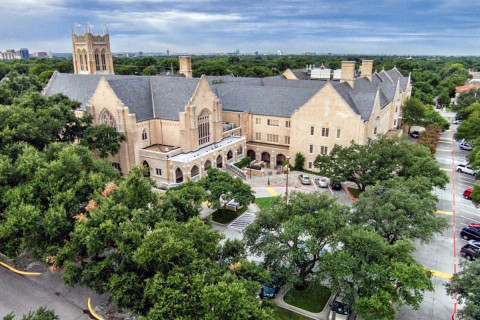
Willimon contrasts this Wesleyan salt-of-the-earth cast with the forces and actors that compose the crux of the memoir: the heist of this once vibrant United Methodist church in downtown Greenville, South Carolina.

The story of Buncombe Street’s disaffiliation is uniquely painful for its individuals who once called themselves a church. And, Willimon asserts, the plot is painfully common for congregations with a similar combination of weaknesses and opportunists. Prior to its disaffiliation, Buncombe Street experienced weak church leadership and a void of information. In this climate, a conservative minority began a scare campaign against the UMC and LGBTQ inclusion. They were outfitted with talking points and plans of action by the Wesleyan Covenant Association.

By now, it is no secret that the WCA functions as a Methodist partner to the Institute on Religion and Democracy. First formed to combat liberation theologies in the 1980s, the IRD has orchestrated dysfunction in mainline Christian denominations to reverse social justice gains in society and theology. Like many congregations that later aligned with the WCA, Buncombe Street was targeted from the inside with misinformation, secret meetings, exclusion, and threats of litigation—misdeeds Willimon recounts in meticulous detail.

And yet, Willimon equally challenges despair and defensiveness. He urges his reader to see the heist of Buncombe Street as “a cautionary tale showing that connectional, itinerating, evangelical Methodism is a demanding polity requiring constant refurbishment and inculcation.” If that sounds cumbersome or unattractive to the reader, Willimon recalls the dangers of a half-baked Wesleyan identity: “It was easier to attract Baptist, neo-Calvinist, congregationalists and give them a Methodist shine, clustering around what’s left of the conservative faith they’ve inhaled just by living in Greenville, than to venture church the Wesleyan way.”

As Willimon’s account of Buncombe Street nears its conclusion, he describes declining numbers of United Methodist congregations and members across the country—and then the diminution of mainline denominations more generally. Here, the memoir may benefit from the panoramic view of a social scientist: mainline Protestant denominations are not declining in a vacuum. Data from the 2023–2024 Pew Research Center’s Religious Landscape Study shows that evangelical Protestant affiliation is also in decline in the United States. That includes membership in the Southern Baptist Convention, which deeply influenced the leaders of the Buncombe Street schism.

There are many people whose accounts don’t appear in this memoir. Their omission is no fault of the author, but the reader may take care to remember them as the book unfolds. What happens to the queer and trans people at Buncombe Street who’ve lost their more affirming kin? What happens to children born into a church whose legacy included a $3 million fee paid to sunder connectionalism and accountability? What happens to the witness of the people of God after a public and deceitful divorce? These are the stories we don’t want to miss in the next chapter of the story of God’s church.

The Church We Carry offers an unvarnished vision of the church persisting. As through a window from a sidewalk at dusk, Willimon introduces Open Hearts UMC. This is a church plant formed from a combination of the people of Buncombe Street who remained United Methodist and a group of seekers, newcomers, and members of another congregation that had once merged poorly with Buncombe Street. Willimon quotes several Open Hearts members, who say of their new home, “It’s good to go to a church where I don’t have to fear that the preacher will say something hurtful about people I love” and “I’m not a refugee, I’m part of something new that’s better than the old” and “I’m glad to be in a church where people ask, ‘How can we welcome you?’ rather than, ‘Whose side are you on?’”

“Things keep dying in Christianity,” says Willimon, “but keep rising again due to Jesus.” Time and again, Willimon interrupts his ecclesial postmortem with proclamations of God’s prevenient and abundant grace. This is the caution and the hope of The Church We Carry: things keep dying—a lament as much as a statement of fact. Willimon does his best to keep from flinching at the sensations and sources of Buncombe Street’s pain. But look, his memoir urges, see what is rising, perhaps from the very places where the church has been broken open. 

Ophelia Hu Kinney

Ophelia Hu Kinney is strategic communications director at the BTS Center, which nurtures spiritual leadership for a climate-changed world.

All articles »