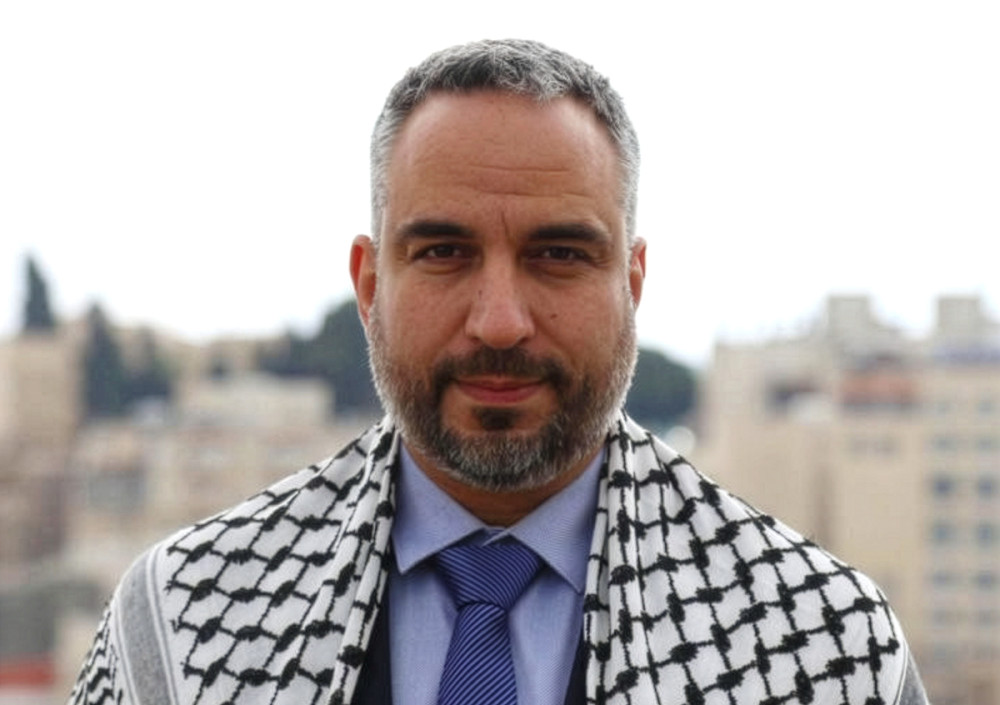
Maher Nicola Canawati, a Palestinian Christian, is the mayor of Bethlehem in the West Bank.
What is life like these days in Bethlehem?
Bethlehem is a small town. It used to be 41 square kilometers; now it’s only 7.3. It’s been carved up by the separation wall, surrounded and choked by 29 illegal settlements and approximately 134 gates, doors, barriers, and checkpoints. The population took a big hit from the separation wall, which separates Bethlehem from Jerusalem for the first time in history. Our 78 hotels have also taken a big hit due to the war and the lack of tourism. We feel that we have been strangled, abandoned by the international community. Our people are simply losing hope and leaving the city.
We as Palestinians have faced tremendous hardships, from 1917 onward—land confiscation, lost loved ones, businesses stormed, our money seized. Every Palestinian has a story; every Palestinian has experienced hardship under the occupation.
There are natural resources we don’t have access to, such as water. We’re not allowed to go to Jerusalem. Many people lost their jobs because the Israelis stopped giving us permits. People cannot pay their bills or fulfill their responsibilities. These are the kinds of daily things we face as Palestinians due to decisions made by an Israeli government that is telling us, indirectly, Just leave.
Read our latest issue or browse back issues.
And now they’re surrounding us with more settlements, and they’re giving those settlers weapons and the green light to use them. Human rights organizations have registered many attacks on Palestinians by settlers.
How has that increasing settler violence changed life for the people of Bethlehem?
People just leave. They lose hope. When your land is confiscated, you can’t do anything about it. When you don’t have your basic rights, like the right to movement—can you imagine being in Bethlehem, walking distance to Jerusalem, and you cannot go there? You can’t work, pray, or visit friends any family members in Jerusalem. And the amazing part is, some people will still say, Really, are they persecuting you? I don’t know, what would you call that?
In two years of war, our city has lost 4,000 people. I can’t imagine Bethlehem without these people, without these living stones.
Tell me about the current Christian population in Bethlehem.
This is the oldest Christian community on earth. We have approximately 10,000 Christians in the city of Bethlehem. The biggest denominations are Greek Orthodox and Catholics. We also have evangelicals, a Baptist church, a Methodist church, a Lutheran church. We welcome all Christians of the world to be part of our community. But huge numbers are leaving. There are now 165,000 Christian Palestinians in the Holy Land—and 4 million in diaspora.
Are there barriers to worship for Christians in Bethlehem?
In Bethlehem, we worship without a problem. As Christians and Muslims, we are protected. People feel safe going to church or to the mosque. The Palestinian security forces are great. We are one of the safest cities in the country; the crime rate is very low. What’s hurting us is the siege around us, the settlements around us, the gates and barriers that separate people, and the wall.
As mayor, how are you being asked to help your constituents who are still in Bethlehem?
We’re advocating to demolish the wall that separates Bethlehem from Jerusalem. We’re advocating for our basic rights. We want to tell people, don’t leave. Things will be better. Tomorrow is better than today.
One of my first decisions as mayor was, do we celebrate Christmas or shall we just keep it like the previous years? And I prayed so hard about it, even though 99 percent of the advisers said don’t do it. But Jesus told me to do it, and I did it. And it was a great blessing for people and for the community.
How many Christmases did you go without celebrating in Bethlehem?
Two. How can you celebrate when people are being slaughtered in Gaza? How can you celebrate in your churches, your mosques, your hospitals, your universities, your schools? It was not easy for people to celebrate. But I think people needed hope. Jesus told me we should reignite that hope, and I did.
Why is it important for the mayor of Bethlehem to be a Christian?
To keep spreading this message of Christmas. I think a Christian needs to do that. And even though we’re the minority religion, the Palestinian government recognizes that Bethlehem is the capital of the Christian world. In 11 Palestinian cities the mayor and the majority of the council must be Christians by law. President Arafat passed this law, and President Abbas has continued it. That shows how much the Christian people feel equal among all religions within Palestine. We thank our government for understanding that these cities need to keep their Christian presence, their Christian image.
Do you think that law might be challenged with so many Christians leaving Palestine?
I’m optimistic. I don’t think that we will allow all of the Christians to leave. But when I talk with my Muslim colleagues in Bethlehem, they say, Listen, even if you all leave, we will convert to Christianity so we keep that tradition. That’s how much the Palestinian people love the idea of the Christian presence—they’re willing to protect it. It is considered the original presence—not visitors.
It seems like peace may be farther away than ever. How are you finding hope?
I see the opposite. I think peace is closer, because the world sees it better now. For the past eight decades, people did not see the truth. People were deceived. Now people have a better understanding of what’s really happening in Palestine. And I think the more people know the truth about what’s really happening on the ground, the closer we will get to a just solution.
Where do you see Christ at work in your community in Bethlehem?
Christ never stopped working in Bethlehem. To be able to stay after all of these hardships that we have gone through—there is no other reason but Jesus. I’ve faced immense hardships. In all of the struggle, I always see Jesus helping me. Every step I take and every decision I make, I pray.
Are there special Easter celebrations in Bethlehem?
Yeah, Easter is also big for us. This year, before Easter we prepared for Ramadan, because Bethlehem is a Christian and Muslim community. I think we are the best example to show the world how people can coexist, how people can share the similarities and respect differences.
What is your dream, your hope for the church in Bethlehem going forward?
My hope is not for the church. My hope is for the people. For all people, and for the two peoples and the three religions here to coexist and to have a better tomorrow.
What else do you want our readers to know about life in Bethlehem now?
I want them to know that the people—Palestinians, Christians, Muslims, and I’m sure many Israelis and Jews as well—are looking for peace. We cannot be praying for peace for the church alone, because it doesn’t work that way. If you want peace, you need to have in your heart that peace is for the synagogue, for the mosque, for the church, and for all the people in the region. Because how can you be well when your neighbor’s not well?
We denounce all killing of innocent people. We refuse to have ties with anybody who wants to kill or hurt. That’s what we want the world to know: We are good people. I don’t care about the 5 percent of Muslims and Christians who don’t want peace; I care about the 95 percent who do.
How can our readers help?
Christians need to see Bethlehem as our capital—the capital of the nativity, the Christian capital. We need your support and intervention. We need help. Maybe you can help us with the basic stuff that for some time we’ve struggled with—like removing the waste, due to checkpoints and barriers. Maybe you can help us pay city employees, because businesses were shut down for a long time, leaving people here unable to pay their dues toward the municipality. I think it’s the responsibility and duty of the whole world. Bethlehem might be 36,000 inhabitants, but it’s at the heart of 3 billion Christians who need to support the city and be part of it.
At the same time, support us by raising your voice in the international community to remove the separation wall and the barriers, to protect us from the settlers, to protect what’s left of the community and keep people from leaving. The people of Bethlehem are all over the world; people have been leaving for the past 100 years. We don’t want that to continue.
I’m calling on the world to stand for justice. I’m not asking anyone to take sides, because taking sides will hurt both, and I don’t want anyone to be hurt. We want to live in peace. We want to coexist. And I think the United States can help tremendously with that by being on the side of justice.