Clam Down
A Metamorphosis
As I write, springtime is, quite literally, in the air. In the mornings, we can’t quite decide between pulling on a sweater or simply donning a T-shirt. Daffodils, eastern redbuds, and serviceberry trees are blooming, finally bringing pops of color to winter’s barren landscape. Eastertide marks the cycle of resurrection, a celebration of life’s insistent, relational dance with death. It feels like an appropriate time to turn to books about the many metamorphoses we witness, analyze, or survive.
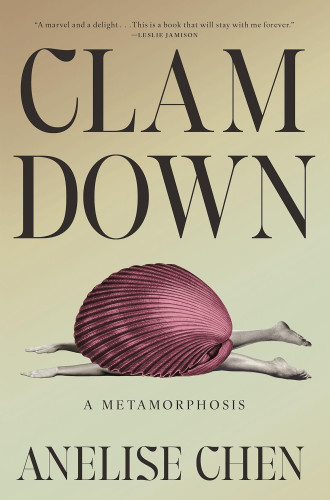
“She hadn’t meant to become a bivalve mollusk, but it happened,” opens Anelise Chen’s Clam Down. Echoing Kafka’s work in The Metamorphosis, Chen’s genre-defying memoir excavates the post-divorce metanoia of a writer who finds herself inexplicably transformed into a clam. The prompt for her transformation—her mother’s text messages to “clam down” in the wake of crisis—endows the typo with a certain kind of power to summon the protective covering of a shell, a place of retreat but also alienation. Clam Down is the work of a writer in more ways than one, interrogating the nature and form of narratives, metaphors, and family lineage. Chen’s family immigrated to the United States from Taipei when she was a child, and Clam Down also behaves as a story about the formative waters of immigration, and finding a way back to belonging.
Read our latest issue or browse back issues.

Metamorphosis
How Insects Are Changing Our World
In this treatise on the relationship between entomology and human innovation, which features photography and illustrations alongside storytelling, Erica McAlister and Adrian Washbourne look to the natural world, where insects and their astonishing abilities can enlarge our capacity to drive change. Each chapter focuses on an exploration of one specific insect and its historic connection to scientific, social, or technological advancement. Readers are in good hands with McAlister and Washbourne: McAlister is the principal curator of diptera at London’s Natural History Museum, and Washbourne produces award-winning documentaries. McAlister writes, “But insects aren’t just a name or a function—they are a form. And what a marvellous variety of form they exhibit. . . . It is this extraordinary variety that is at the heart of this book.”
Consider a quintessential symbol of transformation: the butterfly. Taxonomists have described 180,000 species of butterfly, and these creatures have captured our imaginations. Their wings have inspired bioengineers to create everything from iridescent pigments and antireflective coatings to self-cleaning surfaces, proving that beauty can sometimes have surprising applications. How Insects Are Changing Our World reminds me that all forms of life—human and otherwise—are intricately interwoven and worthy of our respect.

Metamorphosis
A Natural and Human History
Oren Harman, in the preface to Metamorphosis: A Natural and Human History, muses that he decided to write about metamorphosis because of the birth of his first child. “I was curious to uncover the scientific story of metamorphosis . . . but again and again, the human themes kept emerging. The science and philosophy and art of transformation seemed hopelessly entangled.” Anyone who has birthed a child or helped bring a child into the world can understand Harman’s sense of fascination with the many factors that converge to drive a miraculous shift in the world as we’ve previously known it. While this book covers the many creatures that undergo a metamorphosis (cicadas, frogs, and the endlessly intriguing immortal jellyfish, just to name a few), it explores questions asked by philosophers, theologians, scientists, and poets across time. Where do we come from? Where are we going? What is the self?
In his wide-ranging work, Harman turns to thinkers such as Ovid and Aristotle—but I was most fascinated to learn about 17th-century naturalist and trailblazer Maria Sibylla Merian. We have her to thank for, among other things, proving that insects did not spontaneously generate from mud.

Three Metamorphoses
Novellas in Verse and Prose
This textual triptych by Amit Majmudar is, in a word, stunning: it evokes a momentary pause, as if blinded by something beautiful and difficult to categorize in the mind’s eye. Majmudar re-creates origin stories from Islam, Christianity, and Hinduism in lyrical prose and verse that contains all the heft of mythic significance, while he somehow simultaneously manages to leave a light touch. The notion of an unbearable lightness of being comes to mind when faced with the prompt to reconsider familiar (and unfamiliar) narratives shaping the questions that possess and disrupt us.
As Hawwa and Adam’s story in the garden comes into focus, I felt a surge of (dare I say) rage at the way the serpent narrates Hawwa’s dilemma: “Allah thought of her as Adam’s pet. Adam thought of her as a distraction. If the boys had played with her a little, she wouldn’t have followed a stranger.” This framing brings forward the roots of misogyny in some of our interpretations of original sin, a wound we are still attempting to drain. If you’re comfortable holding tension, fascination, and tender revelations in the same hand, Three Metamorphoses is a text to surrender to.

Metamorphoses Reimagined
Perhaps no other book has been more influential on Western literature than Ovid’s Metamorphoses. Comprising 15 books total, the original Latin text details a mythic history of the world from creation to the apotheosis of Julius Caesar. Gods, humans, plants, and animals intermingle and morph, shape-shifting into figures meant to help us better understand what it is to be human. Metamorphoses Reimagined takes Ovid’s seminal masterpiece and asks, “How to make, or to let, metamorphoses (and Metamorphoses) metamorphose?” The question of transformation is one that every translator of a text must wrestle with, and Michael Marder describes his work with an attentive, trustworthy acumen. Having only read excerpts of Ovid’s Metamorphoses in the distant past of my undergraduate days, I can’t speak to the specific shifts of Marder’s creative reimagining with anything broaching authority. But, the opportunity to rediscover Greco-Roman myths—like that of Narcissus, Daphne, and Andromeda and Perseus—should tempt readers to “discern the folds and ramifications of an ancient text, the text of transformations, of metamorphoses interwoven as threads in the fabric of life and death.”