Books

Not homeless enough to count

Brian Goldstone shows how America’s housing system renders five working families in Atlanta invisible even as they teeter on the brink of collapse.

Annually, the US Department of Housing and Urban Development conducts a point-in-time count. Across the nation, volunteers disperse to tally heads. They may encounter two unhoused Black men trundling their bedrolls in a shopping cart, seven runaway teens squatting in an abandoned mill, four veterans showering in the public library sink, or one White woman in a wheelchair experiencing a mental health crisis under a bridge. The official math determines how federal dollars get allocated—and this entrenches the myopic, decades-long definition of who is homeless.

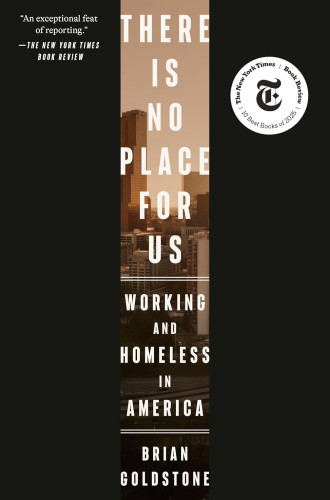
The only thing worse than having your plight reduced to a number is not being counted at all. In his monumental work There Is No Place for Us, anthropologist Brian Goldstone organizes his nonfiction narrative around the statistically invisible: the women, children, and men who, according to HUD, aren’t officially homeless (i.e., sleeping either in designated shelters or in places not meant for human habitation) but who contend with chronic housing precarity while hustling at full-time jobs.

Set in rapidly gentrifying metropolitan Atlanta—the first US city to build, defund, and bulldoze public housing—Goldstone’s narrative follows five families, all victims of predatory capitalism, as they negotiate how expensive it is to be poor. Refusing to investigate from afar, Goldstone exposes the infuriating fallacy in the myth of American meritocracy.
Britt Wilkinson (the protagonists’ real names are protected) works at Low Country, a restaurant at Hartsfield-­Jackson Atlanta International Airport. She hires babysitters and negotiates an hour-long bus ride just to clock in and earn minimum wage without benefits. With the median rent for a one-bedroom apartment at $1,600, she knows Section 8 housing is her family’s only chance. Against the odds, her number is called in the housing choice voucher lottery. Yet, after two years on the waitlist and furious attempts to secure an apartment, she surrenders her voucher without finding a consenting landlord.

Celeste Walker’s landlord demands she pay two months’ rent and forfeit the security deposit after a former partner burned down her rental house. Unwilling to waste her paycheck from stacking boxes at a warehouse on a lot of charred rubble, she’s evicted post-fire. With a scarlet “E” on her record and a plummeting credit score, she toils in line at the Gateway Center, Atlanta’s point of coordinated entry for support. But her VI-SPDAT score, a vulnerability index, is too low, and she’s denied assistance for not being homeless enough.

Natalia and Maurice Taylor, priced out of Washington, DC, move south in search of affordability. North of Atlanta in Sandy Springs, the Taylors discover a suitable condominium to rent. With jobs at State Farm and Enterprise, they nurture a home with their three children—until the property owner notifies them of an immediate sale. (Between 2010 and 2023, 60,000 units renting for $1,250 or less per month in Atlanta vanished.) For the Taylors, the boom economy, dependent on entry-level labor, pushes their family out of a revitalizing neighborhood and into a crisis of poverty.

While the descent into a “shadow realm” differs for each family—exhausting savings on risk management fees, Craigslist scams, writs of possession, forced expulsion at gunpoint—most succumb, against their will, to the pernicious “hotel trap.” By gouging the vulnerable, extended stay hotels extort $2,200 a month from their guests. Out of options, defeated renters surrender to these squalid for-profit homeless shelters, single-room efficiencies replete with encroaching black mold and spark-prone outlets.

Leaning on a rusted second-floor railing, staring off into another bleak afternoon, hotel renters ache for an escape from their “expensive prison.” Since Atlanta is a redevelopment darling, unbridled in its attempts to court the affluent to its inner city, perhaps a new area code for the cost-burdened would help. But, as Goldstone retorts in his most devastating sentence, “today there isn’t a single state, metropolitan area, or county in the United States where a full-time worker earning the local minimum wage can afford a two-bedroom apartment.”

Rather than rushing off toward resurrection with policy solutions, Goldstone forces the reader to hold the intractability of it all, maintaining empathic proximity with each family. Alongside them, reeling from the casualties of a market-driven system that rewards racialized discrimination and the commodification of what should be a human right, we are haunted by an awful thought: Was affordable housing marginally more accessible, despite the evils of redlining and urban renewal, before the government turned development over to the profiteering private sector?

For confronting us with an America where there’s still only room at the inn for the wealthy, we are indebted to Goldstone’s essential work exposing the truth. This book isn’t just worthy of our attention; it’s worthy of our outrage. 

Brian Martinez de la Combs

Brian Martinez de la Combs is the founding pastor of Haywood Street Congregation, an urban ministry in Asheville, North Carolina.

All articles »