Not long ago, I was attending a Methodist service, and during the sermon I heard these words: “Jesus came to make the message of God known to the world.” It’s a familiar statement, and it was offered without controversy, almost as a given. And yet, sitting there as a Jewish writer and researcher, I couldn’t help but wonder: Have we lost an older story? A story in which Judaism, too, once crossed land and sea to share a message meant not only for those born Jewish but for all humanity?
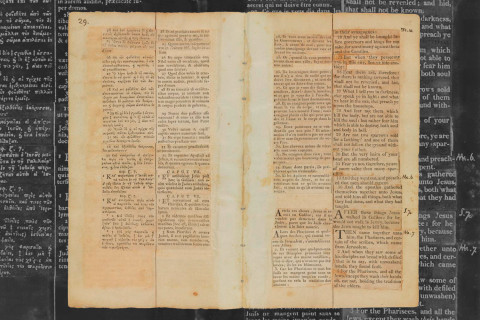
That moment brought me back to something Jesus says in the Gospel of Matthew that I’ve long found fascinating: “Woe to you, scribes and Pharisees, hypocrites! For you cross sea and land to make a single convert” (23:15). Jesus’ words here are often cited in relation to his broader critique of the Pharisees. But they also reveal something else: that Jews in Jesus’ time were actively seeking converts. Judaism, in other words, was not always as inwardly focused as later history might suggest. Judaism had a universalist vision.

Read our latest issue or browse back issues.
I don’t mean universalist in the sense that all people are saved through Judaism regardless of their background or faith. I mean that Judaism offers a spiritual and ethical path open to all who are drawn to it—not only those born into it. Historians such as Shaye J. D. Cohen and Louis H. Feldman have found substantial evidence that Judaism in the Roman period—especially before the Bar Kokhba revolt—was remarkably open to converts. Jewish communities spanned the Mediterranean, and some scholars suggest that at various points in the early Roman era, as much as 10 percent of the empire’s population may have engaged with Jewish teachings or practices. This openness existed long before Christianity emerged as a distinct religion. What, then, happened to that expansive impulse?
The spiritual and cultural appeal of Judaism during this period was complex. The Mediterranean world of the late second century BCE to the second century CE was defined by large empires—Seleucid, Ptolemaic, Roman—that brought together diverse peoples under shared governance. These empires, while remembered for their occasional persecution of Jews, were often relatively tolerant, allowing Jewish communities to flourish, particularly in places like Egypt, where Jews held significant influence. In that world, many gentiles sought spiritual and ethical alternatives to the polytheistic systems around them.
Judaism offered a monotheistic vision of the Divine that was strikingly different. In a religious world shaped by city gods, imperial cults, and secretive mystery rites, Judaism taught that all people are created in the image of one God—and that anyone could enter into relationship with the Divine. Its ethical demands were not secret knowledge reserved for initiates but public laws meant to guide daily life. While Greco-Roman religions emphasized values like duty, family, and honor, Judaism offered a strikingly different moral vision—one grounded in the belief that all people are equal before God, bound by a shared moral and ritual life rooted in the written and oral Torah, and endowed with dignity across class, ethnicity, and origin (Pirkei Avot 3:14). Non-Jews drawn to these teachings were known in some sources as “God-fearers”—admirers who sometimes became formal converts. Unlike the emerging Christian church, which removed barriers like circumcision after the first Council of Jerusalem (Acts 15), Judaism retained its rigorous practices even as it extended an invitation to outsiders.
This complexity makes Judaism’s appeal all the more remarkable. In Greek and Roman societies where public bathing, nudity, and the gymnasium were deeply embedded in daily life, circumcision and sabbath observance marked Jews—and converts to Judaism—as profoundly countercultural. Yet conversion still occurred at rates significant enough to draw attention from Roman historians.
The story of Queen Helena of Adiabene embodies this balance of openness and commitment. A royal figure of high social standing, she is remembered not only for her conversion but for her contributions to the Jewish people—supporting famine relief in Jerusalem and donating treasures to the temple. Converts like Helena did not simply join the community; they shaped it.
The shift away from universalism came not through theological evolution but through historical trauma. After a series of failed revolts and the rise of Christianity as Rome’s state religion, laws were enacted that forbade Jewish proselytism. Centuries of marginalization followed. The universalist vision faded—not because it lacked spiritual merit, but because history made it dangerous. Even so, conversions to Judaism continued—especially in regions far removed from the reach of imperial suppression, including parts of North Africa, Yemen, and later, Central Asia.
The universalist vision never fully vanished. One of Judaism’s most enduring liturgical texts, the Aleinu—recited at the conclusion of all three daily services—preserves a powerful universalist hope:
And all living flesh shall call upon Your name, to turn all the earth’s wicked toward You. All who dwell on earth shall recognize and know that to You every knee must bow, every tongue swear loyalty. Before You, they shall bow and kneel and give honor to Your glorious name, and they shall all accept the yoke of Your kingship. And You shall reign over them soon and forever.
Centuries after this prayer was first included in Jewish liturgy, late 19th-century American Reform Jewish leaders began to center Judaism’s universalist past more explicitly. In the pages of The American Israelite—an English-language newspaper published in Cincinnati and a major platform for Reform thought—writers argued that Judaism once had a global message and might again. A series of translated essays from historian Heinrich Graetz, for example, affirmed the wide reach of Jewish outreach in the Roman era and emphasized that this appeal was rooted in Jewish ethics and theology—not coercion or conquest. One essay noted that the very existence of widespread proselytes in Rome, despite social penalties, spoke to Judaism’s spiritual power. Others referenced Matthew 23 not as a critique to be avoided but as a historical witness to a once-expansive Jewish mission—its full meaning, they wrote, “yet unexplained” but not to be dismissed. Reform thinkers saw in this history a foundation for renewed confidence: Judaism, far from being a closed faith, had once called the world to covenant and could do so again.
This conversation continued into the early 20th century, particularly before the rise of fascism and the Holocaust shifted the American Jewish community’s focus inward. One notable example appeared in 1913, when The American Israelite returned to the question of Jewish universalism. A review of recent historical scholarship highlighted extensive evidence for Jewish proselytism across centuries—from medieval gravestones to the prayer for the righteous proselyte in the Amidah and references in rabbinic responsa. The article cites writings by Tertullian alongside Matthew 23:15 as confirmation of widespread Jewish outreach. It also cites Horace as an external source acknowledging Jewish influence on gentiles and notes that conversions were once so frequent that special blessings were added to synagogue liturgies.
Today, we find ourselves again in a time of profound spiritual searching. In pluralistic societies like the United States, many are seeking religious traditions that offer not only comfort but depth—an ethical, disciplined framework through which to live meaningful lives. This longing is already reshaping religious landscapes. Orthodox Christianity is quietly growing in the United States, driven largely by conversions. Many new adherents have no ancestral ties to the tradition but are drawn to its ancient liturgies, rigorous disciplines, and countercultural moral clarity. According to recent reporting in The Wall Street Journal, some parishes have grown by as much as 15 percent in a single year. Many of these converts describe themselves as finding, at last, a spiritual home after long searching—suggesting that the hunger for rooted, demanding forms of faith is real and growing.
Judaism, too, has begun to experience a quiet renewal of this ancient openness. More individuals are converting to Judaism today than at any point since the Roman era—even though Jewish communities, as a whole, rarely promote or actively seek converts. This reality reveals something important: that Judaism’s distinctiveness—including its rigorous practices, emphasis on action in this life, and theological rejection of concepts in Christianity like original sin and vicarious atonement—is for some seekers not a barrier but a beacon. Many contemporary Christian communities have reexamined or softened their interpretation of such doctrines. Still, in many others, they remain central—and for those who wrestle with them, Judaism may offer a compelling spiritual path.
For those disillusioned with certain Christian doctrines—or for those seeking a faith that, from its most orthodox to its most liberal forms, widely invites questioning and wrestles with ethical responsibility without demanding dogmatic certainty—Judaism presents a powerful alternative. Judaism does not resolve mystery through doctrine; it dignifies the struggle through questioning. It offers a relationship with the Divine rooted in justice, history, and collective memory—an invitation not to ease but to covenantal life.
I know this not only from history but from personal experience. I grew up in a town where Jewish communal life had disappeared; the only local synagogue closed years before I was born. Yet even in that absence, I found myself drawn to Jewish ideas. Eventually, after moving to a city with a larger Jewish community, I formally converted. Mine is not an isolated story. Across time and continents, others have found their way to Judaism in unlikely circumstances—from the Jews of San Nicandro in Italy, to the B’nai Moshe in Peru, to Subbotnik communities in Russia. Converts have often been the unlikely witnesses to Judaism’s quiet universalism, carrying its teachings forward even when formal outreach was forbidden or forgotten.
The idea that Judaism is merely a closed faith with no global vision is, in part, a lingering remnant of supersessionist theology. Before centuries of persecution made openness dangerous, Judaism reached across land and sea to welcome those who sought God. And even under the weight of exile and suppression, seekers continued to find their way to its doors. Today, those doors are still open, even if not always advertised. Converts to Judaism are increasingly organizing, writing, and finding community. In Facebook groups, memoirs, and congregational life, a quiet but vital revival of Jewish universalism is unfolding—not through aggressive proselytism but through welcome and witness.
In many ways, reclaiming Judaism’s ancient universalism is not about changing Judaism to fit the modern world. It is about remembering a deeper truth that goes back to the book of Isaiah: “My house shall be called a house of prayer for all peoples” (56:7). That vision—ancient yet unfinished—calls across centuries to those seeking a home for their questions, their commitments, and their longing for covenantal life.
There is, I believe, something waiting to be rediscovered. Judaism once opened its arms to the world—not through conquest or marketing but through conviction. Its vision was always both particular and expansive, calling people to covenant while inviting them into community. That vision has never fully disappeared, but it has often been misunderstood. Even today, many still assume that conversion to Judaism must be driven by marriage or reclaiming an ancestral heritage. And yet, across generations and geographies, people have heard the ancient call and responded—sometimes in secret, sometimes in silence, and sometimes, as in my case, with the support of others.
When I first began exploring Judaism, some in my family were deeply concerned. A few worried I was moving outside God’s grace. But a Methodist minister in my hometown offered another view: that God was indeed speaking to me, and that I should keep walking. Over time, even those closest to me began to see this path not as a rejection of faith but as a deepening of it. My Christian godparents attended my conversion ceremony. Conversations opened, boundaries softened. What could have remained a rift became a bridge.
Much of my life—my work, my marriage, my sense of spiritual belonging—has grown from the soil of that journey. It has been long and serious but also filled with grace. And that grace, I now believe, is exactly what Isaiah saw. Centuries before Christ, that line about “a house of prayer for all peoples” rang out from the heart of Judaism. And even now, that call continues to reach those still searching for a home they didn’t know they were allowed to find.