
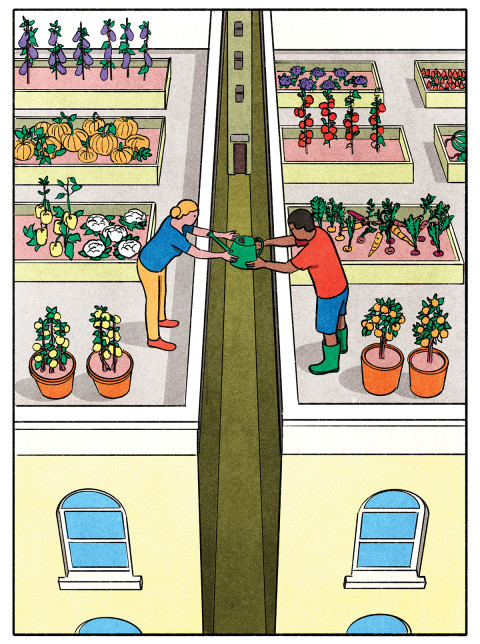
Cultivating a shared vision of the common good is a deeply local task. The key to human flourishing is not located beyond the stars (if only we could build ideological spaceships to capture it). Communities thrive when we turn our gaze horizontally toward our neighbors and the world around us, when we believe that contained in every person is an endless galaxy of beliefs and experiences, of joys and sorrows, of fears and comforts.
Before we can love our neighbors, we must desire to know them. We must allow ourselves to be drawn into the vast expanse of their infinity just as they are drawn into ours. This work not only changes what we believe about our neighbors, it also transforms how we relate to them. They are no longer enemies to fight; they are people to love. They are no longer social media handles or digital avatars; they are complex humans who are motivated by their deep values and their felt vulnerabilities.
Read our latest issue or browse back issues.
Seeking the common good through the local practice of neighbor love is messy and complicated work. How do I love my neighbor across the street whose house is adorned with MAGA signs? Does that differ from how I love my neighbor with a multicolored Pride flag? How do I love the barista at the neighborhood coffee shop who consistently provides me with a delicious cortado, the unhoused person who often stands at the highway exit on my route home, the pastor down the road who pours her heart and soul out every Sunday? There is no easy answer to any of these questions.
It would be far easier to remain aloof and simply read about our “neighbors” in books and surveys or make assumptions about them based on their yard signs. However, our shared flourishing is impossible unless we choose to enter into a common life where we are formed by and toward one another. Cultivating a truly common good requires entering into humble proximity where our beliefs and assumptions about one another are challenged by the lived experiences of our neighbors.
In Being and Time, philosopher Martin Heidegger identifies the experience of “thrownness.” This language aptly describes the experience: a sense of being tossed into the world like a rock down a steep forest slope, knocking against trees and hurling through thick brush. Thrownness is the humbling moment when we become aware of all the countless forces and choices that act upon us. It arises when we stop and ask ourselves, How did I get here? It is the realization that we are who we are because of the people around us and the places we exist.
Thrownness, though, goes two ways. We are not only thrown, we are also throwers. As the world acts upon us, we also act upon the world. By interacting with others, we become one of many forces that our friends and neighbors recognize in their own experience of thrownness. There is relational reciprocity here of giving and receiving, of acting and being acted upon. Thrownness reminds us that we are always dependent on our environment, never above or beyond its formative power. We are enmeshed in tangled webs of interdependence where we are at once being formed and forming others. Recognizing our thrownness humbles us.
This is why I find the incarnation deeply moving. God, the original and ultimate thrower, enters into the thrownness of the world. Rather than standing outside the waves and ripples of cause and effect, Jesus enters the rotations of a world that he set in motion. Christ exists as both creator and creation, divinity and human. Christ does not come to us in a cloud of glory or place himself on an earthly throne. Instead, Jesus humbles himself into Mary’s womb and is birthed into the world he created at the beginning of time. He places himself in John’s arms and is plunged into the Jordan River. He empties himself in taking human likeness and walks with his creation even to the point of death (Phil. 2:7–8). God so intimately enters this world that the world is transformed by God’s touch, and God, in return, is moved by the world.
Christian Wiman puts it simply: Christ is contingent.
Christ’s contingency should humble us, too. In a world that prioritizes individualism and uplifts self-autonomy, Christ chooses to become dependent upon creation—upon oxygen in his lungs and food in his stomach, upon friendships to nourish his soul and human feet to carry forth the gospel into the world. Christ is wrapped up with creation so intimately that he weeps and mourns at the death of his friend Lazarus. He grows tired and weary after a long day. Righteous fury boils within him when he sees houses of worship used for profit or human beings maligned and abused. Jesus also laughs and entertains his friends. He dances and sings at a wedding feast after turning water into the sweetest wine. He places his human body between people in need and those ready to throw stones. He takes time to sit with the children and the least, teaching that the kingdom of God belongs to them. God humbles himself to be with us—and does so at the greatest cost to himself.
Years ago, a wise professor named Michael McDuffee said something about humility that I will never forget. He said, “God permits himself to be a question mark in the mind of those he has created by his own hand. This is the greatest act of humility the world will ever know. How far will you descend? How far will you rise? You can do neither more than God himself, who is exalted on high and the lowest of servants.” Humility is the sapling that grows out of the recognition that we are not our own; we are bound to one another. Our roots are dug into the same earth. Our flourishing is wrapped up with the flourishing of others.
Loving our neighbors in humility recognizes the countless ways we belong to one another and are molded by the people around us. Such love erupts from the daily practice of remembering that, as Kenda Creasy Dean puts it, “we are participating, at Christ’s invitation, in redemption that God already has well underway.” Our humility follows the example of God in Jesus Christ, who descends from the heavens to encounter the world enfleshed.
Theologians speak of Jesus Christ as the logos incarnandus: a God who was, is, and ever will be bound toward enfleshment. Jesus is the goodness and love of God given to us, mysteriously united with the flesh and blood of creation. The incarnation is the intimate entrance of the Creator into the chaos, not to control it but to smell, touch, taste, see, heal, and love. Christ comes in the vulnerability of hope, offering a better way to be in this world for those who will listen. In the incarnation, we see God’s desire to be local, to dwell in the neighborhood.
But why? Why does our good God come to us enfleshed? Why does God humble Godself to the form of creation? Why does God dive into the waves of cause and effect set in motion by God’s very breath? Why does God desire a body that can be broken and bruised, that demands nourishment and rest? Why does God choose to break bread and heal the sick with calloused hands?
The answer is simple and profoundly beautiful: to give it all away.
God does not come to us because there was something for God to gain or prove to us. God comes to us in Jesus Christ so that we might gain God. Everything Jesus does is for the sake of others. Like God’s act of creation, God builds, makes, and gives life so that creation can be enjoyed rather than possessed. God does not come to dominate creation, forcing it to love the Creator. God comes to offer us an opportunity to experience the intimate joy of choosing to love God. Goodness exists to be given away.
The example of Christ is a model for us today as we seek the good of our neighbors, finding and giving goodness away just as Jesus did. We sometimes assume that the work of seeking the common good is reserved for academics, politicians, activists, and best-selling authors. We imagine that the work of cultivating this vision takes place in executive suites, boardrooms, and capitol buildings. It can be difficult these days to imagine that we have any agency at all when it comes to the flourishing of our communities.
But Jesus’ example tells us the opposite. To cast a vision of this common life, Christ does not take his message to the rulers and emperors of Rome or pen a long treatise to be read in the halls of power. Rather, in his earthly ministry, the light of Christ reveals that goodness is present in a place that the political powers and religious elites cannot fathom, the kind of space that cultural theorists Fred Moten and Stefano Harney have dubbed “the undercommons.”
Jesus goes to the well in the heat of the day and offers a Samaritan woman the waters of eternal life (John 4). He beckons the tax collector Zacchaeus to come down from the sycamore tree and asks to share a meal with him (Luke 19). Before religious leaders enact violence, Jesus places his body between a woman caught in adultery and a stone-wielding crowd (John 8). Jesus draws near those deemed impure by Levitical law and reaches out his hand to touch and heal them (Mark 1; Luke 8). When a woman anoints Jesus’ feet with expensive perfume, he reminds those angered by this act that he is preparing for his burial and that this woman will be remembered whenever his good news is proclaimed (Matt. 26).
To find the goodness in our world, Jesus goes to the margins of society to commune with people deemed impure. The first to hear Jesus’ gospel of a coming kingdom are not those with tremendous influence and power but those humble enough to hear and respond.
Jesus, though, doesn’t stop there. Echoing God’s proclamation of creation’s goodness in Genesis, Jesus takes the ordinary things of our world and treats them as sacred and good. When asked about the deep things of God, Jesus does not look for an image or idea beyond our world. As poet and theologian Rubem Alves puts it, “We expected that he would talk about divine things. But he talks only about human things. Little ones. About the delights of heaven and the terrors of hell only a discreet murmur, if not silence.” Alves continues:
He speaks of the tranquility of the birds, the beauty of the wild flowers, the sun that rises on the good and the evil, the rain, as well. And he tells us about children whose games are dancing and playing flutes; he goes to parties, introduces in the midst of the celebration his own wine; he speaks of purity of heart; points out that life is more important than laws; is saddened with our anguish, fear of the future, desire to run things and be seen, wish to be more important; he prefers the company of the marginal and the despised to the bowing and scraping of those who use sacred deodorants; he laughs at the powerful (even knowing its risks); rather the adulterer who sinned for love than those who, virtuous from age and from fear, stand with rocks in their hands; he eats and drinks with ordinary people, speaks in an enigmatic manner, knowing that pearls should not be cast before swine (to the pigs, slop); he tells frightful stories in which the villains of real life always appear as heroes and the heroes of real life always appear as villains. But these are things of this world, about men and women, children and old people, animals and trees. Right. He talks about our world. About life. About our bodies. He talks about smiles and tears.
When asked, “Who are you?” Jesus does not answer us with long-winded theological jargon. Instead, Alves notes, Jesus speaks about his desires. He tells us his dreams.
Alves reminds us that theory and theology proposed from a distance will do little for us as we cultivate localized visions of the common good. Jesus of Nazareth models a tangible, neighborhood-driven theology that speaks to the deep stories we tell about ourselves and the world around us. He calls us to formulate lived theologies that recognize our experiences and embrace our particular contexts, to take what we believe about God and place it on the ground as we live out our calling to love, goodness, and community.
God is active and working in the world today. This redemptive and sacred work cannot be contained in a single place or people. Our task is to join God in it as we seek this good in and for our community through radical practices of neighbor love. Seeing God’s goodness frees us to pursue the goodness found in all of our neighbors, who possess and portray the image of God, and throughout our world, which reflects the glory of God.
This article is adapted from Peterman’s Becoming Neighbors: The Common Good Made Local, © 2026 (Wm. B. Eerdmans Publishing Co.). Reprinted with permission from the publisher.
********************
Amar Peterman joins the Century's community engagement editor Jon Mathieu to wrestle with some big questions. What does it actually mean to be a neighbor, to love those around us? Can we hope to live as neighbors in these times?