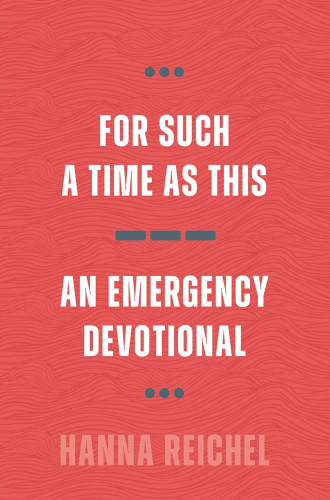
For Such a Time as This
An Emergency Devotional
For the better part of a year, I’ve hoped that someone would write a book that offers the right kind of wisdom to speak truth in the right kind of way to the wrong kind of political power the United States is growing accustomed to. My hope stems from a personal quest to keep seeking fresh ways to inspire beleaguered people tired of feeling powerless in the midst of disappearing democratic norms. When I’m asked how I respond to challenging times, I share my own convictions and Christian resolve, but never with the linguistic clarity or historical insight I’ve longed for someone to package.
That clarity has arrived with Hanna Reichel’s powerful little book, For Such a Time as This: An Emergency Devotional. It’s a small book, reminiscent in size and purpose to that funny series of little how-to paperbacks a couple decades ago that helped readers learn how to perform ridiculously challenging tasks like a self-appendectomy. Except Reichel’s book isn’t funny. Observant readers will notice the Morse code for SOS integrated into the cover design. The book does bear a how-to character, however; it is something of a first aid kit for “regular people” (Reichel’s term) who are trying to reckon with an imperial presidency.
Read our latest issue or browse back issues.
Reichel is currently professor of systematic theology at Princeton Theological Seminary but has lived around the world. Born and raised in Germany and trained at Heidelberg University, this scholar knows firsthand the historical burden of having relatives who were once a part of the Nazi enterprise. Reichel has studied the triumphs and failures of the German church as well as the tactics of totalitarian leaders who like to control public and private thoughts and feelings by creating various states of emergency. The impetus for the book stems from Reichel’s study of various 20th-century theological titans—Barth, Bonhoeffer, and Niemöller, among others—who resisted National Socialist ideologies by remaining faithful to their own deep religious convictions.

Part of the genius of this book is that Donald Trump never receives a mention, a refreshing move since Trump’s muscular rhetoric and shock and awe strategies inform so many critiques of the present moment. Reichel is not a political analyst and has no desire to become one, preferring instead to remind readers of key practices the Christian faith offers. What the reader is left with is practical and spiritual advice that’s at once urgent and honest.
Twenty-eight chapters, many of them no more than three or four pages in length, constitute the bulk of insights, with the last third of the book providing a useful study guide. Compared to Reichel’s larger works, the writing in this volume is decidedly crisp. Clipped sentences. Pithy insights. No long-winded explanations. The work functions as an antidote to the paralysis and numbing desensitization that many people feel when they’ve run out of outrage. Instead of throwing up our hands in the face of unrestrained power that seems obsessed with demonizing other people, Reichel encourages readers to nurture a capacity for courage and critical thinking. An urgent refrain runs through this very unconventional devotional: Don’t allow authoritarian powers to reign with little pushback, lest they control your emotions and fashion reactions and responses for you. By all means, don’t be a bystander. Christians belong out in the world. So “get out of yourself,” counsels Reichel. “What you can do is more important than keeping your hands clean.”
There are plenty of imperatives in the book, some gentle and some forceful but always wise in nature and often accompanied with biblical insight. In a section on finding calm: “Follow the news, but limit your exposure. Ask yourself: Am I gaining important information, or am I giving away my attention? Am I focusing on what matters, or am I just getting dizzy?” In another section encouraging us to find our own rich and expansive language that won’t capitulate to panic: “Take care that the way you talk about others and the world reflects who you want to be . . . . Rephrase instead of repeating. Respond instead of reacting.” In another section on social media posting: “Are you communicating something specific to specific someones—or are you just posting out of inner restlessness? Are you building relationships—or are you just skywriting to not feel disconnected?”
There’s even a reminder that joy can serve as protection from reactions to trauma that tend to harden the heart. “Let [joy] roar through your life . . . laugh vibrantly, celebrate unabashedly, enjoy fully, and love without restraint.”
I can imagine myself using the 45-page study guide in the back of the book as a resource for discussion groups and faith communities eager to wrestle together with what difference the cross of Christ makes for believing people. For each chapter, Reichel provides questions, a vast array of resources for exploring issues further, and particular commitments to try on and try out.
For those who are demoralized or overwhelmed by trying to live faithfully in a volatile, divided, and pessimistic political moment, there’s no time like now for taking to heart For Such a Time as This.