In the season of Advent and the days after Christmas, I typically tell Christians who are wanting to dive deeper into texts about Jesus’ birth to give the Qur’an a try. Not only is Jesus treated with reverence in the text, but facts like the virgin birth are even retained in the Qur’anic telling. In this season of the holy birth, the Qur’an even gives us a Jesus who speaks from the cradle and a Mary with even more importance than the biblical narrative.
That advice is usually met with a mix of skepticism and surprise, as Christians are not used to looking outside of their tradition for meaningful reflections on their most sacred figures. Yet, I have found as a pastor and a theologian that it is precisely by looking at other faiths and learning from them that we can come to better appreciate our own stories, even developing some of what Krister Stendahl and Barbara Brown Taylor call “holy envy.”
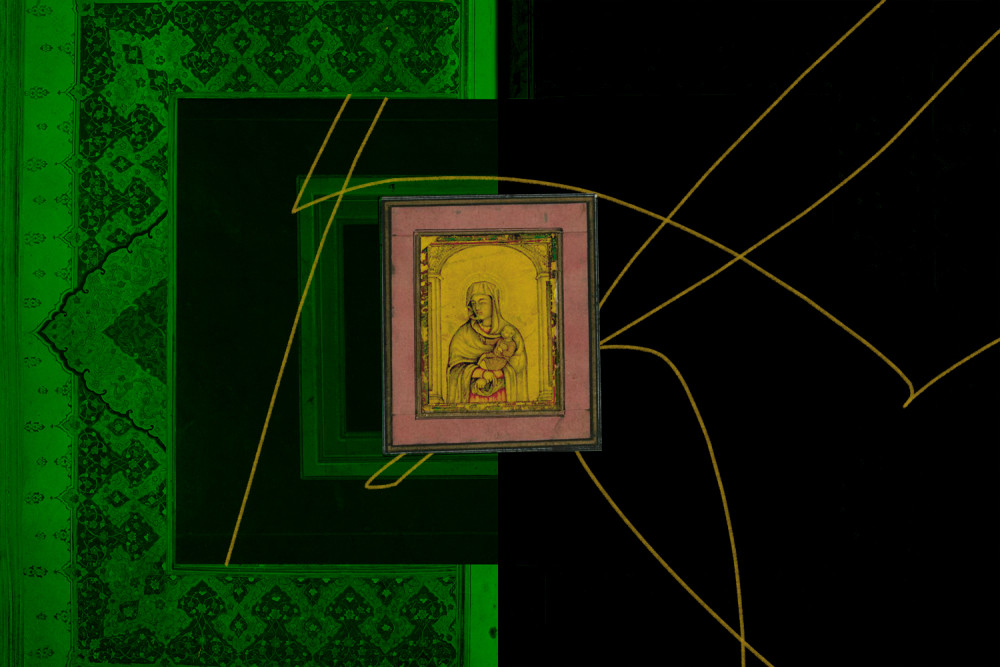
For such an important figure in Christianity, Mary gets startlingly little time at the narrative center of the Bible. It’s a little different in the Qur’an; Mary even has her own chapter called Surrah Maryam, the only chapter named for a woman. Jesus is even identified as the “son of Mary” in the Qur’an (Q 19:34), a subversion of the typical patriarchal naming patterns that we see in the Bible.

While the chapter features plenty of the most familiar events in the lead-up to the birth of Jesus, it also tells stories that Christians are likely to be unfamiliar with. In fact, the chapter features one of the most beautiful interactions between the Divine and humans that I have ever encountered:
She wondered, “How can I have a son when no man has ever touched me, nor am I unchaste?” He replied, “So will it be! Your Lord says, ‘It is easy for Me. And so will We make him a sign for humanity and a mercy from Us.’ It is a matter ˹already˺ decreed.” So she conceived him and withdrew with him to a remote place. Then the pains of labour drove her to the trunk of a palm tree. She cried, “Alas! I wish I had died before this, and was a thing long forgotten!” So a voice reassured her from below her, “Do not grieve! Your Lord has provided a stream at your feet. And shake the trunk of this palm tree towards you, it will drop fresh, ripe dates upon you. So eat and drink, and put your heart at ease." - (Q 19: 20-26)
One of the things that is missing from the biblical account of Jesus’ birth is his actual birth and Mary’s labor, but here it is made central. Moreover, God’s essential character is revealed to be compassionate. Not only does God tend to our souls, but also our bodies. The one for whom it is easy to do the miraculous does not look past our embodied nature, but instead embraces it and cares for us in ways that are perhaps more tender than we are used to in the Bible. That makes the characters of scripture less removed from our everyday human experience and connects us to them in exciting ways.
At Christmastide, I always like to read such stories in worship as dialogue partners for our lectionary readings, and one in particular always feeds my sense of awe. It would not be an exaggeration to suggest that almost from the beginning of Christianity, we have been seeking more information about Jesus’ childhood. How else could you explain the Infancy Gospel of Thomas? The Gospels give us surprisingly little information to work with when it comes to Jesus’ childhood, but the Qur’an offers some glimpses.
In addition to a story about clay birds being brought to life, we also get a Jesus who speaks from the cradle in order to share his divine mission of the prophet in the Qur’an: “So she pointed to the baby. They exclaimed, ‘How can we talk to someone who is an infant in the cradle?’ Jesus declared, ‘I am truly a servant of Allah. He has destined me to be given the Scripture and to be a prophet’” (Q 19: 29-30).
Such moments in scripture, whether in our own tradition or another, ought to awaken in us a sense of awe and appreciation. Personally, it has made my faith more capacious to encounter the holy in other traditions, tracing both the ways that its truth coincides with what my tradition teaches, or offers a critique or other way of believing. Both outcomes are beneficial because they make my faith living and adaptable as opposed to static.
God seems more real to me when I encounter other traditions’ reflections on what God is like. That is what I think Max Muller was getting at when he said, “whoever knows one religion knows none.” It is in comparison that we are invited to a deeper relationship with our own tradition, putting it into dialogue with nuanced and interesting understandings of the divine.
It is particularly important to engage in interfaith comparison and dialogue with Islam because Islamophobia continues to be such a pressing concern in our country. The latest Institute for Social Policy and Understanding American Muslim poll shows that Islamophobia increased by several points in the United States, but it increased by an even greater percentage amongst Christians.
One of the ways that we can counter this is by situating Islam as a peer tradition with nuanced understandings of God that are worth encountering, wrestling with, and revering. Churches in particular have an outsized role to play in this work because they are where many Christians first learn how to perceive Islam, and they can powerfully shape attitudes towards a Muslim community that faces high levels of discrimination and is the least highly regarded religious tradition in the United States.
That is not to say that Christians ought to take up this work for others, although that is a venerable and important thing to do. Christians can benefit from this encounter by being pushed to learn more about their tradition. I confess I never thought much about the Trinity before I started reading classical Muslim critiques of it. I was comfortable simply chalking it up to a mystery, but these critiques pushed me to take seriously what my own tradition had to say.
A similar example: I’ve always struggled with wanting more answers than I receive from prayer. It was my Muslim friends who taught me to think of prayer differently. After an interfaith event, my friend told me, “Christians seem to be looking to hear something from God, but when we pray, we are content to simply offer our prayers to God and trust that they are heard.” Ever since, I’ve been more at ease with my prayer life and have drawn much closer to God spiritually.
No two traditions are the same, but that is what makes them such interesting dialogue partners. I have attended many interfaith events that I call “falafel interfaith,” where we mostly eat falafel and talk about the things that unite us. Those events are important, but what has been most useful for my spiritual growth are the points where we disagree. Put differently, if Islam and Christianity agree on 80 percent of things, then that forces Christians to articulate why the remaining 20 percent matters to us as people of faith.
Those conversations make it clear that pluralism is not dependent on sameness. Christians, as the hegemonic religious power in the United States, are used to being the starting point for comparison and conversation, but we can be more generous conversation partners by being committed to exploring the ways that we are different and celebrating those differences.
It seems to me that God must delight in diversity. There are so many races, languages, and ethnicities in the world, and that delight must also be experienced by God when it comes to religion. There are so many different ways of naming the divine, of experiencing the awe of what it means to be human. It’s time we as Christians embraced that diversity, not only for the good of others, but so that we can be better Christians.