

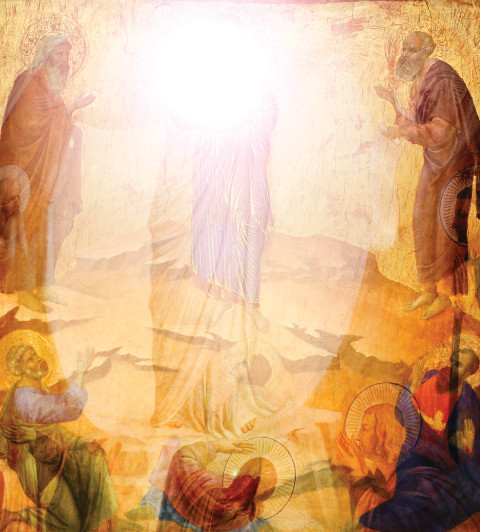
“He was transfigured before them,” the scripture says (Mark 9:2; Matt. 17:2). The Greek word is not fancy: metemorphothe, from which we get the word metamorphosis. It means “changed”: The caterpillar is changed into a butterfly. It is a metamorphosis.
This is what seems to happen to Jesus. The caterpillar Messiah—who was poor and persecuted, who once said of himself, “the Son of Man has nowhere to lay his head” (Luke 9:58), of whom Christians (borrowing from Isa. 53:2) said, “he had no form or majesty that we should look at him”—that one is suddenly changed from caterpillar to butterfly. Suddenly he is beautiful, shining like the sun.
Read our latest issue or browse back issues.
This is no parable of seeds, no prophet on a donkey. This is Epiphany’s aurora borealis. God takes to the mountain, as God will do, and there he stands with the great lawgiver Moses and the great prophet Elijah, like stars on God’s walk of fame.

In response to this story, several commentators have used the word pointless. They aren’t trying to be sacrilegious. It’s just that in most of the gospel stories about Jesus, Jesus does something. He is always performing: demons are cast out, sick people are healed, the dead are raised. Isn’t this the point of his ministry? And isn’t it still the point today, when we think of our own expectations of him? The Gospel of Mark includes the story of a man with a withered hand (3:1–6). He asks Jesus to fix it, and Jesus does. Imagine you are that man, but in this version of the story a voice from heaven asks, “Which would you rather have, a supernatural vision of unspeakable beauty or the use of your right hand?” Most of us would take the hand.
In his memoir, A Whole New Life, writer Reynolds Price tells about a vision of Jesus he had in the early morning hours of his first radiation treatment. Jesus appeared to him, bathed him in water, forgave his sins, and healed him. The analytic mind pounces: Was this real, a dream, or a hallucination, perhaps the product of that liminal space between sleeping and waking? Why ask? Let’s call it a gift. Throughout his long ordeal with chemo, radiation, drug dependency, searing pain, panic attacks, and irreversible paraplegia, Price refers six different times to his vision of Jesus and its power to sustain him. Nowhere does he use the word pointless.
I’m thinking of a little girl who is about to perform in her very first flute recital. She is shaking like a leaf, so nervous she can barely hold on to her instrument. Just as she is about to begin, she sees her mother, who is seated at the rear of the auditorium, stand and move into the aisle. There she stands with arms folded, smiling and radiating confidence. The mother did not teach her daughter to play the flute, and she can’t perform the recital for her. But at the moment of truth, she is simply there, where she needs to be, as a kind of lighthouse in a darkened space.
Or consider a person who is facing the end of life. In his last days, the number of visitors dwindles; now only his memories keep him company. They swirl around him like fireflies. One by one they disappear into the dark—until only one figure remains. The room grows dark, but the one standing at the edge of his bed is sheathed in light.
I think this is what the gospel means when it says, “And when they looked up, they saw only Jesus” (Mark 9:8). Whoever called the transfiguration pointless didn’t understand how much courage and encouragement we need every day of our lives.
The Epiphany season that began with the twinkling of a star leading the Magi to Jesus ends in a blinding vision of him. Many of us don’t exactly know what to do with a vision. We are people of the ear, trained to distrust the eye. “Faith is an acoustical affair,” said Martin Luther. “Stick your eyes in your ears,” he said, and just believe. Of course, Luther is following Paul, who says that “faith comes by hearing” and asks, “How are they to hear without a preacher?” (Rom. 10:14–17).
Transfiguration replies, “How are they to see without a vision?” In the book of Revelation, the writer is a seer. “Then I saw a new heaven and a new earth. . . . I saw the holy city, the new Jerusalem, coming down out of heaven from God” (21:1–2). Stranger still, the prophet Habakkuk, who we don’t hear much about, is commanded to “write the vision” and “make it plain” (2:2).
Christmas Eve honors both ear and eye. We listen to the beautiful Christmas story, then we turn out the lights and light candles, and for a moment we become little epiphanies to one another. Psalm 34:5 should be read every year on Transfiguration (and Christmas): “Look to him, and be radiant.”
It’s May 8, 1373, and a priest has been called to administer last rites to a young woman in Norwich, England. We don’t know what her name was, but through history she has come down to us as Julian of Norwich. Julian has lain near death for three days. She is unable to move or change expression. All feeling is gone; her head is rolled sideways onto her shoulder. Her mother is preparing to close her daughter’s eyes. The priest has seen this before: another tableau in the Black Death. He has brought a boy with him to carry the crucifix. The boy holds the crucifix where Julian can see it as the priest intones, “Daughter, look upon him who died for you and me.” While Julian’s eyes are fixed on the crucifix, something surprising happens: the little figure on the cross begins to bleed.
Thus begins a rolling series of visions that Julian will experience over a 24-hour period. She will see vision after vision of the glory of God, the suffering of Jesus, and his royalty signified by his blue attire. She will see the whole world no bigger than a hazelnut, secure in God’s hand.
Julian of Norwich did not die that day. She lived another 50 years, sharing with anyone who would hear the content of one day’s revelations. Eventually, like Habakkuk, she wrote the vision. She became the first woman to publish a book in the English language. She called it Showings.
Julian wrote at a time when it was controversial (to say the least) for a woman to teach theology. Yet she asks, Just because I am a woman, and a poor one at that, does that mean I cannot tell you what I saw? “In this vision,” she writes, “as I understand it, I saw truly that he is everything that is good for us. . . . Thus I chose Jesus as my heaven, though at that time I saw him only in pain.” For 650 years, people in every walk of life have drawn a blessing from what this young woman saw.
You can live a long time off a vision. Just ask Julian; ask Reynolds Price; ask the people of Guadalupe in Mexico or Fátima in Portugal, whose visions have nurtured the faith of believers around the world. We too must look. It’s why we have paintings and sculptures of divine things, why we have beautiful windows in our sanctuaries: so we can look and see.
But there is much else in this world we must look at, from which we dare not avert our eyes. For it is everyone’s civic duty to keep an eye on injustice by the light of a better vision. I think that’s what Rep. Nancy Pelosi, then Speaker of the House, was reaching for on January 6, 2021, when she reconvened Congress after it had been cleared of the mob and its chaos. Her first words were, “Today is Epiphany.”
We have to look, even when it brings pain. We watch children die in Sudan and Gaza; we watch endless destruction in Ukraine; we watch mass shootings in America. We repeatedly watch grainy film of human beings in small boats being obliterated at sea. It is a fundamental human duty to allow ourselves to be touched by what we see. The violence is so plentiful and easily accessed that it has assumed a routine quality. I believe there’s a secret passage that runs from the eye to the soul—that what we watch can, over time, produce a callus on the heart that makes us insensitive to the suffering all around us.
The great fear is that we and our children might become what we watch. That’s why God gives us a better vision. Transfiguration is not an escape from reality. When Jesus comes down the mountain, he immediately encounters human suffering in the form of a little boy in seizure and his distraught father (Luke 9:37–42). God gives us a better vision not to escape the suffering of others—or our own—but to strengthen us in the midst of it.
As we enter the season of Lent, we will sift through the ashes while remembering the glory of God. For Lent ends not with the gore of the cross but with the glory of the resurrection.
As do our lives. They will not merely stop, like an unwound clock. They will culminate in resurrection. “Beloved, we are God’s children now,” says the writer of 1 John. “What we will be has not yet been revealed. What we do know is this: when he is revealed, we will be like him, for we will see him as he is” (3:2).
Transfiguration adds the exclamation point: Yes, and it will be spectacular.