Books

Trained to disappear

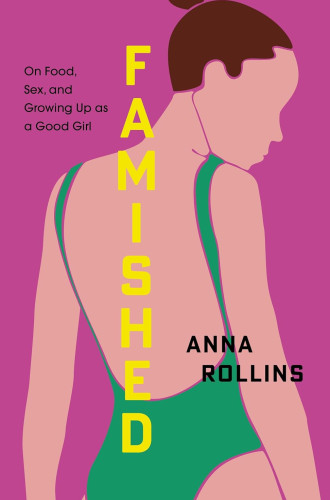
Anna Rollins’s memoir examines purity culture, disordered eating, and the cost of being a good Christian girl.

There’s a scene right in the middle of Famished wherein one character, Leah, confesses that she is mad at God. Leah is newly married and admits over drinks that the prosperity gospel–like myth of purity culture has not panned out. Leah is convinced that she did the right thing—she and her husband waited to have sex—but it doesn’t feel like God has blessed their marriage.

“You know that’s not how it works,” replies Anna Rollins, author and narrator of the memoir. She adds: “Though I wondered if I, too, believed that was precisely how it worked.” For the rest of their exchange, Rollins defends herself against the temptation to empathize with her friend and instead parrots what both of them have always been taught: that no matter what, Leah should probably go back to church. In this deftly dramatized scene, Rollins captures one of the seemingly countless double binds which underpin her book. As the titular good girl, Rollins feels obligated to steer Leah back to the straight and narrow, ignoring her own quiet doubts and essentially invalidating her friend’s.

For girls raised within fundamentalism, as Rollins was, there is often no room afforded for intellectual or emotional honesty. Rollins was taught to value control, and every time that control is threatened—by external factors, by the unpredictability of the world, or by Rollins’s own unsanctioned emotions—Rollins recounts, “the more I micromanaged meals, perseverated over calories, and added extra workouts to my already full days.”


Through girlhood, marriage, and motherhood (the three sections of the memoir), Rollins shows how her fundamentalist church emphasized the inherent dangers of the world and taught her to respond with hypervigilance. To preteen Rollins, literally everything is a threat: getting left alone at the grocery store (was the rest of her family raptured?), empty stalls in a public restroom (is the door concealing a would-be assaulter?), and her own body’s imminent development (will her sexual development turn her into an object of lust?). As a result, she turns to excessive exercise and disordered eating in an attempt to manage her world.

This book originated in online discussion groups Rollins joined during the pandemic, virtual cohorts of women seeking freedom from the self-restriction they learned in purity culture or diet culture. “Our tales all followed similar scripts,” she writes. Between purity culture and diet culture—both at their peak in the late ’90s and early 2000s—nearly every woman in America was influenced by the glorification of the small, submissive woman. In Famished, Rollins excavates all the messaging that taught her that smaller is better. “Perhaps I was drawn to disappearance,” she writes, “because it was precisely what I had been told I, as a woman, needed to do.”

Rollins presents an exhaustive compendium of voices that taught her self-restriction was the only thing that would keep her safe. This message manifests differently in each stage of her life, but its essence remains consistent. Despite being plagued with shame about her extreme exercise regime and hyper-attention to calories, Rollins persists in her disordered eating because she is so widely rewarded for its effects. After a doctor congratulates Rollins on her postpartum appearance, Rollins wonders, “Why doesn’t anyone see me and call me on this shit?”

The church’s fraught relationship with accountability is certainly one of Rollins’s themes. She attended a fundamentalist school and church growing up, and she depicts several scenes in which pastors, teachers, and other adults prioritize jockeying for status, approval, or sexual desirability over care and charity. Early in the book, a woman at Rollins’s childhood church takes to the pulpit—unusual in itself, in a denomination where women aren’t allowed to preach—in order to launch a church-sanctioned weight loss ministry based on a curriculum she found at a Lifeway Christian store. But even more than Christian hypocrisy, Rollins is concerned with recognition: Why doesn’t anyone see me? She recalls a math class assignment to record a week’s worth of calories—an exercise that earned her extra credit in class but not the adult concern her behavior truly merited. “I knew my dietary log revealed something more pernicious than basic discipline,” Rollins says. “I wanted to be seen.”

Rollins’s upbringing, due to forces both religious and cultural, kept her from seeing herself as a person. She writes, “The female body was a trap with no escape, a problem with no solution.” Especially within strains of Christianity that emphasize patriarchy, girls are often taught that we do not possess the authority to witness or validate our own experiences. If what Rollins most deeply needed was to be seen and acknowledged, her faith did not enfranchise her to offer this vital recognition to herself. By writing Famished, Rollins finally delivers the recognition she so desperately craved for so long. Furthermore, she seeks to offer it to others who have been similarly wounded. “I have a wish,” Rollins writes toward the end, “to see others the way I so desperately want to be seen myself.”

This is a divine calling. When I consider Rollins’s story, I think of the moment in Genesis when Hagar, pregnant with Ishmael, encounters the angel of the Lord near a spring in the desert, and Hagar describes God as “the One who sees me” (Gen. 16:13). Famished does the divine work of acknowledging the experiences of the women and girls diminished by misogyny within the church, deceived by the false promises of purity culture, and taught by diet culture that their worth is contingent on their weight. 

McKenzie Watson-Fore

McKenzie Watson-Fore is a writer, an artist, and executive editor of sneaker wave magazine.

All articles »