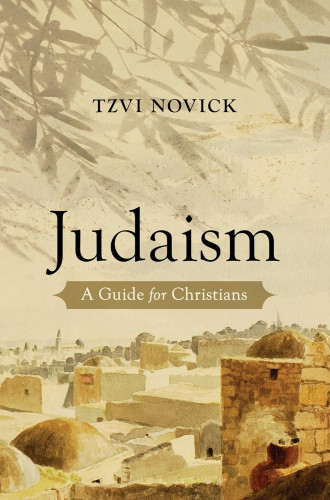
Judaism
A Guide for Christians
Tzvi Novick begins his new book with the three maxims for interreligious dialogue that were famously taught by Krister Stendahl, bishop of the Church of Sweden in the 1980s. Authentic dialogue, he writes, requires that each party be allowed to speak for themself (so, for example, Christian educators should not be the primary source of information about Judaism for their congregations). Second, we should compare best to best, rather than comparing the best of one tradition to the worst in another. Finally, productive interreligious dialogue creates space for what Stendahl calls “holy envy,” a reverence for aspects of another’s religion that is not present in our own and that perhaps even addresses an unmet need.
In Judaism: A Guide for Christians, Novick offers all three opportunities for Christians who want to engage meaningfully with Judaism. As an Orthodox Jew who teaches Jewish thought and culture at the University of Notre Dame, Novick has experience in translating elements of Jewish thought and practice for a Christian audience. His substantive knowledge of Christianity, particularly Catholicism, gives him insight into the areas where a typical Christian may struggle with a concept (for example, Judaism as both a religion and an ethnic identity), and he is skilled at putting ideas and practices in terms familiar to Christians. He models respect for both religious traditions. Reading his book as a Christian is an experience of healthy interfaith engagement.

Read our latest issue or browse back issues.
Throughout the book Novick offers clear and concise introductions to important aspects of Judaism, including Torah study and practice, the covenant with Israel, God’s relationship with gentiles, the sabbath, festivals, marriage, sexuality, the life cycle, philosophy, spirituality, and the relationship between Judaism and the state of Israel. For each topic, he provides an overview of the fundamentals (including the diversity of thought and practice among Jews themselves), a bibliography for readers who wish to learn more about the various points explored in the chapter, and discussion questions that go deeper than one would typically expect in such a guide. Here we see the college professor at work, inviting his readers to apply new ideas and knowledge in interesting and open-ended ways.
But before Novick can present Judaism as he knows and practices it, he asks the reader to acknowledge the lens of bias against Judaism that has been passed down throughout the history of the Christian church. No authentic Christian-Jewish dialogue or relationship can exist without naming the very real harm caused by the church’s teachings over the centuries and into today. Novick is intentional about his purpose. He writes:
The purpose of the survey . . . is not, in the first instance, to arouse shame or guilt, or to stake a spot in a victimhood competition. Its purpose is. . . to appreciate the long history of anti-Jewish discrimination and violence as the backdrop against which new directions in Christian theological thinking about Jews and Judaism, and Jewish theological thinking about Christianity have occurred.
At the core of this harmful history, Novick demonstrates, are theories of supersession—the view that with the coming of Christ, God moved the covenant from the Jews to the Christian church. This doctrine has led to various ways of subordinating the Jewish people and created a teaching of contempt toward Jews and Judaism, resulting in anti-Judaism, antisemitism, and violence. While parts of the modern church have wrestled with and attempted to rectify this harmful history, the bias still exists in lamentable ways. This historical and present reality will come to the table in every discussion between Christians and Jews.
Novick not only introduces readers to the fundamentals of Judaism but also models Jewish thinking. For example, in a chapter on Torah study, he offers that “Torah study is in principle a lifelong undertaking; it is not something from which one can or would wish to graduate.” He then offers a snippet of a text from the Mishnah in which the rabbis discuss how people know whether they have met the mandate to “be fruitful and multiply” and so can stop having children. Unlike in the typical Christian catechism, the rabbis offered different answers to this question. Novick spends several pages showing how this particular debate continued through the Talmud—and in this way he draws his readers into an experience of Torah study. Lest we misunderstand Torah as a simple list of dos and don’ts, Novick guides us to grasp the dialogical nature of Torah study, revealing its complexity and valued position for Jews. Throughout the book he consistently invites readers into conversation, offering thoughtful questions that are meant to provoke insight through debate without suggesting a right or wrong answer.
This book is an excellent resource for anyone who wants to learn about the fundamentals of Judaism, particularly Christians. It would make an excellent book study for a congregation that wants to grow in its interfaith sensitivity and relationships. Even better, it could be the starting point for a Jewish-Christian discussion group, where people meet face-to-face to learn about one another from one another, compare best to best, and perhaps walk away with a bit of holy envy.