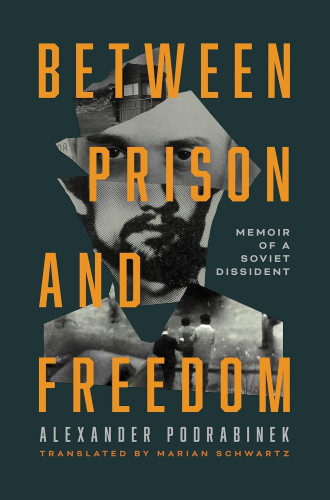
Between Prison and Freedom
Memoir of a Soviet Dissident
Leonid Brezhnev’s premiership of the Soviet Union during the 1970s is usually regarded as benevolent, compared not only to Stalin’s brutal regime but also to Khrushchev’s liberalizing “thaw” (his repression of religious rather than political groups). Neither the Wikipedia nor Encyclopedia Britannica articles on Brezhnev mentions any political crackdowns. In fact, Richard Nixon met with Brezhnev in Moscow in 1972, urging his efforts at détente by way of increased cooperative trade and the signing of the first Strategic Arms Limitation treaty. With the publication of Alexander Podrabinek’s Between Prison and Freedom, we now know the cruel truth beneath Brezhnev’s humane surface.
On August 15, 1978, Podrabinek was arrested under article 190.1 of the Russian Criminal Code: “The dissemination of erroneous falsehoods besmirching the Soviet state and public order.” It was not his first clash with Communist repression. In 1977, he had managed to have his manuscript Punitive Medicine secretly smuggled out of Russia and published, first in Russian and later in English. There he recorded what he had discovered while working for an ambulance service. Though he had been denied entrance to medical school for political reasons, his medical expertise gave him access to psychiatric hospitals. He discovered that they were populated not so much with deeply disturbed souls as with perfectly sane people being punished for their political dissidence. Podrabinek’s subversive act caused the KGB to threaten his arrest, together with his father and brother, if they did not emigrate to Israel. They refused.

Read our latest issue or browse back issues.
Podrabinek describes himself as a “Jew out of a sense of contradiction.” Russian nationality is determined in relation to one’s father, and he couldn’t call himself a Russian because his father was a Jew. But because Jewish identity is defined as being born to a Jewish mother, neither was he an authentic Jew. Thus, Podrabinek professes no religion at all. Yet he is deeply sympathetic to two religious groups who rejected any cooperation with the Soviet regime.
He cites the example of Baptists who were arrested for worshiping in their apartment without Soviet sanction:
One after another, the Baptists started getting dragged out of their apartment and being put in police vans. First they led out the men. Those remaining continued to sing, ignoring the police, and the more they led out the men, the higher and more penetrating the chorus’s voice became. . . . What was happening gripped me with genuine ecstasy, which I felt in the singers’ voices and read in the eyes of those praying. It was like encountering good and evil, faith and power, in their pure forms.
Podrabinek was especially touched by the witness of Nikolai Volkov, a Baptist who organized an underground printing press in order to publish the Bible. Despite four years of imprisonment, Volkov was never hot-tempered or embittered but always subdued: “His religiosity was not feigned. Sometimes he would fold his hands, close his eyes, and pray silently. I liked the absence of show in his religiosity such as you often run into with Orthodox and Catholics.”
Podrabinek also honors Vladimir Shelkov, an Adventist who was first imprisoned for his religious convictions in 1931 under Stalin. Shelkov was repeatedly arrested and tortured for nearly 50 years until, in 1980, he died in prison at age 85. “He didn’t anathematize or curse anyone, but only preached, telling the zeks [fellow prisoners] about Christ. He died quietly and with dignity.”
The bulk of Podrabinek’s memoir is devoted to his eight-year fight against the Soviets’ efforts to break him. In an attempt to make him confess his guilt, they subjected him to endless transfers from one remote prison to another, each more miserable than the previous, amid negative 50 degree weather and eventually including solitary confinement. He employed stern strategies to keep from capitulating, including hunger strikes. What most infuriated the Communists was his refusal to answer their questions. To do so would have been to admit the legitimacy of their regime when, in fact, they were violating the basic human rights officially guaranteed by Russian law. As if the cruelties visited on him by the government were not sufficient punishment, Podrabinek recounts even worse horrors visited by prisoners on each other. Yet he had no desire to get vengeance on them: “I noticed that God always punishes those we couldn’t punish—moreover, much harder and keenly than we could have. Maybe we ought to entrust that matter to him always.”
Podrabinek survived not simply because he maintained his own bedrock integrity but also because he received unswerving support from fellow Russian dissidents, including the exiled Aleksandr Solzhenitsyn. His wife, Anna, stood by him without fail, sometimes smuggling him food and special treats. In one of his cells, he placed a crumb of bread outside a mouse hole. When Mishka Mouse poked out his snout to nibble, Podrabinek would talk to the attentive rodent, quoting the poetry of Boris Pasternak as well as his own compositions. “Mishka was a grateful listener. He listened to it all and never criticized.”
It all ended rather flatly after the death of Brezhnev in 1982. The following year, Podrabinek was allowed to leave prison without any further charges.
Yet the real climacteric occurred a few weeks before his release, when Podrabinek was offered the freedom to leave for the West if he would collaborate with the Communists, even briefly. Since Podrabinek had suffered so long and painfully, his father and brother urged him to accept. This was the worst blow of all. They failed to see that the deepest—if also the most ironic—freedom arrives when nothing can be taken because one has nothing to claim as one’s own. “If you make your peace with the fact that they’re going to take your life, you become completely free. . . . Once I’d stopped clinging to life, I calmed down inside. This was an unusual state—calm, detachment, and inner triumph.” Hence this stunning conclusion to the witness of Alexander Pinkhosovich Podrabinek: “The temptation of freedom is the greatest of all temptations.”