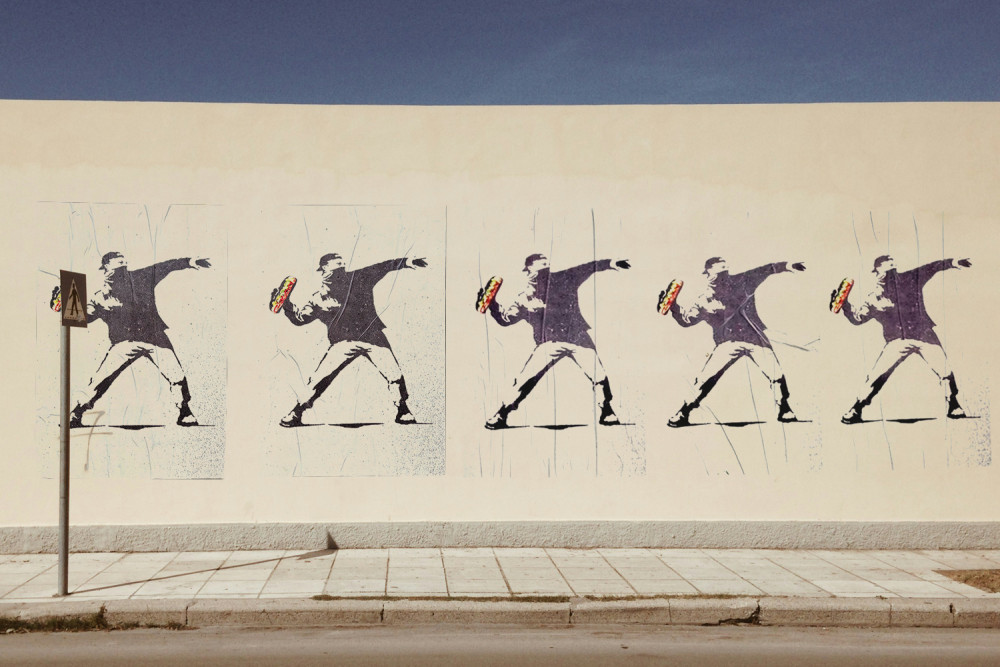
Sean Charles Dunn made headlines this summer when, out of anger and frustration at federal troops being deployed to Washington, DC, he hurled his foot-long sandwich at the chest of a US Border Patrol officer assigned there. Attorney General Pam Bondi, who apparently didn’t have the January 6 Capitol riot on her mind at the time, quickly declared that anyone who ever assaults a law enforcement officer deserves a felony charge. Video footage of the “Sandwich Guy” went viral, with memes flooding the internet and protesters proudly holding Subway sandwiches to the sky. New street art appeared—large, stenciled murals depicting a man with a salami and provolone sub, winding up as if pitching in the World Series. Artistic whimsy lightened the load of locals disturbed by the military occupation.
While my wife and I don’t have protest artwork of this sort in our house, our art collection is eclectic, and it delights our eyes every day. Every painting, print, and object we own expresses something of who we are and what matters to us; this is the nature of household art. Art makes a home more human. The pieces you display in your home breathe personality, character, and story.

Read our latest issue or browse back issues.
Typically, we have to leave home to get beyond our own aesthetic enough to have our perceptions challenged and assumptions tested. Museums and public spaces are great settings for art displays that can spark new perspectives, alter viewpoints, and force a confrontation with issues we may otherwise ignore or be unaware of. Since seeing the Sandwich Guy murals, I’ve been noticing various art forms that encourage social change or communicate important values.
Art that reckons with history. If you haven’t seen Titus Kaphar’s Beyond the Myth of Benevolence, first displayed at the National Portrait Gallery, look it up sometime. Kaphar peels back half the oil painting canvas of Thomas Jefferson’s pale face to reveal another portrait behind Jefferson, that of a young Black woman with searching eyes—a striking juxtaposition given what we know about Jefferson’s treatment of young women he enslaved.
Art that encourages hope. Raed Issa is an artist in Gaza, a Palestinian father of four desperately clinging to hope. Cobbling together anything that might substitute for the lack of paint pigment—tea, hibiscus, coffee, rust—he hosts art classes for displaced and traumatized children in his makeshift tent studio.
Art that aids ecology. Paolo Fanciulli of Tuscany acquires all manner of sculpture, including works by famous European artists, and sinks them to the bottom of the Mediterranean Sea. He’s determined to stop illegal trawlers from decimating entire marine ecosystems as they scrape the ocean floor with their miles-wide nets. The sculptures tear the nets, save valuable marine life, and provide a unique underwater art museum for divers and snorkelers.
Art that serves a social purpose. The Boston organization Artlifting assists homeless artists and those with disabilities with selling their work.
Art that offends the powerful. Kat Rodriguez’s Immokalee Statue of Liberty is disappearing from the Smithsonian’s National Museum of American History, thanks to President Trump’s commitment to whitewash history and celebrate American exceptionalism. Twenty-five years ago, immigrant farmworkers in Florida walked hundreds of miles with this ten-foot-tall papier-mâché brown-skinned Lady of Liberty holding a basket of tomatoes, as they demonstrated for fair wages.
I hope you love the art displayed in your home as much as I enjoy the art in mine, however modest, lavish, or idiosyncratic those collections may be. But we can’t afford to let our personal art limit our imagination for the art world’s full splendor.