

News

As universities shutter DEI offices, progressive Christian groups open their doors

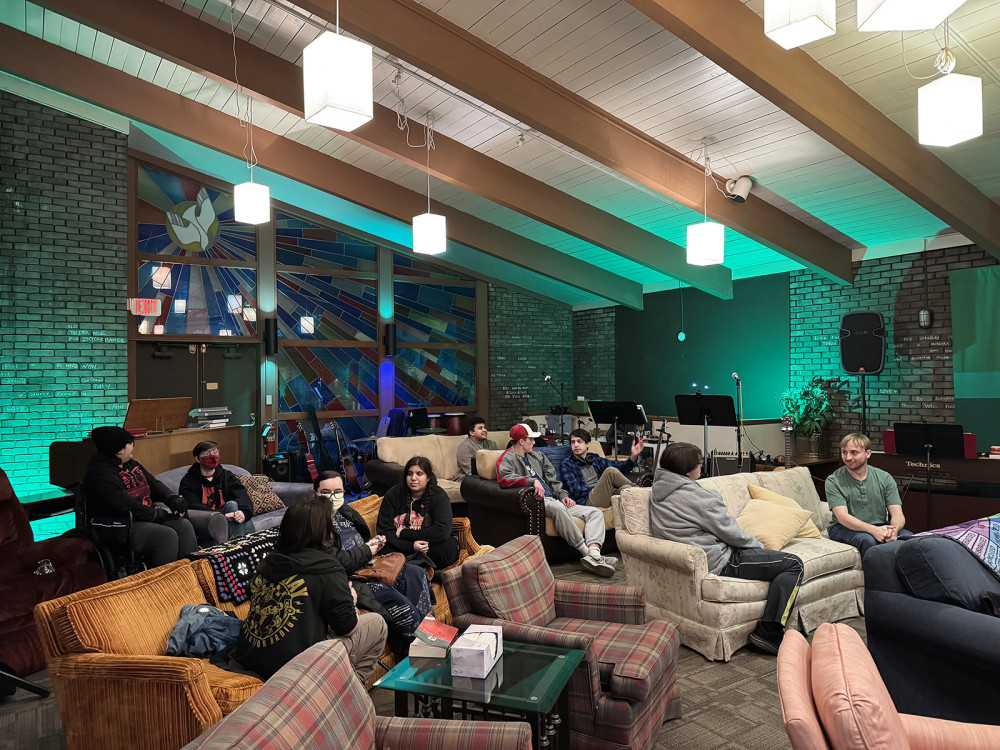
It’s a blustery Sunday evening in January and about a dozen students are splayed on couches in a church sanctuary a block away from Ohio State University.

It looks like a movie night, but they’re here to worship with a student ministry called Jacob’s Porch. The service begins with a collective breath, a prayer, and a song written by the group called “Be Here Now.” The informal setup reflects the ethos of the ecumenical Christian group, which, though founded by Lutherans, welcomes students who wrestle with faith—including those who are not religious.

“It’s very nonjudgmental,” said second-year OSU student and Jacob’s Porch attendee Oli Wood, who said that his friends jokingly refer to Jacob’s Porch as “gay church,” since about 60 percent of the two dozen students who participate identify as LGBTQ. “It definitely makes me feel very accepted, very safe.”


Its reputation as an LGBTQ haven has made it an asset to the school’s broader queer student population, especially as campus diversity programs have been dismantled.

In February 2025, Ohio State University closed its Office of Diversity and Inclusion and its Center for Belonging and Social Change. Months later, an Ohio bill banning diversity, equity, and inclusion activities, known as DEI, on public universities shuttered at least 20 other identity-based centers statewide.

Jacob’s Porch has responded by expanding its LGBTQ-affirming footprint on campus. And it isn’t alone. As school-sponsored DEI and LGBTQ programs are gutted at public universities across the US, some progressive Christian student ministries—funded by denominations and local churches—are filling the gaps left by now-defunct programs.

The Christian college ministry landscape has long been dominated by conservative groups such as Cru and InterVarsity. Unlike those national networks, mainline Christian campus ministries often operate independently along denominational lines. But a new, pro-LGBTQ Christian campus ministry network, ZOE, is uniting more than 100 progressive ministries like Jacob’s Porch, creating an interdenominational infrastructure as many of their members defy DEI cutbacks.

Launched in 2022, ZOE, named after the Greek word for life, was the brainchild of Jim Burklo, longtime associate dean of religious and spiritual life at the University of Southern California, and Brian McLaren, a leader of the Emergent Church movement of the ’90s and 2000s.

McLaren said that as early as 2015, he began to notice “the more evangelical campus ministries were taking a turn to the right,” while progressive, mainline Protestant alternatives “tended to be very much in their denominational silos.”

Today, ZOE connects its ecumenical, progressive Christian student ministries via meet-ups, social media, and group chats and offers them resources about topics such as contemplative spiritual practices, climate justice, and peacemaking.

The Church Lot, an Evangelical Lutheran Church in America campus ministry at Kennesaw State in Georgia, joined ZOE after the university announced in March 2025 it could no longer house student centers based on identity groups—a decision impacting seven campus initiatives, including the LGBTQ+ Resource Center, Women’s Resource Center, and African American Male Initiative.

“It happened, it seemed like, overnight,” said Kat Folk, vicar of First United Lutheran Church in Kennesaw and leader of The Church Lot. “It was just, one day we had these seven centers, and then the next day we didn’t.”

Folk’s church, located across from campus, had a large Sunday school room that wasn’t in use; in August, around the same time that The Church Lot joined forces with ZOE, the church opened the room to students from the Kennesaw Pride Alliance, many of whom were also involved in Folk’s ministry.

Now bedecked with LGBTQ pride flags, the Sunday school room has become home to name change clinics, affinity group meetings, and movie nights. “It’s now basically like the LGBT resource center,” said Folk.

In Ames, Iowa, another ZOE campus ministry is hosting students impacted by DEI cuts.

The Vine, a Presbyterian Church (USA) group that serves Iowa State University, meets at the Collegiate Presbyterian Church, just off the university’s campus. In May 2024, Iowa adopted a law prohibiting public universities from having DEI offices; the following month, Iowa State University shuttered its DEI office, and later it closed the Center for LGBTQIA+ Student Success and refitted it into a computer lab space.

When a grassroots student group, the Coalition for University Equity, emerged to protest changes, Jen Hibben, director of The Vine, invited the student activists to use The Vine’s location at the church as a home base.

Erin O’Brien, a student at Iowa State who is part of the Coalition for University Equity, said the group appreciates the support of The Vine, especially given that it’s fallen on students to organize programming that used to be school-sponsored.

“The vast majority of the work has been placed on the students,” O’Brien said. “The anti-DEI stuff is capable of seeping into every part of our education here, so we do want to maintain the university that welcomed us.”

The Vine has also hosted an annual Drag Bingo event (formerly co-sponsored with the LGBTQ Center) and organized an Interfaith Pride service on campus. Hibben said The Vine’s agenda is helping students find “healing and wholeness.” That agenda, she said, has become more critical amid the growing influence of conservative campus ministries on campus, which she described as feeling “more emboldened to double down on homophobia, transphobia, sexism, and other social issues” in recent years.

Neither Iowa State University nor Kennesaw State in Georgia responded to requests for comment.

In Moscow, Idaho, progressive Christians have long been the outliers. That includes the Ecumenical Campus Ministries Association at the University of Idaho, whose campus ministry location, R House Student Center, is affiliated with seven mainline denominations. For years, the group partnered with the campus’s Women’s Center, Black and African American Cultural Center, Office of Multicultural Affairs, and LGBTQA Office, all of which closed in December 2024 after the Idaho State Board of Education voted to ban DEI offices at the state’s higher education institutions.

A spokesperson for the university said the 18 employees impacted by the cuts were offered other positions. “We have made many adjustments across the university in response to the new statutes and will continue to support all students in their quest for higher education,” the spokesperson said.

Prior to the cutbacks, ECMA was partnering with the LGBTQA Office to bring Semler, a queer Christian artist, to perform on campus. When the LGBTQA Office closed, ECMA funded Semler’s performance on its own. In November, it hosted a Trans Day of Remembrance event in partnership with students previously supported by the LGBTQA Office. And in spring 2025, when the university announced it would no longer have cultural graduation ceremonies—which incorporate rituals and symbolism specific to underrepresented groups, such as LGBTQ, Black, and Latino communities—ECMA agreed to host the identity-based celebrations.

“There are people in the community that care, and want to see them succeed in life, and want to be supportive of them, and are going to leverage our resources to do so,” said ECMA executive director George Fricks about the students impacted by the suspended programs. “I think that’s just a super important space to hold as the church, especially in our area where the majority of the church context is the exact opposite of that.”

At Jacob’s Porch, students said that being part of a faith group protected from university cuts gives them a sense of stability, especially as DEI initiatives disappear.

“The best part is that it doesn’t label itself as a pride club or anything. It labels itself as a Christian club. So it should be safe,” said Lee Painter, an education major at OSU. “When I come in here, I can be way more honest about who I am and not feel threatened.”

Jacob’s Porch members noted the group co-founded Wonderfully Made, a coalition of LGBTQ-affirming faith groups at the university that hosts a queer Bible study, queer-affirming Ash Wednesday service and Trans Day of Visibility dance party.

As part of ZOE, Jacob’s Porch, The Vine, The Church Lot and ECMA belong to an emerging network of progressive student groups that view commitments to diversity and LGBTQ-inclusion as matters of faith. As these groups carry on the work of eliminated programs, they’re collaborating with students regardless of faith affiliation—not to evangelize them, but because their faith compels them to.

“We really, in progressive campus ministries, are at this juncture where we can do stuff the university can’t do anymore, and we can be for students and the community, again, not just a place of religious conversion, but of deep social justice,” said Hibben. “If we don’t take advantage of that, we are abandoning ourselves, and we are sabotaging the work of the church.” —Religion News Service

This story was produced with funding from the Templeton Religion Trust.

Kathryn Post

Kathryn Post is a reporter for Religion News Service.

All articles »
