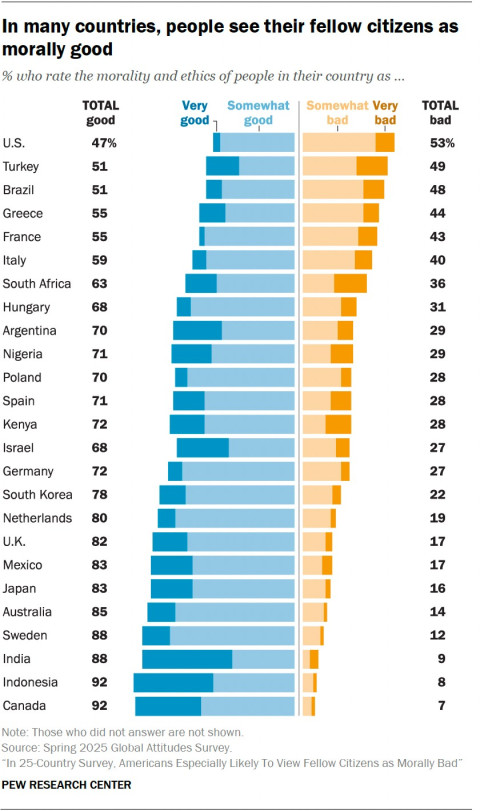
Out of 25 countries, the United States was the only one where most people said their fellow citizens’ morality was generally bad, new research has found.
A Pew Research Center report examining morality and ethics, released on Thursday, also found self-identified Christians are more likely to view abortion, using marijuana, having extramarital affairs, and other behaviors as “morally unacceptable” than other religious groups. The report marks the first time Pew researchers asked respondents about their views on the morality of their fellow citizens.
In total, more than half of US adults—53 percent—said the morality and ethics of people in their country were somewhat bad or very bad, while 47 percent rated their morality as good or very good, according to the study.

Still, the findings “don’t support that Americans are overarchingly more judgmental or moralistic than in other countries” based on responses to other questions, Jonathan Evans, senior researcher at Pew, said on Wednesday.
Partisan politics seems to play a role in the US. Sixty-percent of Democrats rated other peoples’ morality as bad, while 46 percent of Republicans agreed. And, according to Pew, there’s a rise in both Republicans and Democrats considering those in the other party as immoral.
Though Christians were among the religious groups most likely to condemn certain behaviors, views differed widely across countries, Evans said. Overall, people who said religion is very important in their lives were more likely to condemn certain behaviors as morally wrong than other adults were.
The center surveyed 28,333 people outside the US from January to April 2025. In the US, the results came from 3,605 members of its American Trends Panels pool, interviewed in March 2025, and from 8,937 people who took part in its May 2025 American Trends Panels survey .
A majority of Christians in Africa, Latin America, and the US said abortion was morally wrong, while Christians in Europe were less likely to say so. Across Europe, 4 in 10 or fewer Christians said abortion was morally wrong. In Sweden, only 7 percent of Christians agreed.
The survey also pointed to Muslims having diverse viewpoints about abortion in at least two countries. In Indonesia, 93 percent of Muslims said having an abortion was morally unacceptable—the highest rate of all countries surveyed—while only 33 percent of Muslims living in Israel did.
Jewish Americans and Jewish Israeli also hold varying views on the issue, with 21 percent of Jewish Americans saying abortion is unacceptable, while 43 percent of Jewish Israelis said so. That could be because Orthodox Jews, who tend to hold more conservative views than other Jews, are a larger share of the population of Israeli Jews than of US Jews, past research has found.
Religiously unaffiliated people, also called nones, who declared being atheist, agnostic, or “nothing in particular” were less likely to say abortion was morally unacceptable compared with religious people. Still, a majority of nones in Brazil and South Africa said abortion was wrong, while only 1 in 10 nones in Europe said so, pointing to cultural differences.
In 13 countries, Pew examined differences in the views between Catholics and Protestants. In all countries, they had similar views on most issues, but on homosexuality, Protestants were harsher than their Catholic counterparts. In the US, which had the greatest gap, 59 percent of Protestants condemned homosexuality, compared with 34 percent of Catholics.
Out of the nine behaviors the center asked about—abortion, viewing pornography, gambling, drinking alcohol, having an extramarital affair, homosexuality, getting a divorce, using contraceptives, and using marijuana—extramarital affairs drew the strongest disapproval. More than half of the respondents across countries condemned it. The US was among the countries where respondents were most likely to disapprove of having an affair—9 in 10 respondents did—similar to Turks and Indonesians.
Meanwhile, the French and Germans were among the least likely to say having an extramarital affair was morally unacceptable, with 53 percent and 55 percent, respectively, condemning it.
US adults were among the most accepting of marijuana use and gambling, with 23 percent and 29 percent condemning them, respectively. In most countries, upward of 40 percent considered gambling and marijuana morally wrong.
Views on abortion varied widely from one country to another. Half of the adults in Latin American and African countries said abortion was morally unacceptable, while most in European countries said it was acceptable or not a moral issue. In total, 47 percent of US adults said having an abortion was morally unacceptable.
Gambling was also a divisive issue. Pew found 10 countries in which most people condemned it, and 10 other countries where most people said it was either acceptable or not a moral issue.
According to the report, views seem to have softened on most issues since the center first asked those questions. Moral disapproval generally declined since the center first asked about the issues in 2013, though it varies by issue.
Of the 22 countries surveyed on these questions in 2013, half have seen most people soften their views on divorce, except for India, where disapproval for it increased by 12 percentage points, mostly driven by Indian women. Meanwhile, the number of Kenyans who disapproved of divorce dropped from 59 percent to 30 percent.
Overall, women were more likely to classify certain behaviors as morally wrong, particularly viewing pornography, gambling, drinking alcohol, and using marijuana. Women in almost every country were more likely to condemn viewing pornography than their male counterparts. In the US, 58 percent of women said viewing pornography was morally unacceptable, while 47 percent of men did.
However, men were more likely than women to say homosexuality was morally unacceptable. In countries with significant gender gaps in opinions about homosexuality, men were almost 10 percentage points more likely to condemn it. Greeks were the most divided on this issue, with 40 percent of men disapproving of homosexuality and only 20 percent of women.
The report reveals that education level also was related to respondents’ attitudes toward some of these behaviors; less-educated people were more likely to make moral judgments than more educated people.
Overall, adults over 40 years old were more likely to cast the behaviors as morally wrong, particularly gambling, drinking alcohol, and viewing pornography. However, younger generations, ages 18 to 39, were more likely than older generations to condemn extramarital affairs.
In every country, younger respondents tended to hold views on the morality of their fellow citizens similar to those of older generations. Yet, the US was the only place where younger people were more likely than older people to rate their fellow citizens as morally bad; 57 percent of US adults under 40 said the morals of people in their country were bad, while 50 percent of those over 40 agreed. —Religion News Service