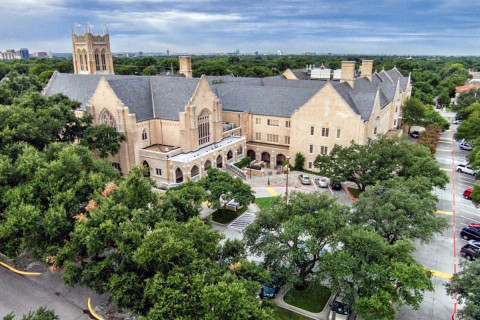
Saint Augustine’s University, a historically Black university with Episcopal roots in Raleigh, North Carolina, is filing for bankruptcy to restructure its finances and will end its fight to keep its accreditation. Even so, the university says it isn’t closing and has not given up on long-term plans to rebound financially and academically.
“Chapter 11 [bankruptcy] provides a comprehensive path to address our financial challenges and move forward with a stronger foundation,” the board of trustees said in an April 28 news release, which also named a new interim president, Verjanis A. Peoples.
Saint Augustine’s had been fighting since 2023 to retain its accreditation with the Southern Association of Colleges and Schools Commission on Colleges, or SACSCOC. In 2025, it filed an injunction request in court, allowing its current students to continue earning degrees from an accredited university while the case was pending, but it now says that litigation will end effective May 15.
All students who complete their studies before May 15 will be able to earn degrees from an accredited institution, the university says. After that date, students in the middle of degree programs will need to finish their studies at another accredited institution. Saint Augustine’s says it will support those students with “teach-out agreements” with other colleges and universities, to transfer their admissions and credits.
After May 15, the university will focus on “developing non-degree certificates and apprenticeship programs and building a pathway toward reaccreditation.”
Saint Augustine’s was established in 1867 by Episcopalians in the Diocese of North Carolina. Though still rooted in the Episcopal tradition, it now operates as an independent institution.
It and Voorhees College in Denmark, South Carolina, are the two remaining historically Black higher education institutions with Episcopal roots. The two colleges have received several million dollars from the Episcopal Church in recent years, including through the church’s Absalom Jones Fund, while also accepting the church’s guidance on administrative and fundraising matters.
Episcopal News Service sought comment from Martini Shaw, a priest in the Diocese of Pennsylvania, who serves as chair of the committee on HBCUs that reports to the church’s executive council.
“The HBCU Committee of The Episcopal Church continues to prayerfully support the university during this period of transition,” Shaw said in an emailed statement. “We remain fully committed to higher education and academic excellence.”
Under federal guidelines, colleges and universities seek accreditation by an approved governmental or nongovernmental agency like SACSCOC to ensure they meet “acceptable levels of quality,” according to the US Department of Education.
Accreditation, for example, is a minimum standard typically verified by managers when assessing graduates for potential employment. An academic institution that fails to retain accreditation also could be disqualified from federal grants and student aid programs, potentially jeopardizing the school’s ability to remain open.
Saint Augustine’s had faced an earlier threat to its accreditation about a decade ago, but in 2018, it announced that its accrediting agency had removed it from probation because it had turned the corner on its financial struggles and enrollment decline.
Then in December 2023, SACSCOC again sought to end Saint Augustine’s membership after concluding the university had failed to meet six of the accrediting agency’s requirements and standards, including those related to the university’s governing board, its financial resources, and financial documents. Now, by ending its litigation, Saint Augustine’s will no longer appeal SACSCOC’s ruling to end accreditation.
Over the past decade, Saint Augustine’s enrollment has plummeted, from nearly 1,000 in 2017 to an estimated 150 at the start of the 2025-26 academic year—when all classes were moved online. The university did not say in its recent updates how many of those students will graduate before May 15 or how many will be forced to transfer to new schools.
A press release provided additional information in a list of answers to “frequently asked questions” on its website. Regarding the university’s land and assets, it said the bankruptcy proceedings are “designed to provide a structured court-supervised pathway for the university to protect key assets, including real estate and land, strengthen financial stability and implement a sustainable plan for long-term success.” —Episcopal News Service