

Shoshana Akua Brown was one of few students of color at her Orthodox Jewish day school in New York City in the 1990s. Hoping to fit in, she decided to go by the name Tiffany—a nod to Saved by the Bell actress Tiffani Amber Thiessen—for an entire year.
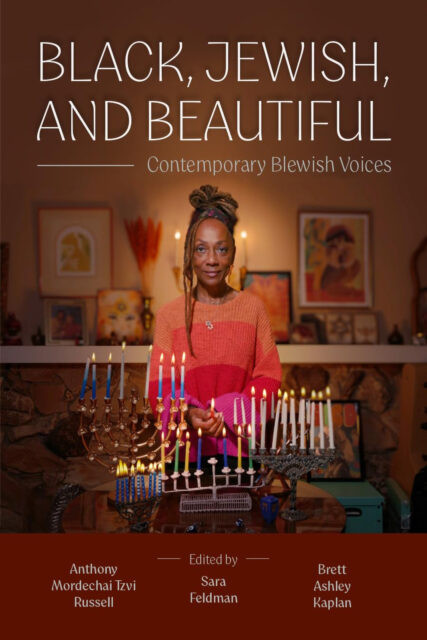
“Somehow in that White Jewish space, I wanted what I deemed as Whiteness (read: Christian) more than I wanted to be Jewish, which I am,” Brown writes in an essay in a new anthology titled Black, Jewish, and Beautiful: Contemporary Blewish Voices. “‘Shoshana’ was too ‘ghetto,’ whether you meant that as in a Black ghetto or a Jewish ghetto, and in the fourth grade I rejected both.”
As a teenager, Brown—the daughter of a White, Ashkenazi mother and a Black, non-Jewish father—would come to embrace her mixed identity. One December, she developed a guide for celebrating Kwanzakkah (a combination of Kwanzaa and Hanukkah) with her family.
“It was there in my mother’s living room that I felt complete, seen, and held,” she writes.
“Black, Jewish, and Beautiful,” published October 15 by Syracuse University Press, includes essays by and interviews with 14 Black Jews from across the United States, Ethiopia, Cameroon, and Uganda. The book highlights the stories of people who were raised Jewish or converted, as well as two who learned as adults from genetic tests that they have Ashkenazi ancestry.
“I’m happy to represent a facet of being Black and Jewish, not that my life experience is the experience, but an experience,” Brown, co-founder of the Black Jewish Liberation Collective, said in an interview. “It’s really important because we don’t have a lot of literature in our own voices about our lived experiences at these intersections.”
Several Black Jews have published acclaimed memoirs, including Julius Lester, Rebecca Walker, Michael W. Twitty and, most recently, Elizabeth Stordeur Pryor. The co-editors of Black, Jewish, and Beautiful believe theirs is the first collection of original pieces by and about Black Jews. (The book does not include people affiliated with the Hebrew Israelite spiritual movement, some of whom also identify as Black Jews.)
“When we surmised that there hadn’t been an anthology of this type, I do have to admit to having been surprised, given the pervasiveness, influence, and dynamism of Black Jews, both within and without the greater Jewish community,” co-editor Anthony Mordechai Tzvi Russell said. “When we finally got together and endeavored to begin working on this project, it really did seem like a project whose time had come.”
Black Jews are a minority within a minority; just 2 percent of US Jews identify either as Black or “White and Black,” according to the Pew Research Center. Many have reported feeling marginalized in Jewish spaces because of their race. But philosopher Lewis Gordon, who was born in Jamaica, said during a book pre-launch event in March that he chose to focus on the joyful parts of his identity in his essay, “A Jewmaican Blewish Reflection.”
“One of the things that I’m critical of is the tendency to reduce the category of Jews and reduce the category of Black exclusively to our oppression,” said Gordon, a professor at the University of Connecticut. “I’m very happy to be Black and very happy to be Jewish.”
For filmmaker Renée Wilson, the interview she did for the book was part of a process of self-discovery that had begun several years earlier. Wilson, who was raised Catholic in New Orleans, took an at-home DNA test in 2018 and learned that she has 13 percent Ashkenazi ancestry.
“My dad also took the test, and he’s 25 percent,” she said. “It started opening up conversations about our history.”
Wilson believes her light-skinned paternal grandfather was the product of a non-consensual relationship between a White Jewish man and a Black woman, and she is currently working on a documentary that grapples with that legacy.
“My story shows there are so many ways to be Jewish, and to be Black, and to be mixed,” she said.
The seed for the book project was planted in 2018 when Russell, a Yiddish singer who is Black, gave a concert at the University of Illinois Urbana-Champaign, where Brett Ashley Kaplan and Sara Feldman were both teaching at the time. Kaplan interviewed Russell, and Feldman, now a lecturer in Yiddish Studies at University of California, Berkeley, suggested the three of them collaborate on an anthology.
Over the next five years, they invited contributors from a range of backgrounds and levels of religious observance to submit essays or sit for in-depth interviews. They lightly edited the pieces and organized them into four sections: Black and Jewish Roots, the Worlds of Black Jewry, Articulating the Black Jewish Self and Building Black Jewish Futures.
One of the challenges the trio faced was choosing a title for the collection. “There’s a number of books that are about Blacks and Jews, where the Blacks are assumed not to be Jewish and the Jews are assumed not to be Black,” Kaplan said. “We really didn’t want there to be confusion.”
Black, Jewish, and Beautiful is a reference both to the “Black is beautiful” movement of the 1960s and to a verse in the “Song of Songs” biblical poem. According to one translation, the line reads, “I am dark and beautiful, O daughters of Jerusalem, like the tents of Kedar, like the curtains of Solomon.”
As for the subtitle, some of the contributors connected with the concept of “Blewish,” while others said they have never self-identified that way. (The term has been used informally by some Black Jews for years, according to Russell.)
Looking beyond the borders of the United States, the co-editors invited Ethiopian Israeli activist Michal Avera Samuel and Rabbi Gershom Sizomu, the spiritual leader of the Abayudaya Jews of Uganda, to participate in the project.
“The book offers an opportunity to educate a wider audience about the existence, history, identity and contributions of the Abayudaya,” Sizomu said in a WhatsApp message from Mbale, Uganda. “More importantly, it can help bring our community into the spotlight, strengthen our visibility within the global Jewish family, and ensure that our story receives the recognition it deserves.”
Kaplan said she expects universities, synagogues, Jewish community organizations, and reading groups to be interested in the volume.
Be’chol Lashon, a nonprofit that has raised awareness about ethnic and racial diversity in the Jewish world for more than two decades, cheered news of the publication.
“Some 15 years ago, Be’chol Lashon started publishing stories of diverse Jews on our online publication Jewish& because no one else was doing it,” said Julian Voloj, the organization’s executive director. “Seeing a book like this being published now shows how far we’ve come but also how much more there can be done.”
Brown of the Black Jewish Liberation Collective called the book an “invitation” for readers to engage with Black Jews in their communities. “We are part of many communities — be in dialogue with us about these dynamics,” she said. —Religion News Service


