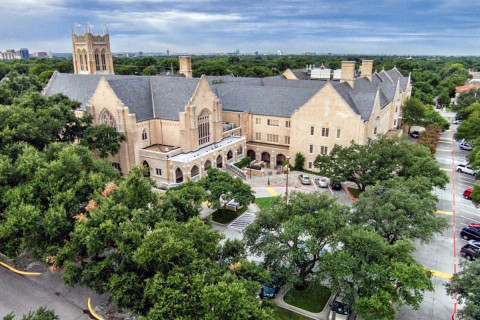
Zholia Parsi bounced on a blue-and-white Noxon mountain bike as she rode laps around the fieldstone sanctuary of St. Petri Kirche in the town of Burg near Magdeburg, Germany, speaking to family on the phone and laughing.
Parsi, who led a women’s rights movement in Afghanistan and fled after imprisonment and death threats from the Taliban, is known internationally for her work on human rights. But in her past three months living at St. Petri as part of its church asylum program, she’s careful not to venture beyond the cement wall that encloses the congregation’s chapel and parish house.
But the bike, which she’d never ridden before coming to St. Petri, is enough freedom for now.
“Believe me, learning was not easy. I fell many times,” Parsi said in an interview, using a translation app on her phone.
She rolled up her corduroy pant leg to reveal a scar on her shin as proof of her practice. “Now, whenever I get on my bicycle . . . I forget all my sadness and worries. Cycling is not just a hobby for me.”
Under the leadership of Ulrike Bischoff, pastor of St. Petri since 2023, the church dedicated the parish house to church asylum. As many as 20 people stay there every year, Bischoff said.
She tells the refugees that beyond the church’s campus, they risk run-ins with law enforcement and might be detained. Refugees in church asylum have suffered a particular hardship and are waiting for immigration officials to review their cases more carefully. The outcome of that review determines whether the person is eligible to work and rent an apartment elsewhere, allowing them to leave church asylum.
But that could all change if the far-right Alternative für Deutschland party has its way. The AfD won 44 percent of the vote in elections held in the eastern state of Saxony-Anhalt, where St. Petri is located. And although the party failed to secure the majority of seats, this was the first time a right-wing party in Germany has gained power in state elections since World War II.
The AfD has vowed to send police into churches to detain refugees and initiate deportation proceedings.
“We are an open sport right now,” Bischoff said.
The proposed attack on church asylum is one part of the AfD’s larger plan to oust refugees from Saxony-Anhalt. But it’s also a blow to churches, which criticize the AfD as antithetical to their Christian values.
Amid this conflict, the AfD wants to strip funding from “state churches”—Catholics and a Protestant, or Lutheran, body known as the Evangelische Kirche—that they claim are too liberal and have veered from their core mission.
But the churches are fighting back, and fiercer than ever. Local clergy have arranged counterdemonstrations, hosted town halls on defending democracy and, in at least one instance, run for office with the main purpose of unseating a powerful AfD politician in the state parliament.
The Catholic Diocese of Magdeburg and the regional Evangelische Kirche in Mitteldeutschland, or the regional Protestant authority, each coordinated public awareness campaigns, with banners, podcasts, and video interviews, and participation in anti-AfD rallies and festivals.
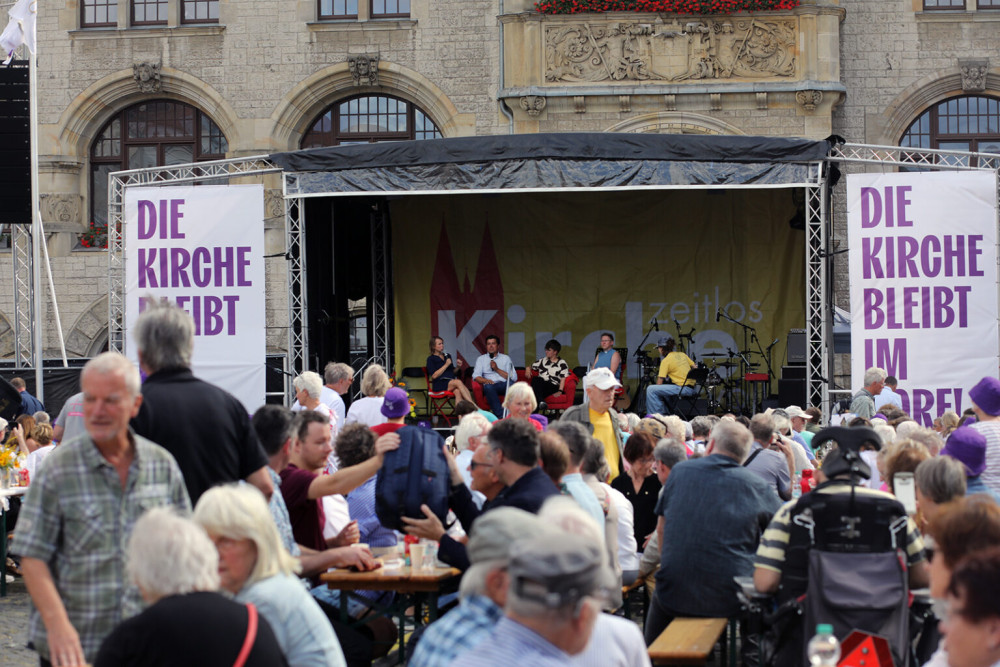
One of those festivals was a week before an election in Dessau on August 30.
As thousands of parishioners and clergy enjoyed bratwursts, musical acts, and panels with top church leaders addressed the election. As this mostly older crowd listened or danced, kids climbed a rock wall, took selfies with a famous influencer who briefly showed up, and stacked a “democracy Jenga tower.”
Klemens Schubert said the tower, imprinted with phrases like “solidarity and human rights,” is a fitting metaphor, whether it stands or falls.
Bishop Friedrich Kramer, the top administrative leader for the Protestant church in most of Saxony-Anhalt, said all this activity is unprecedented for churches, but it wasn’t their choice.
“The churches are not the motor of escalation. In this case, it’s the AfD,” he said in an interview, translated from German. “We have to say something against them, and we have to defend the people or the groups that are affected by the AfD.”
The person within the AfD who’s most responsible for the proposals and messaging that’s stirring this outcry among churches is Hans-Thomas Tillschneider, deputy state chairman for the AfD in Saxony-Anhalt.
As he walked through the state parliament building in Magdeburg, his footsteps reverberated through the halls. He paused to think of an answer to a question about whether the AfD serves only White, Christian Germans.
“We make politics in the interest of our citizens, and our citizens are mostly German. Whiteness, I am not interested in this race question. And if there’s a Black German voting for AfD, no problem,” Tillschneider said. “Muslims of course can practice their religion. But this doesn’t alter the fact that Germany is a Christian country. Hundreds and hundreds of years of German history is influenced deeply by Christianity.”
Known within and beyond Saxony-Anhalt for his inflammatory comments about LGBTQ+ people and immigrants, Tillschneider was the key figure behind an election manifesto that drew international attention for controversial policy proposals.
One proposal that drew attention was a tax incentive for families to have more children. Another is ending inclusive classroom programs for children with disabilities and restricting school attendance for some immigrant children.
Tillschneider has also led the charge on proposals that aim to weaken the Catholic and Protestant churches, which would strip them of two public funding sources and even redirect some of that income to so-called free churches.
This is partly motivated by Tillschneider’s ongoing conversion to Orthodoxy, inspired by a visit last year to a monastery that infuses German language and cultural customs with Greek Orthodox liturgy.
“In the church, prayer should do no more than this. Not talking about parties, not talking about political tendencies, not talking about political agenda,” Tillschneider said. “Only praying for our country.”
Saxony-Anhalt is home to the birthplace of the Protestant Reformation. Ironically, it’s now one of the most irreligious parts of an already secularized country. This is because it was one of five states that comprised the former German Democratic Republic, which was part of the Soviet bloc and functionally atheist. Today only about 10 percent of the total population identifies as Protestant and just 3 percent as Catholic.
Conflict between churches and the AfD has been growing since 2017, when the Catholic and Protestant churches barred AfD politicians from speaking at the largest Christian gatherings in Germany.
Then, in 2024, the German Catholic Bishop’s Conference denounced the party. That same year, the Protestant church demoted a pastor in Saxony-Anhalt who ran for city council as an AfD candidate.
In August, a nursing home operated by the Protestant church’s social welfare agency fired an employee who is running for city council as an AfD candidate.
“I’m really proud the church is taking a stand and, for example, not allowing people to continue in workplaces if they run for the AfD,” said Kate Harris Weishaupt, a pastor from the US who has lived in Germany since 2015. “I’m hoping we can prevent it before it gets too far.”
This past June, a regional United Methodist Church assembly declared it was “incompatible” to be associated with the AfD and part of the United Methodist Church in Germany, based on a paper from Harris Weishaupt, who leads a United Methodist congregation in Halle, a city in Saxony-Anhalt.
Pastors in more rural parts of the state are resisting as well.
In Salzwedel in northern Saxony-Anhalt, the red-brick Marienkirche towers over a medieval village with hidden courtyards and buildings that slouch and slump under the pressure of sinking foundations.
The region, known as the Altmark, was the center of commerce in Prussia centuries ago, and its share of church buildings per capita reportedly outnumbers other parts of the country. But today, its job market and churchgoing culture struggle.
“It’s in the middle of nowhere, and the people have it in their minds they are forgotten by everyone,” said Alexander Tiedemann, pastor of Marienkirche.
Tiedemann said he’s trying to follow the example of his father and grandfather, who were Protestant pastors in the German Democratic Republic when churches were being repressed. He has sought to embody the tradition of preachers finding clever ways to resist from the pulpit using “parables,” rather than outright denunciations.
The so-called Peaceful Revolution that led to the fall of the Berlin Wall in 1989 began with protests that sprang from churches where demonstrators gathered for Monday morning prayer meetings. That history is on the minds of many faith leaders in their recent advocacy against the AfD.
“Especially when I look at a historic place like this, there are so many difficult times the church went through,” Tiedemann said. “The message nevertheless found a way.”
Back in Burg near Magdeburg, vandals spray-painted a pro-Nazi reference and other divisive phrases on the wall surrounding St. Petri. In response, Bischoff organized a party to repaint the wall and focus on “election empowerment,” she said.
Parsi had expected an update on her asylum case by early August, but she was still waiting in church asylum just a few days before the election.
“I don’t know what is going to happen with my case . . .” she said in a message. “I just want to know what my future will be and whether I can stay safe.” —Religion News Service