God’s silence
I was deeply touched by Rachel Mann’s October column (“The silent, suffering God”). She shares her journey with Crohn’s disease in a way that touches on an experience I believe all mature Christian disciples have had in their lives: seeking God’s words but hearing only silence. Mann reminds me of many other Century writers who remain faithful while acknowledging and owning the gray areas of their belief. I think many of your readers, while they may not suffer from Crohn’s disease, have their own challenges that on the one hand dumbfound them but on the other provide deeper spiritual insights about God’s presence in their lives.
Thank you so much for this article. I cannot affirm it strongly enough.
—David Coffin
West Union, IA
AI in ministry?
I applaud Zac Koons and Danielle Tumminio Hansen for their words about ministry and AI (“The priesthood of all chatbots?” and “My artificial chaplains,” September). I agree with them that there is no replacement for human connection in ministry. I remember recognizing this when my church finally opened its doors again following COVID. Worship and the Eucharist are meant to be shared in person.

Read our latest issue or browse back issues.
After reading these articles, I tried EpiscoBOT and found it to be clunky and at times incorrect. Like Koons, I noticed that it promoted the spiritual journey using the analogy of the development of AI. Very strange! However, I find myself excited about our shared future with AI. Given the decline of full-time priests in the Episcopal Church, AI can be extremely helpful for administrative and HR tasks. This could free up enough time to allow the real gifts of the priest—preaching, teaching, and pastoral care—to shine.
I don’t share the concern that a bot’s work will replace a great sermon delivered in person, which is like a live musical performance. Meaning is communicated through a human being in ways that just can’t be replicated. You feel it when you are present to it. Given that we are in a worship service to be spiritually fed, it wouldn’t do to trade out a well-prepared sermon for a quickly produced AI one. The human being is the means to something greater for the listener: the Spirit working through us. Wouldn’t it be great if AI’s partnership with us would allow for even more of our spiritual gifts to come forward?
For those of us who rightly worry about deepfakes or other AI issues involving ethics or safety, it is critical to engage in conversations about policies and guardrails to protect us. These conversations will shape our future with AI and will help determine whether that future moves toward human flourishing. There are several organizations—All Tech Is Human, for example—that provide great on-ramps to connect people with these issues.
I believe this moment is ripe for ministry. We have an opportunity to shape something that will greatly impact the human community as we know it. I hope the church steps to the table and joins the conversation.
—Channing Smith
Santa Barbara, CA
While I could echo much of what Zac Koons writes, it seems that he is talking about extreme uses of AI, in which the user surrenders all personal investment and effort. Without going to such extremes, however, a pastor might employ AI in less invasive ways to assist with their work.
For example, rather than asking AI to write my pastoral prayer, I ask the tool (I use MS Copilot), “What events in my nation or world might I want to pray about this week?” Copilot responds with a list of items, some of which I would have thought of or known about on my own, but a couple—for instance, a news story about a Pakistani woman who finally received legal recognition of her Christian faith after years of persecution—that I would not have. The list might include an item or two that don’t align with my progressive values. Nonetheless it is helpful to expand my view with the AI suggestions as I compose my own prayer.
Another time I was writing an article for publication. I was satisfied with it except for one clumsy sentence. Finally, after several attempts at fiddling with rewrites, I gave Copilot a shot at it. Within seconds it produced a word arrangement that broke my logjam. I altered Copilot’s sentence a bit too, but it helped me arrive at a wording that communicated what I wanted to say smoothly and without confusion.
AI can be a tool for pastors, but it cannot be a priest in its own right.
—Stan Purdum
Gallipolis, OH
Obergefell is personal
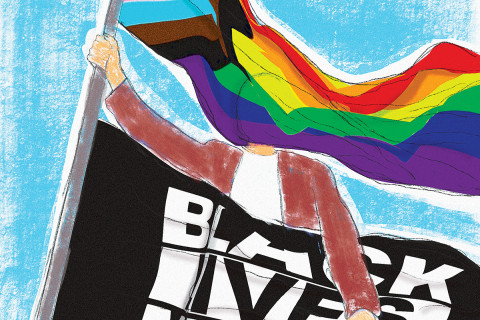
I read your October editorial with a heavy heart (“Christian progress, Christian regress”). As you note, for many of us the challenge to Obergefell v. Hodges is not just a legal matter—it is deeply personal. As a gay man, I worry about my own marriage. As a pastor, I worry about the rights and dignity of many within our community of faith. We worship a God of mystery whose love reaches far beyond our understanding but is revealed in Jesus Christ. Again and again, scripture calls us to make room for one another, to build longer tables rather than taller walls. Yet when some claim to know the whole truth of God and use that claim to exclude people, the table of Christ’s love grows shorter. In times of fear and uncertainty, our call remains clear: to stand together and pray that our leaders and decision-makers would be guided by justice and compassion. May we continue to live as witnesses of a God whose love is wider than we could ever comprehend.
—Terry Hagensen
Turtle River, MN
A farewell to Wells
Thank you to the Century for the years of publishing Sam Wells’s columns. He will be much missed in the Voices section—but all of your columnists contribute to this layman’s Christian understanding.
—Dix Fulton
North Bend, WA