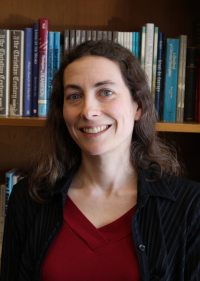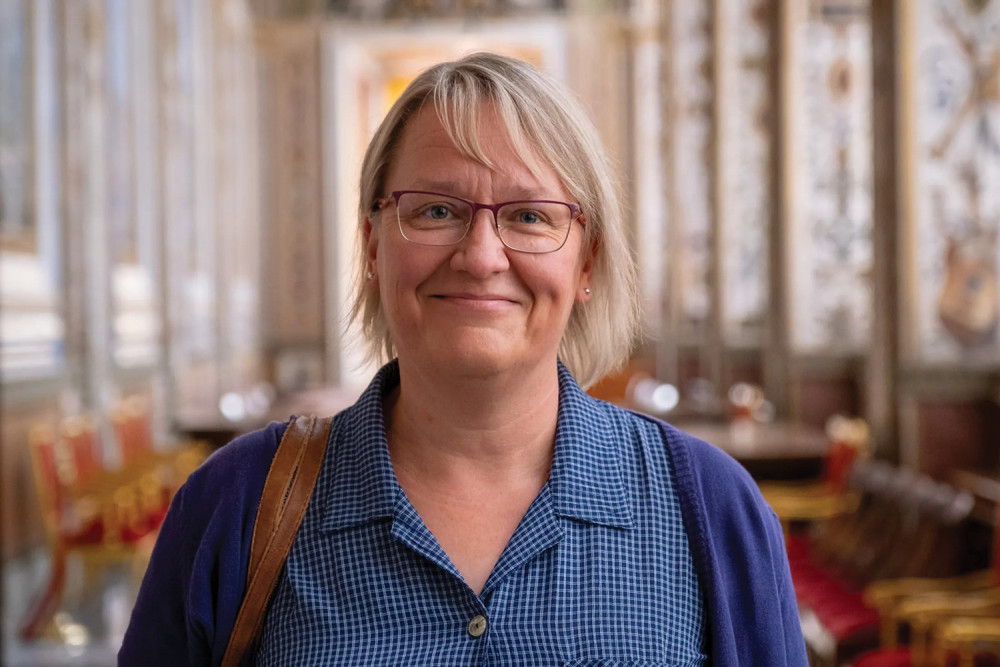
Maria Immonen is director of the Lutheran World Federation World Service, the humanitarian and development arm of the LWF. She holds a master’s degree and honorary doctorate from the University of Helsinki and has spent her career working in global humanitarian assistance and sustainable development.
What is the Lutheran World Federation, and who is part of it?
The Lutheran World Federation was founded in Europe in 1947, shortly after the Second World War, when Lutheran churches came together to help people in need. At that time, one out of every five or six people on the move—whether they were internally displaced or actual refugees—were Lutheran. The churches were deeply impacted by their own members being victims of war or displacement, so from the beginning they worked closely with the Red Cross movement and the Catholics in responding to refugee needs in Europe. Soon after that, World Service was founded as a formal structure within the broader LWF, with the goal of responding to humanitarian and development needs globally.
Read our latest issue or browse back issues.
Since then, the LWF has expanded to include 153 member churches from 99 countries, including the Evangelical Lutheran Church in America. Together they represent more than 78 million Lutherans, and they range in size. For a long time, the largest LWF member churches were the founding ones: the Nordic churches and the churches in Germany. Today, we can see a shift to the Global South: the largest LWF member church is in Ethiopia, the second largest is in Tanzania, and the third largest is in Indonesia. World Service has also grown and responded to almost all large-scale humanitarian crises since its founding.
So basically, you’re a giant international nongovernmental organization that does humanitarian and development work in partnership with Lutherans from all over the world. Where do you get your funding?
It’s complex. We function as an NGO when we’re talking about LWF World Service. But from a theological perspective, the LWF is a communion of churches, and its mission involves everything that the idea of communion brings to bear on how churches relate to each other. LWF World Service implements one aspect of that communion’s mission: diakonia, or service to the world.
Funding for the core structures of the LWF that don’t relate to World Service are covered by membership fees that the member churches pay. Those fees take into account the church’s membership numbers, the country’s gross national income, and so on. For the work of World Service, we receive institutional funding from donors, government-backed funding, and donations and other funding from what we call our related agencies, which are often the diagonal arms of the member churches—such as Finn Church Aid in Finland or Global Missions in the ELCA. We also receive some funding from individuals, states, the EU, and various other sources.
We’ll come back to the funding question. But first, tell us about some of the most exciting projects happening right now in World Service’s country programs.
That’s a really difficult question, because we have so many and I love them all. One that I was recently reading about is the work we’re doing in Colombia with people who have been injured by land mines. The country is full of land mines, so it’s common to accidentally step on one and get injured. These land mine victims end up in very marginalized situations: They often lose their ability to work or go to school. So we work with them to help them recover their agency over their own lives.
We often emphasize education. In Nepal, we work to help girls stay in school through puberty so they don’t get sold off into early marriage. Early marriage is very prevalent in poor families there, so we provide the support these girls need to stay in school. Another example is our programs in Kenya and Somalia, where we provide the support for disabled children to be integrated into the local educational systems.
Can you explain the difference between humanitarian work and development work?
A humanitarian disaster is the kind of thing you see on your television, and our initial response focuses on acute needs. Then, as things improve slightly, we move into what’s called recovery, where people start slowly to make sense of how to rebuild their lives. Only after recovery can we get into long-term development. But it’s not a linear process; the two feed into one another. Often there are shifts back from development work to humanitarian aid, because repeated shocks can cause people to go back to a bad situation before they’ve gotten out of it completely.
In addition, the nature of conflicts has changed, causing more people to be in acute humanitarian situations for a very long time. For instance, in many refugee settings, people live in camps that are much like prisons. They may be able to do a little bit of kitchen farming or something else, so the camps don’t look like prisons. But people are stuck there for a very long time. The average time a person spends in a refugee camp is around 17 years.
Wow, that’s a shockingly long time.
Well, there are fewer and fewer durable solutions. The opportunities for refugees to find a place to live in the United States or Europe or Australia are increasingly rare. And almost all conflicts are becoming more protracted. When there’s no effort made to stop the conflict, people can’t start rebuilding their lives.
LWF World Service is known for its rights-based approach to humanitarian aid and development work. How is that different from other approaches, like, for example, a faith-based approach?
Well, the way we see it, a rights-based approach is a faith-based approach, because it focuses on the dignity of people who have human rights, and human dignity is an essential part of faith. But there are other kinds of faith-based approaches, such as a charity-based approach. That’s when you look at a crisis situation and see that a girl doesn’t have shoes, so you give her shoes. And she does need the shoes, but she may also need more basic things like shelter or protection from violence. If you react only out of the goodness of your heart, without thinking about the girl’s larger context, you might not be giving her the assistance she needs the most.
The other reason we talk about human rights is that it provides us with an international framework that’s globally recognized—and it’s also a legal framework. States that have signed on to particular human rights conventions are responsible to their citizens to fulfill those rights. So, for instance, if there are not enough schools in South Sudan, we will support the South Sudanese government in their role of providing education. We might challenge them: “Look, we’ll build you the building and we’ll run this school, but how about you give us two teachers from your system to come and work in the school?” And then, little by little, we’ll transfer responsibility for the school to the government—because it’s not the responsibility of NGOs or churches to provide schools. It’s the responsibility of the government.
You work in a lot of different countries, and you cycle in and out of them as the need arises—do I understand that correctly?
That’s how it’s supposed to work. But we often get stuck for a very long time, because emergencies stretch out or development needs continue. For instance, all I need to say is “our program in Haiti,” and you will immediately understand why we can’t leave: Things in Haiti are unimaginably bad, and yet they keep getting worse. Unfortunately, that is somewhat typical.
That being said, once we’ve built an organization in a country that does have capacity, we hand it over to local governance and ownership. In the early 1960s we entered Tanzania to set up a refugee response because refugees were coming in from all of the neighboring countries. We were there for 40 years, and in that time we slowly built up a local organization that we eventually handed over to the church as an independent entity. So the church in Tanzania now has a refugee response organization linked to its structures that it runs independently. We don’t need to be there anymore.
Is the church in Tanzania running the country’s entire refugee response?
Yes and no. The Tanzanian church wasn’t initially built up in a way that allowed them to access funding from the European Union or the United States or the United Nations. With our help, they now have within their auspices an independent entity with specialized know-how and structures to access those funds.
Globally, LWF World Service has around 6,000 staff members, and 99.4 percent of them are local. Our work is based on building local capacities and making sure that our colleagues grow in their jobs in a professional manner. We don’t just have humanitarian cowboys that we send around from place to place. From the very beginning of each program, we look for local expertise in running it.
The LWF says that to be Lutheran is to be evangelical, sacramental, diaconal, confessional, and ecumenical. You mentioned before that World Service enacts the diaconal part of that mission in particular, putting LWF’s theology into action. Where do you see Luther’s theology fitting into your daily work?
I’m not a theologian, but my understanding of church in the Lutheran tradition is that it doesn’t just offer the word and the sacraments; it also does diakonia: service. If a church isn’t serving the world around it, it’s not a church. Our calling is to seek Christ out in the margins, and not because we want the people we meet there to convert. They’re created in God’s image, so we just need to help them. I think that’s very Lutheran.
I should add, though, that only about half of our staff are Christian. The other half are predominantly Muslim. When I ask them why they joined LWF—rather than, say, Muslim Aid or Care International or Oxfam—we often end up having values-based discussions about what’s most important and why we do this work and how we can work together toward the same goals.
How has your work been affected by the Trump administration’s massive cuts to international aid?
Those cuts have had a huge impact. We relied on US government funding particularly in our large refugee operations in East Africa. For those programs, the funding was there one day and gone the next. On a global level, the US funding cuts impacted our budget by about 15 percent. And since the US grants came with an administrative overhead, the cuts had a disproportionate effect on our global coordination structures, which we’ve had to cut by 25 percent. So we’ve had to restructure a number of our country programs as well as our headquarters. We’ve had to lay off at least 300 staff.
That’s from the organizational perspective, but of course the real impact is on the people who we can no longer help. One dramatic example is in South Sudan. The civil war in Sudan has displaced 12 million people, so refugees are pouring into the northern region of South Sudan. We have schools near the border, and those schools used to have feeding programs that were funded by the US government. When the funds were cut off, we had to scrap those programs. Now the kids aren’t coming to school because they’re too malnourished, and the girls are being sold off because the parents have too many mouths to feed. So these girls go into a new family, where they are subjected to early marriage and early childbirth. That’s an example of the sort of immediate impact on very vulnerable people we’re seeing in the field.
And the cuts from the United States are not the only problem. Many countries that used to be big donors of humanitarian assistance are also giving much less—partly because military alliances can no longer rely on the United States. The governments in Europe are now building up their military budgets at the expense of their development and humanitarian budgets. So we’re being hit from all sides. The more we spend on war, the less we can spend on international aid and development. It’s disheartening, because a single day of the conflict in Iran would probably cover the world’s humanitarian needs for months.
How are some of the other current wars, such as the war in Ukraine, affecting your work on the ground?
Well, we’ve always operated in war zones. But the use of drones in warfare has recently made our work more difficult. In the first four months of 2026, our humanitarian workers were directly at risk of being injured or killed by drone attacks in four different countries, one of which is Ukraine.
In addition, the erosion of international humanitarian law—and the impunity with which state actors are just bombing everything out there—has made the work of humanitarians in immediate conflict zones extremely dangerous. Before, if we had the LWF logo on our car’s roof so helicopters could see it, we were safe. Now that same logo makes us a target. Many of these warring parties are targeting humanitarians, because they don’t want anyone to witness what’s happening. This has been a massive and rapid shift. Our staff in these regions are stressed and tired all the time.
Amid this reality, where do you find hope?
A few weeks ago, a colleague who works in Somalia updated me on a diagnostic center for children with disabilities that his team recently set up. We thought that maybe a few dozen people would come each week. But the center has been flooded by people, some of them traveling from very long distances. I’ve been thinking about those mothers, who can see that other parents have disabled children too. The nurses and physiotherapists on staff can show these parents how to work with a kid who can’t move or who hasn’t learned to walk. We can tell them that this is not a punishment from God; their children are valuable. That’s where I find my hope. We can’t help everyone, but we can help a lot of people.
That reminds me of Luther’s idea of the finite holding the infinite, which came out of his sacramental debates. When people asked him how Jesus’ body could really be present in a tiny piece of bread, he would say, “Well, the finite has the capacity to hold the infinite in ways that we can’t explain.” That mother in Somalia who sees another mom of a disabled child for the first time and realizes she’s not alone—that’s a really small thing compared to all the suffering in the world, but it has the capacity to tell a bigger story.
Yes, these small things hold a much bigger story. They do. But there’s another side to it. Imagine if we had the capacity at that clinic in Somalia to distribute an egg each day to every child and every pregnant mom. In that area, drought is prevalent, many women are malnourished throughout their pregnancies, and the number of children born with physical or mental disabilities is higher than we could imagine in the West. An egg is a small thing; it only costs a few cents. But we don’t have the funding for those eggs. How is it that we, as humankind, can’t at least buy eggs for kids? So there’s hope in the small things, but there’s also despair in them—because the solutions are right there, just out of our reach.
How can someone like me—a Christian in the United States—help you get those eggs?
Well, the most direct way is to donate, and it doesn’t have to be to LWF: You can donate to any organization that provides humanitarian assistance and supports long-term development in the world’s areas of highest need. Every small gift helps. Even if you feel like your donation is a drop in the ocean, it will be life-changing for the people it reaches.
That’s helpful, because I think a lot of people in the United States are feeling pretty powerless right now. What I hear you saying is that we do have power; we just need to find where it is.
That’s right. And another thing I’ve learned in my work is that churches don’t die with political conflict. Whatever else changes, churches will still be there. They actually have the potential to grow in difficult times—if they concentrate on the right things.