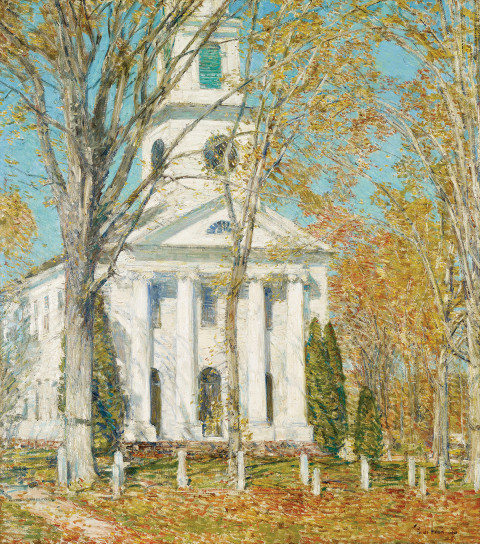
Several years ago, I—a nonagenarian who served as a parish minister, campus minister, and academic—discovered six poems by Marilyn Nelson in my mailbox. They had been torn from a literary quarterly and mailed to me by my best friend, who knew that the transmuting of history to poetry is a process I value. Nelson’s poems would eventually become a part of The Meeting House—a long work made up of short poems about the history of an actual congregation, First Congregational Church of Old Lyme, Connecticut. The poems span from the church’s inception to its 350th anniversary.
Most church histories are either a celebration of themselves that differs little from public relations or an exercise in academic history, or a synthesis between the two. Usually there is emphasis on buildings, clergy, and temporary movements that distinguish one period from another. Usually there is little emphasis on the laity and almost nothing about the pattern of personal piety in the lives of everyday parishioners, whether reading scripture or saying grace before a meal. Usually there is much about faith but little about doubt.

Read our latest issue or browse back issues.
Though The Meeting House, published in 2016 by Antrim House, is a difficult book to find copies of, it brings all our era’s critiques of common life to bear on the past of the congregation: questions of gender, race, and class. Generally church histories don’t give us the subjectivity of church members: their dreams and nightmares, their lifestyles, their interior monologues. But in The Meeting House we find reports on dreams, enter into stream of consciousness musings, and overhear dialogue. The result is an honest church history, depressing as well as inspiring.
As First Congregational neared its 350th anniversary, the minister asked Nelson—a parishioner of the church—to consider writing poetry in observance of the event. Nelson is the former poet laureate of Connecticut, a chancellor of the Academy of American Poets, and a three-time finalist for the National Book Award, including once for her children’s book Carver: A Life in Poems.
The Meeting House consists of 25 poems presented in chronological order. Some are anchored in national political events: the Revolutionary War, the War of 1812, the Civil War, abolition, women’s suffrage, the two world wars, and the Vietnam War. Others are anchored in national religious events experienced from the viewpoint of Protestantism: the Great Awakening, the temperance movement, the social gospel, and the ecumenical movement. One poem can even be linked to American Impressionism, while others have a more parochial focus. They all have a connection to Connecticut.
Nelson’s chief themes are introduced in the first poem, which concerns the original 1666 meeting house. The first of its two stanzas opens by focusing not on architecture but on soundscape—and more specifically, sound effects. The European invaders make a difference: first of all with their language, English, which is new to the environment; second, the metal of their tools; third, the cobbling of their boots (as opposed to moccasins); fourth, gunfire; and finally, the drumbeats that summon them to worship. The first stanza ends with these lines: “a container for worship, a refuge / from the New World of heathen savages.”
What does it mean to contain worship, to put a box around our conversation with the infinite God? And how is a church diminished when we regard it as a refuge, assembling together as a means of escape from the aspects of reality we don’t wish to face? A photograph of the gravestone of the congregation’s first minister, Moses Noyes, accompanies this poem, reminding readers that a congregation’s history shapes its present. The second stanza concludes by describing the segregated seating arrangements, which separate female from male, adult from child, White from Black—the hierarchy of patriarchy. While the first stanza ends with the words “heathen savages,” this stanza ends with the word “slaves.”
The consigning to secondary ecclesial status of Indigenous and Black people is a theme woven through The Meeting House. The second poem in the collection is about the meeting house’s first minister and his enslavement of Arabella, the woman who becomes a surrogate mother for his children when his wife dies. In the third poem (which at only eight lines long is the shortest in the book), “one mulatto girl / of three years old” is sold by one church member to another to be enslaved for her entire lifetime.
Some characters appear in multiple poems. In the page-long “X Her Mark,” Temperance, a young woman who is of both African and Mohegan lineage, questions her own agency. She imagines addressing Oxford, a fellow enslaved person whom her owner has decided will be her husband. The consent to sale she will sign by making her mark pretends that the marriage is her choice rather than that of her owner. The legal document dictates that Temperance and Oxford’s children will become property. This poem makes clear that White supremacy carried tragic consequences for enslaved Africans and Native peoples. “What if Africa hadn’t been plundered, / or this land seized? Would our eyes have met?” wonders Temperance.
The themes of these early poems—the racism inherent in White supremacy and the church’s ease in adopting the conventions of the dominant culture—run through the book. “The Patriot Preacher” depicts a pre–Revolutionary War minister decrying England’s “enslavement” of the colonists in a newspaper article which is read by a family while the girl they enslave recalls her recent baptism by the minister. In “The Continental Army,” an enslaved woman watches as a military parade led by George Washington passes by the church. She and the other Black onlookers are dumbfounded to see the uniformed troops marching in practiced unison to the beat provided by “the least of these,” a Black drummer.
Perhaps the most insistent theme in the book, after racism, is doubt. During the military campaign against Native people described in one poem, God appears to be absent from morning prayer. Several times the poems imply that there can be faithful ministry without faith—and that the thinking Christian has to entertain doubt.
The Meeting House presents an honest church history in the form of reader-friendly poems. Nelson’s use of language is exact and concise—not far from prose, but consistently poetic in its use of imagery, figures of speech, and sound effects. The ironies in these pages are simultaneously obvious and subtle. Through it all, Nelson invites us to be honest about the histories of our own faith communities and where culture has shaped them rather than the gospel.