Looking back on that night on the mountain, I’m tempted to call it a singularity—a sudden leap forward in consciousness. Sometimes it’s only much later that we find words for an experience we’ve had in the past.
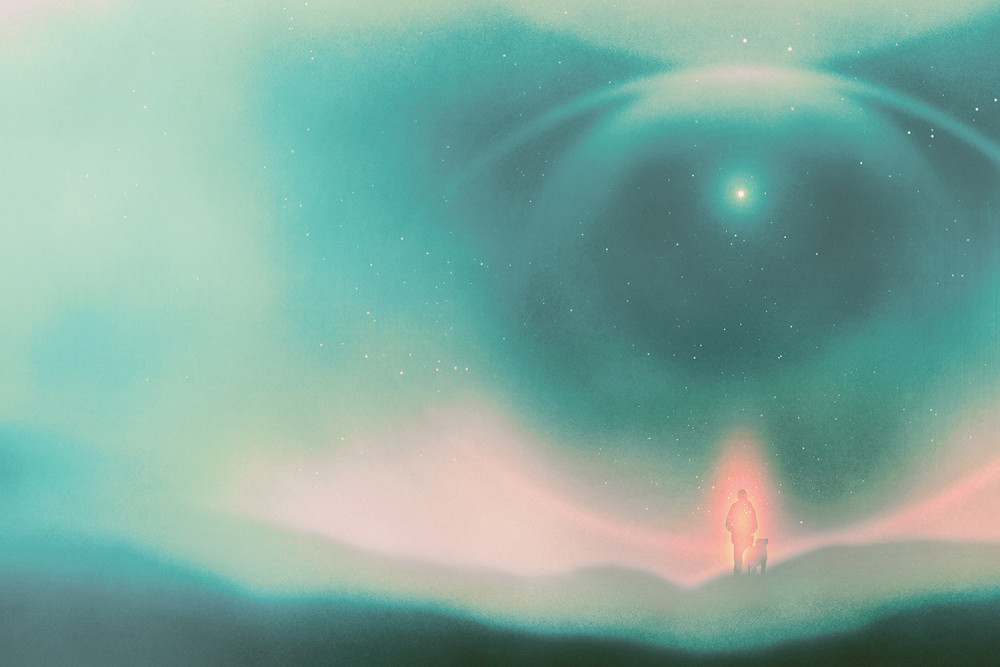
I was camping in early January on a mountaintop in the Missouri Ozarks. Waking up in the middle of the night, I had a feeling I’d experienced before when backpacking alone: I knew I was being watched. With the dog still asleep beside me, I knew that whatever it was couldn’t be very threatening. Something high overhead had fixed me in its vision—maybe a night-hunting owl or a peregrine falcon.
Read our latest issue or browse back issues.
As I stared up into a sky full of stars spread from one horizon to the other, I was struck by the brightest star in the constellation directly above me. It was Rigel, a blue-white supergiant that marks the left leg of Orion the Hunter—a familiar but stunning image. I had an uncanny sense of being singled out by this star, like a rabbit held paralyzed in the hunter’s gaze. But in this case, I sensed being looked upon with wonder—the same wonder with which I responded back. One attraction prompted another.
Rigel is the seventh-brightest star in the sky, tens of thousands of times brighter than our sun. It is located 870 light-years from Earth. The light I witnessed that night had left the star almost nine centuries earlier. These are numbers I cannot fathom. Even more absurd was the thought that the star was seeking connection with me. My mind assured me that its twinkling was due to the bending of its light moving through warmer and cooler sections of the atmosphere, but my imagination insisted that the star was trying to get my attention. Lying vulnerable atop a mountain at two o’clock in the morning, I’d become the object of a star’s fascination.
Suddenly I wondered if this were but a single instance of what happens over and over again throughout the universe in any given moment: one body is inextricably drawn to another. Isaac Newton’s insight established that every object in the universe attracts every other object with a force proportional to their mass and inversely proportional to the square of the distance between them. One is always seeking out another and longing for connection, enamored of what seems so different, so intriguing, so far. The world is fed by one desire awakening another. Rumi knew that “the thirst in our souls is the attraction put out by the water itself.” Cosmologist Brian Swimme writes this: “By pursuing your allurements, you help bind the universe together. The unity of the world rests on the pursuit of passion.”
So what was this mystery, this desire, preying on my mind, coming back to me years later? Dare I imagine that my sudden burst of insight, coming on a winter night in the wilderness, constituted a singularity—a unique, world-changing moment? It certainly occasioned a remarkable shift in my own consciousness. I’d known as a child that I’d been singled out by a God of immense majesty who deigned to love something as insignificant as me. But that night in the Ozarks I was opened to the mystery that this yearning to connect pervades the entire universe. Everyone and everything is caught up in its web. From orb weaver spiders and pollinating bees to drifting continents and spiral galaxies, each one is insatiably curious about the other and wanting to fall in love over and over again.
The experience has led me to an obsession with Thomas Berry’s notion of the great conversation extending across human and more-than-human boundaries. I’m intrigued by proliferating accounts of people communicating with other sentient beings: Yo-Yo Ma playing his cello for breaching whales, Temple Grandin using her neurodivergence in communicating with animals, David Abram marveling at the spell of the sensuous, Mary Oliver in conversation with trees. These are forays into a mystery that’s rushing toward us—a growing sense of the unity of life on our blue planet hanging in space. It’s what left the first astronauts speechless.
In the unfolding of evolution, might the human species be approaching a massive shift in human perception, one that rids us of the illusion that we’re separate from the rest of the living, self-aware, and highly interactive Earth community? What new reality might appear—flushed with unimagined possibilities—were we to embrace Wendell Berry’s notion of our membership in the family of Earth? Joanna Macy’s vision of a great turning? Thich Nhat Hanh’s conception of the inter-being we share with everything else?
The idea of a sudden mushrooming of consciousness may seem highly unlikely. Yet throughout human history there have been informational cascades that give birth to radically new conceptions of Earth and our life together. We’ve moved from a flat planet to a spherical one, from a geocentric to a heliocentric solar system. Darwin disclosed our connection with the vast array of others on the evolutionary tree of life. The discovery of DNA amazed us with the number of genes we share with trees (up to 60 percent) and chimpanzees (98.8 percent). The Webb telescope continues widening our sense of kinship with galaxy after galaxy. Breakthroughs of the mind and spirit are increasingly less surprising.
Ray Kurzweil’s 2024 book The Singularity Is Nearer: When We Merge with AI is what recently brought my attention to this concept of a singularity. Kurzweil is one of the earliest researchers in artificial intelligence, having successfully predicted breakthroughs in its development long before they occurred. His latest estimate is that by 2029, computers will pass the Turing test, fully matching—if not exceeding—the limits of human intelligence. (Alan Turing was a British mathematician, the father of modern computer science.)
More stunning yet, says Kurzweil, is the breakthrough that will occur by 2045: “We will merge with AI and augment ourselves with millions of times the computational power that our biology gave us.” Brain-computer interfaces will expand the neocortex, giving the human brain access to the cloud and its massive body of information. This, Kurzweil argues, is the singularity that “will transform life on earth profoundly for the better.”
I’m not convinced that our access to an explosion of information will in itself transform the human mind, making our world inherently better. Mystics tell us that it’s not what we know so much as what we marvel at not knowing that gives us the humility of wisdom.
Neuropsychologist Nicholas Humphrey argues that evolution’s finest gift to us isn’t the ability to process data with phenomenal efficiency but the sensation of awe that leaves us speechless before what we can’t explain. He calls this “the biological advantage of being awestruck.” It gives us an “incentive to survive” so that we relish being here, we’re enchanted by the magic of experience itself, we stand dumbfounded by the astonishments that surround us. Theologians use the language of being ravished by beauty (Augustine), plunged into a mysterious darkness (Dionysius), or struck by wonder (Heschel).
In our most unsettling seasons of change, the soul can still be enthralled by mystery. Etty Hillesum held on to her childlike capacity for amazement even as she stared into the unfolding terrors of the Holocaust. “God has moved me up into a more advanced class,” she said, and “the desks are still a little too big for me.” She knew that in the breakdown of all she’d thought secure, God invites the heart to encompass what the mind cannot fathom.
We stand today on the cusp of a great transition. The promise of artificial intelligence is immense, allowing us to process astonishing amounts of information. Kurzweil observes that in 2023 a Google Cloud A3 virtual machine could carry out 26 quintillion operations per second—handling problems that 70 years earlier would have taken tens of thousands of years. Data centers around the world are churning out quantities of information that stagger the human mind.
This may prove profoundly helpful in dealing with issues like climate change, allowing us to track endangered species and deforestation patterns, reduce carbon and water use, coordinate programs supporting sustainability, and propose altogether new solutions. But access to a vast store of accumulated data does not, in itself, guarantee that we will make choices that benefit the planet. Explosions of knowledge and technology are invariably controlled by centers of wealth and power. They benefit privileged people at the expense of poor people and the environment. The possession of knowledge doesn’t assure we will use it for the common good.
We require more than the phenomenal processing power of supercomputers. We need to see ourselves standing today on another threshold as well—a breakthrough into a humbling sense of amazement at a world that reaches out to us, inviting us to affirm the bonds that link us to each other. The soul requires an explosion of both intelligence and awe. We need to be reminded of the unpredictable power of knowledge and ensure that the heart and body keep up with the mind by maintaining a grounded relationship with the earth as we explore the vast possibilities of the brain.
My deepest concern is to underscore the mind-blowing and heart-opening effects that a spiritual singularity (a colossal flash of insight) might exercise on the human spirit. Jesus spoke of this as the in-breaking of the kingdom of God: a sudden realization of the magnitude of the incarnation. We live in apocalyptic times, when whatever singularity overtakes us will announce the end of one age and usher in the beginning of another.
What, then, is a singularity? Different disciplines use the term in different ways: scientists working with systems theory, physicists theorizing about dark matter, mathematicians wrestling with infinitely large values, computer scientists exploring AI. To use the term in the broad-brushed way that I’m doing is to risk a vast oversimplification. I’m a meddler here in fields far beyond my expertise. I take refuge in the fact that the public task of the theologian is to serve as poet and provocateur, stepping in where we don’t necessarily belong.
The singularity, at the bare minimum, is an event unlike anything previously conceived. It makes thinkable what has never been imagined before. A singularity—depending on the context in which we use the word—can have any or all of the following five characteristics.
First, the breakdown of familiar patterns, where previous laws no longer apply, is an aspect of a singularity. Astrophysicists tell us that the gravitational force of a black hole in space is so extreme that matter collapses in on itself. In the singularity that occurs, nothing, not even light, can escape, so time and space cease to exist. What we experience as reality no longer holds.
Second, a singularity may be marked by a relatively small event that occasions massive change. Theoretical mathematicians working with chaos theory suggest that a small shift in one part of a system can have unexpected effects elsewhere. This is the notion of the butterfly effect. Vast changes often start in the most insignificant ways. The doors that open to amazement are often the smallest.
The third characteristic we may experience is an uncontrollable and irreversible leap into a new reality. The first test of the atomic bomb in the New Mexican desert in 1945 left Robert Oppenheimer thunderstruck. “I am become Death, the Destroyer of Worlds” he quoted from the Bhagavad Gita, having witnessed “the radiance of a thousand suns bursting at once into the sky.” The world in that moment lost something irretrievable. We were launched into an altogether new way of being.
Fourth, a new level of consciousness may emerge, one that appears limitless. At times of significant cultural change, mystics like Dōgen and Meister Eckhart have pushed for a transcendence of ordinary consciousness, breaking out of the confining world of the self. In this widening of perception, they embraced a world without borders that reconfigures the relationship of the individual to the whole. A singularity of this sort opens the soul to an apprehension of what the mind can’t even imagine.
Last, once we cross certain thresholds, there’s no going back. Climate scientists warn that if the planet continues warming another two degrees Celsius by the year 2035, we may reach yet another singularity in a point of no return with respect to climate stability. Cataclysmic consequences could follow. Forestalling such an event would require a singularity of its own, as human beings make choices with the oikos in mind, the entire household of God on the planet (Eph. 2:19–22, Ps. 24:1).
The singularity that most intrigues me is the awakening of a consciousness that binds us to the cosmos as the wider family of God. Western Christians have rarely taken creation seriously enough, focusing instead on individual salvation at the expense of the whole. To move beyond this would demand a striking conversion of the heart and mind, a cosmic matter of being born again, as Jesus would say.
Meanwhile, the rest of the family is already reaching out to us. We’re surrounded by tiny singularities, seeming impossibilities, that continually want to draw our attention. Attending to these small encounters with ordinary wonders may be one of our most important spiritual practices today. Moments of inexplicable awe are as common to the eyes of science as to the ears of faith.
I wonder, for example, whether an experience like mine that night on the mountain may be more common in our culture than we imagine. How often do we find ourselves being lured by a startling world reaching out to embrace us? A towering cedar tree suddenly appears as one walks an Irish footpath, blocking the sun and provoking astonishment laced with fear. A butterfly lands on the nose of a three-year-old child, opening her to the sheer fascination of delight. Initially we suspect there’s magic at work. But we quickly dismiss these singular moments of bewilderment as no more than phantasms of the imagination. The tree has no mystical intent. The butterfly isn’t concerned with the child’s pleasure. Instead of being awestruck at a world that wants to connect, we rule out mystery altogether.
By contrast, were we to imagine the multiplication of these tantalizing experiences across an entire culture—building toward an explosion of insight—we might find ourselves in a world where everything is alive, where everything belongs. Our intimate connection to the others would be as readily apparent as the law of gravity.
This has happened in diminutive ways throughout the history of Western science and spirituality. Playing in his backyard at age seven, Teilhard de Chardin dug up an iron plow hitch and was stunned by the weight—the captivating “thisness” of matter. He was “sought out” by the palpability of things, and a nascent paleontologist was born. As a child, G. K. Chesterton gazed on a dandelion and suddenly experienced “a submerged sunrise of wonder.” For the rest of his life he viewed the world with the ecstatic delight of a child. C. S. Lewis and J. R. R. Tolkien strolled one evening down Addison’s Walk in Oxford. An abrupt gust of wind encircled them, with falling leaves swirling wildly. Enrapt in a cosmic mystery, Lewis was swept by his enchantment with myth into a deeper faith.
At age four, Jane Goodall hid for hours in a henhouse to learn how hens lay eggs. She emerged with sparkling eyes of wonderment—only to discover that her parents had called the police, frantic over her disappearance. A sixth grader wrote a letter to Thomas Merton, asking about his life in the hermitage at Gethsemani. The Trappist monk responded in the voice of a 12-year-old, remembering his childhood in southern France: “I live alone in the woods with squirrels and rabbits and deer and foxes and a huge owl that comes down by my cabin and makes a spooky noise in the night, but we are friends and it is all ok.” One night, Rachel Carson waded through the stunning bioluminescence of sparkling creatures in the surf near her summer home on the Maine coast. She marveled at a firefly attracted to what appeared to be other lightning bugs there in the water. Getting too close, the firefly was quickly swept under by a wave, but she managed to save it. She knew in that moment that there was hope for a world full of astonishment.
There are times when we glimpse an indefinable mystery lying in what we’d previously disparaged as merely ordinary. We sense a crossing over into another dimension. Whenever life establishes a foothold in the world, says Teilhard, we can expect it not only to expand but to reach out with an intensity that’s explosive. We witness a shift from “simple Life to ‘Life squared.’” Common occurrences reveal their potential for magnificence. Science stumbles into poetry. Life sings.
What singularity do we seek in the end? A boundless expansion of intelligence or an ability to stand in awe at the wonder of being alive? The choice, of course, is artificial. We need both—an understanding of the complexity of the world around us and an appreciation of how amazingly entwined we are with each other. Evolutionary scientists are now saying that cooperation is as important as competition is to the survival of species. Reaching out makes sense. It fosters collaboration. It also resonates with the theological conviction that every attraction in the universe is rooted in an underlying allurement at the heart of being itself.
God is continually luring the created world to a consciousness of its divine nature—to its fullness in the cosmic Christ, the Omega Point toward which evolution is aimed. Every little encounter, says Richard Rohr, discloses the universal Christ, the explosive reality that Jesus anticipated. We exult in a God who “loves things by becoming them.” Call it an extension of the churning love at the heart of the Holy Trinity, a scintillating world that for Rumi disclosed the ecstasy of the Beloved, or a manifestation of wonder caught in the dancing eyes of Krishna. It’s an indescribable vision of wholeness. A recognition that we already are one, that every life carries the DNA of the divine.
All this came home for me a year ago at Ring Lake Ranch in the Wind River Range of Wyoming. I was leading a retreat where we discovered that four couples among us had lost adult children over the last two or three years. My wife and I had lost our son Jon to cancer three years earlier. The pain was still fresh for all of us.
On our last morning together, we met down by the lake, where snow-dusted mountains rose in the distance. We’d gathered to dedicate a wooden bench in memory of the 18-year-old daughter of one of the couples. Her name was Bee, and the story of her unexpected death had touched every one of us. We were invited at one point to throw a stone into the water and speak a few words. When it was my turn, a fierce wind suddenly came sweeping across the lake, driving me to my knees. Something wildly alive had wrestled me to the ground. Impulsively I cupped my hands and shouted out as loudly as I could across the water. “I love you, Jon!” I said, “and Bee! May you dance together!”
Within a few seconds, an osprey came flying across the lake toward us, soaring in circles directly overhead, calling out as it flew. Soon a second osprey joined it—the two flying in circles above us, around and around. It was as if the universe were assuring us that love was not forgotten, that in a wild and untamed wilderness two lost children were still part of the whole. In that moment the earth joined us in a mystery we would never forget, welcoming us into the unthinkable allurement of God’s longing to connect, giving us a taste of singularity.