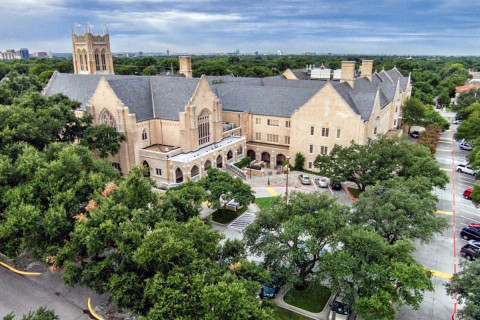


On a bright, crisp morning in early May, a group of community members makes its way around the University of Chicago campus, stopping in front of buildings, lingering on lawns, clustering underneath budding tree branches, and gazing out and up while listening intently to their group leader’s animated exposition. Tour groups on campus are commonplace—prospective students and their parents visit year-round, led by undergraduate guides skilled at walking backward while delivering rapid-fire monologues full of campus facts and figures. On this occasion, however, the audience is more diverse—we are scientists, clergy, community organizers and nonprofit leaders, divinity school faculty and students, and neighbors. The pace is leisurely, and the questions are about not class sizes or dorm life but the names and habits of the native trees, prairie grasses, and wildflowers that share our urban landscape.
This is a “tree walk,” led by Kathleen Golomb, the university’s manager of campus environment and design, and meant to introduce participants to the campus not simply as a collection of buildings but as an arboretum. UofC’s 217-acre campus was designated as a public botanic garden more than 25 years ago, and this garden has been contributing to the well-being of the community ever since. As we walk, we experience intimations of this well-being firsthand, our minds awakened by our guide’s descriptions of the lively ecosystems that sustain diverse colonies of plants and animals. Our imagination is activated, our curiosity stirred. Now our eyes can discern the distinctive growing patterns of branches and the many shades of green in budding leaves. Snatches of birdsong inspire intervals of silence: We pause together to listen, as if one body. Heart rates relax and spirits soar. The environment—so often problematized, its decline inciting anxiety, worry, and fear—becomes a source of connection, resilience, and joy.

Read our latest issue or browse back issues.
The tree walk was part of a one-day conference called Living Well During Climate Change, hosted by the divinity school with support from a grant from the Climate Science in Theological Education initiative of the American Association for the Advancement of Science. Planning began the previous year, when three faculty members invited a group of Chicago-based clergy, environmental nonprofit leaders, and graduate students to meet monthly for a year to explore the depth and breadth of our human responses to climate change. The project’s aim was not to debate the veracity of climate science, to amass evidence of environmental decline, or even to garner support for one mitigation strategy or another. It was to create a community of conversation and support for the essential work of determining what it might mean to live—and to live well—amid the reality of climate change.
These workshop conversations acknowledged that the effects of climate change—rising sea levels, extreme temperatures, floods, wildfires—are now a present reality for communities around the world. We also recognized that many people are experiencing not only environmental, economic, and social change but also grief, anxiety, guilt, shame, despair, and existential dread. Participants identified the presence of these emotions within their congregations and community organizations. In a reflection of the wider culture’s rising concern over the emotional toll of climate change on young and old alike, our campus hosts both a climate anxiety group for students and an existential risk group formed by scientists. Applications to the divinity school’s MDiv program also articulate this deep hunger for values, meanings, and practices that can address the myriad effects of climate change on human systems, most especially its impact on the human psyche and spirit.
While these existential dimensions of climate change have received some scholarly attention, they remain understudied. Psychological research can document the deleterious effects of climate change for people’s sense of wellbeing, but what then? Religious traditions have long been sources of wisdom in the face of personal, societal, and environmental threats, with teachings and practices that invite us to engage such challenges with open eyes, open hearts, and an expansive understanding of what it means to live well. What might happen, we wondered, when climate science, religious sensibilities, and community members meet in the spirit of mutual exploration and collaboration? What might we learn from each other about the human spirit—both its precarity and its ingenuity—in the face of climate change? The monthly workshops invited participants to explore these questions, offering time, space, and a broad menu of texts, presenters, and activities as catalysts.
We began our work together with readings from Paul Bogard’s edited volume Solastalgia, named for the concept philosopher Glenn Albrecht characterizes as “the homesickness we feel while still at home.” In the book, Bogard, Albrecht, and others describe the pain and longing they feel as they notice changes in their corners of the natural world. Reading it together, we were able to articulate our own experiences of climate grief associated with places precious to us. This act of naming and narrating these losses was inspiring, not dispiriting: Attending to our grief reinvigorated our appreciation for these places. Several group members reported feelings of relief, confirmation, empowerment, and even joy.
Perhaps this depth of emotion in response to climate change should not be seen as disordered or dismissed as collateral damage but instead apprehended as a form of intelligence, an affection that reawakens our connection with our planet and with one another. Acknowledging those connections, experiencing real grief, and talking together about our losses built a scaffolding of trust and truth that made this community of discourse valuable and real; the power of our shared emotion emboldened our ongoing conversations and explorations.
Over the course of our year together, we heard from local scientists engaged in climate research. We increased our awareness and updated our knowledge; we also made sure to ask these guests about their own relationship to their emotions in response to climate change. There were moments during those exchanges when scientists and clergy recognized that they had a difficult challenge in common: telling complicated truths in a culture that resists both hard news and complexity. Together we were able to acknowledge the vulnerability and cost of such truth telling, and we found renewed strength for that work in one another’s acknowledgment and encouragement.
Another guest presenter—a poet and artist—led the group in a salvage art project, sharing some poetry she created with words clipped from the paper in her recycling bin and inviting us to do the same. Participants strung words together—literally threading salvaged print on strings that spanned the room—in an improvisational performance that was by turns playful and profound and underscored the creative energy of embodied, collaborative witness. Other sessions made space for participants to reflect on our own practices of climate justice, deepening connections with each other, sharing strategies for sustainability and resilience, and closing each workshop gathering with reflections, readings, or poems from our own traditions’ wisdom.
Accessing our emotions as a source of intelligence, wisdom, and connection; engaging climate science in a spirit of care and concern rather than agonistic culture combat; learning from each participant’s connection to the environment and their practices for healing the earth and themselves; experiencing creative forms of individual and collective expression—all these activities informed the planning of our May conference. With the shared insights and imaginative leadership of these cohort members, organizers planned a campus- and community-wide event that took its inspiration from the workshop’s curriculum. The day included sessions typical of academic conferences, such as a panel of local scientists presenting on their research. But these scientists shared both their anxieties about the task at hand and their excitement about research findings that help communities live well—planting more trees in urban neighborhoods, walking in natural spaces to improve mental health, paying close attention to air quality not only in the skies above our cities but in our homes. Representatives from nonprofit organizations described their efforts to engage their communities in climate actions that were meaningful and sustainable; their presentations created a palpable synergy in the room, weaving a network of mutual concern and solidarity even as they spoke.
Other speakers added their own innovations to the usual conference menu. A recent MDiv graduate presented on climate change, theology, and comedy, exploring the relationship between our vulnerability and our capacity for humor in the face of our own precarity. A standup comedian—another MDiv alum—offered a performance that embodied Christianity’s ancient wisdom that holds life and death, grief and joy, in irreducible and irresistible tension. As humans and as people of faith, we always live and move at that incarnational intersection.
Throughout the day, conference attendees were invited to connect with one another, with the natural world, and with themselves in a variety of participatory experiences: the tree walk, an art exhibit, guided storytelling circles to explore their own solastalgia. Transitions between sessions included brief breathing exercises and guided meditations; participants were encouraged to take breaks for silent prayer in the divinity school chapel. Even lunchtime was an opportunity to connect with the environment and with one another, with a locally sourced vegan menu and discussion questions about foodways to prompt conversation at each table.
The feedback from conference attendees was as spirited and engaged as the conference itself. In place of the usual comments about information fatigue or the paralysis of environmental responsibility, people described feelings: feeling seen and heard in their grief and loss, feeling encouraged by the presence of so many people doing good work on so many fronts, feeling inspired by the breadth and depth of one another’s practices and responses to climate change, and especially feeling wonder, awe, and joy in those moments when a speaker or activity sparked a connection with the natural world.
One workshop participant and conference planner, an MDiv student, described his experience of the Living Well project:
I recently read John Barton’s The Nature of Biblical Criticism, where he defines a religious outlook as one focused on the “appreciation of reality.” I think for many of my friends, most of whom are not religious, this would sound like an odd definition of religion. Yet this group is a great example for how religion needs to be focused on realities, both externally in our warming climate, and internally in our emotional responses to it. . . . Today, I am going to test air quality in a friend’s apartment, which I would not have done before this group. Last week, I put off my homework to go look at snowy owls in the city, and when I wrote my ordination paper for the UCC, it was full of lessons I’d learned from our group. . . . My first memory is monarch butterflies, and I can express my witnessing of their decline as a sort of chaplaincy, similar to watching a patient struggle with a terminal illness. And yet, I still plant milkweed in our church garden, praying at least one butterfly will savor it.
Our project’s funders initiated a conversation between scientific knowledge and religious wisdom, our scientific partners helped us understand the impact of climate change on planetary life, and our religious traditions reminded us that living well involves being fully present amid challenges and fully connected to our own emotions, to each other, and to the nonhuman world. What none of us expected was the extraordinary power of this connection for exploring such a massive issue as climate change. Convening matters. On our own, we divinity school faculty would likely have planned a conference similar to those we’re accustomed to attending. Within their own disciplinary communities, the scientists may have emphasized their factual findings and not the practical implications that brought them such joy. Busy clergy might have continued to be concerned about climate change, might have spoken about it in their congregations or mentioned it in sermons and then turned their attention elsewhere. And those folks in the nonprofit trenches, engaging their communities every day in acts of climate justice, would continue to feel alone and overwhelmed in their efforts to stem the tide of inevitable disaster.
Our disciplinary, denominational, and professional identities train us to focus on a particular aspect of the human experience. They can also isolate us from one another’s insights, sever our communal ties, and thus impoverish our imagination and understanding. The Living Well workshops were an experiment in transcending these limitations, bringing people together in honest conversation about the love and grief at the heart of human existence, asking questions about living well that are universal—that can only truly be explored in relation, in connection, with one another.
For this author, what also emerged was a renewed appreciation of the possibility that is theological education. In a season when many Christian denominations wrestle with their own identity and precarity, our traditions’ wisdom about living well might renew our own practices of teaching and learning. What would it mean for theological education to live well in these times? What if we were to shift our attention from individual knowledge acquisition and mastery inside our classrooms—forming leaders who function inside our church organizations—toward a revival of the commons, the places where a multireligious, multidisciplinary, multiprofessional, multidirectional human community comes together to take mutual responsibility for life together? Could we reinvigorate our habits of communal knowledge creation, transgressing disciplinary borders and traversing institutional boundaries? Could we open our conversations, classrooms, and curricula beyond our customary preoccupations and participants? Could we organize classes, conferences, and other convenings with and for our wider communities, teaching and learning about issues that vex our spirits, compromise our humanity, and challenge our very existence?
Many theological schools already offer certificates and dual degree programs to give graduates interdisciplinary skills. What I’m imagining are opportunities for more robust interprofessional dialogue in our MDiv classrooms, courses team-taught with leaders from across the professions, alongside a field requirement for students to intern in another professional setting or a community organization in a location, field, or tradition unfamiliar to them. Perhaps our workshop/conference model could shape the syllabus for an interactive course in public theology or offer a template for field education that invites students to create similar communities of conversation and knowledge production in whatever context they find themselves, in response to whatever concerns are resonant there. Perhaps we create such workshops in our own university settings, in which MDiv students are joined by those studying law, medicine, and public policy to talk about the existential challenges that face us all—including, of course, an exploration of the deep emotions such challenges entail.
None of these imaginings is meant to discourage the rich heritage or curricular substance of contemporary theological education. Careful scholarship that conserves our religious histories, texts, theologies, and practices, mining new insights for future generations of practitioners, has been integral to these traditions since their inception. At the same time, these traditions were conceived, flourished, and developed robust pedagogical practices whenever and wherever they were responsible to their worlds, present to the challenges and sufferings of their communities, concerned for the well-being of others, and constantly engaged in new forms of knowledge, commerce, education, governance, and healing. Religious wisdom concerns itself with the human spirit—the spirit that animates humanity—and not simply the spirits of a select group of humans.
Today’s MDiv students bring that same concern, and while we must continue to make the complex riches of our religious heritages available to them, imparting that wisdom also means equipping this new generation of leaders to become confident connectors, collaborators, and conveners in a world that is dying for relation. As our MDiv student correspondent concludes,
[our workshop] also read an essay by Ross Gay that described relationship as the basis of reality. I’m leaving this group transformed by this understanding of relationship. The purpose of theological education is the cultivation of attention to relationship. This group cultivated my desire to dive into my external relationship with the world by exploring my internal relationship of joy, grief, fear, anger, and love with the world. I can’t hope for more from div school.