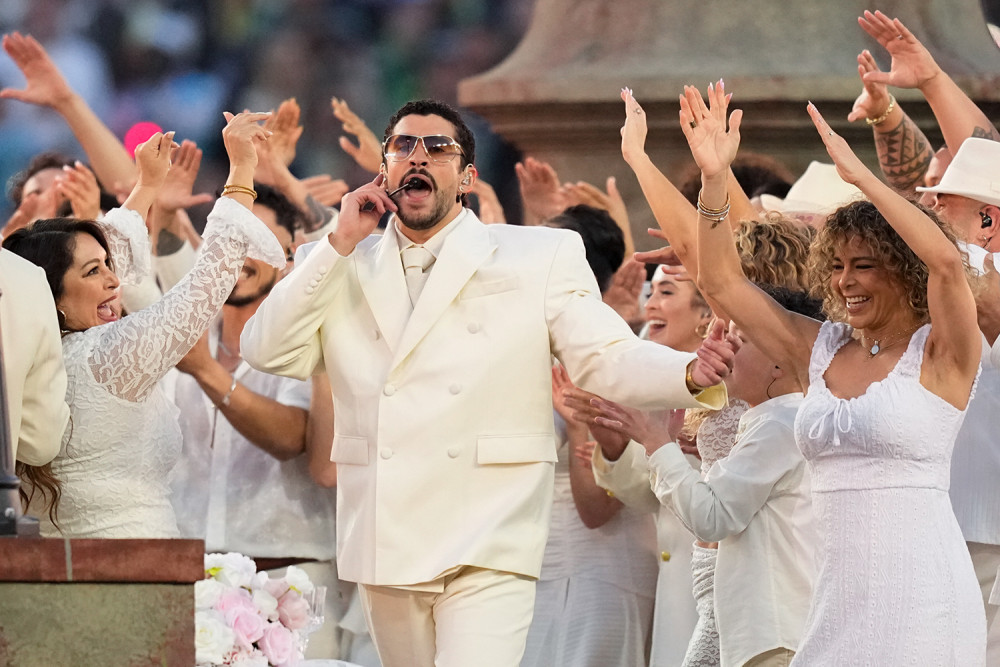
There was a moment, seemingly small, at the end of this year's Super Bowl Halftime Show that took my breath away. As the song "DtMF" concluded, Puertorriqueño singer/rapper Benito Antonio Martínez Ocasio (known globally as Bad Bunny) turned to his collaborators, ripped his microphone off, and continued to dance and sing all the way off the football field. The cameras cut away, but videos shared on social media showed singers, dancers, and musicians spilling out into the streets, filling the air with celebration as they sang:
Debí tirar más fotos de cuando te tuve
Debí darte más besos y abrazos las veces que pude
Ojalá que los míos nunca se mudenI should've taken more pictures when I had you
I should've given you more kisses and hugs whenever I could
I hope my people never move away
If it wasn't abundantly clear already, this clarifying moment further revealed that what we witnessed during the Super Bowl was less a Bad Bunny performance, more an invitation to participation. Maybe I'm cynical due to my proximity to the ultra-monetized, US-American music business—I live in Nashville—but such moments of uncontainable musical freedom and joy feel rare. This wasn't about auto-tuned precision and spectacle for spectacle's sake. Although, don't get me wrong. Every element of the production—staging, costuming, choreography—was breathtaking and full of life. But this musical and dramatic excellence seemed to emanate from Benito's celebration of joy con los míos rather than a desire to simply entertain the paying audience.
What struck me throughout Benito’s performance was that the joy the performers shared was a specific joy, a rich and deep joy that erupts from being rooted in a particular place and having profound love for its people and culture. Benito’s dedication to the particulars of Puerto Rican culture and geography is a gift to those of us from different social contexts. He has given us an example of how art can pull us out of our experiences of daily life into the lives of others, offering us glimpses of divine life breathed out into the world and bearing fruit in a vast array of colors and textures.
Benito packed his 14-minute celebration with a medley of Latin and Afro-Caribbean rhythms, seamlessly weaving together the fast-paced energy of reggaeton and trap with vibrant splashes of salsa and plena. Perreo dancers, piragua vendors, nail stylists, and domino players all added to the tapestry of Puerto Rican life on display. In the second half, Benito sang "NUEVAYoL" as he honored the diasporic life of Puertorriqueños in New York with a set featuring a model La Marqueta bodega and a cameo from Toñita, a legendary figure from Williamsburg, Brooklyn, who has long resisted gentrification with her Caribbean Social Club.
The centerpiece was wedding. Not just a staged wedding–the real wedding of Eleisa “Elli” Aparicio and Thomas “Tommy” Wolter, soundtracked by Bad Bunny’s “BAILE INoLVIDABLE” and guest star Lady Gaga’s “Die with a Smile” (given a delightful salsa remix), and officially witnessed by Benito himself. In the show’s overflow of joy and vitality, this was one of the clearest images of hope and love I've seen in some time.
Importantly, none of this felt escapist. This was not an empty display of “good vibes.” The joy Benito's gathered community exuded at the Super Bowl never denied darkness. Rather, through music, they fearlessly confronted injustice with a certainty that joy will always prevail. Indeed, the first image the show presents is of fields of sugarcane, evoking a painful history of Spanish and American colonialism, slavery, and the exploitation of both land and people for the sake of greed. Later, Benito climbed atop a utility pole to perform “El Apagón” (“The Blackout”), a critique of government forces and a privatized power grid that have caused Puerto Ricans to experience thirteen times the number of power outages as mainland US citizens annually (and that’s without considering major weather events like hurricanes).
The ongoing effects of colonialism, gentrification, and injustice are real threats to the sort of vibrancy Bad Bunny celebrates throughout the show, something fellow Puerto Rican guest star Ricky Martin highlights, as he sings:
Quieren quitarme el río y también la playa
Quieren el barrio mío y que abuelita se vaya
No, no sueltes la bandera ni olvides el lelolai
Que no quiero que hagan contigo lo que le pasó a HawáiThey want to take my river and my beach, too
They want my neighborhood and grandma to leave
No, don't let go of the flag nor forget the lelolai
'Cause I don't want them to do to you what happened to Hawaii
The more I reflect, the more I’m captivated by the way lament and joy are held hand in hand throughout the show. The way light doesn’t pretend the darkness doesn’t exist, but instead overwhelms it. I admit, I’ve often struggled with scripture’s call for the Thessalonians to “rejoice always, pray without ceasing, give thanks in all circumstances.” If I’m rejoicing all the time, where is the space for lament? Where is the opportunity for protest? The good news that Bad Bunny offers is that our protest need not be joyless. Our resistance against oppression need not suck the vibrancy out of life. Joy and lament can exist alongside each other. Perhaps they must.
In the midst of state violence, government dehumanization, rampant distortions of truth, oppression of the vulnerable, protection of the powerful, and on and on, we must never forget to celebrate that which we protest on behalf of—or the beautiful communities we love.
Benito’s gospel, displayed in all caps on the Jumbotron, is this: “The only thing more powerful than hate is love.” In context, this felt like more than platitude. At the conclusion of this glimpse of life overflowing with abundance, it telegraphed a neighborly invitation into transcendent, transformative love rooted in a particular cultural expression, yet extending throughout the cosmos. The blessing of abundant life, Benito reminds us, is a gift for all–from the southern tip of Chile to the barrios of Puerto Rico to the northern expanses of Canada. Each one of us, all of whom bear the image of the divine, is invited to the celebration. And though nationalism and all its fellow ills seek to silence that celebration at present, they will not outlast the rhythms of eternal, joyful love emanating from the streets.