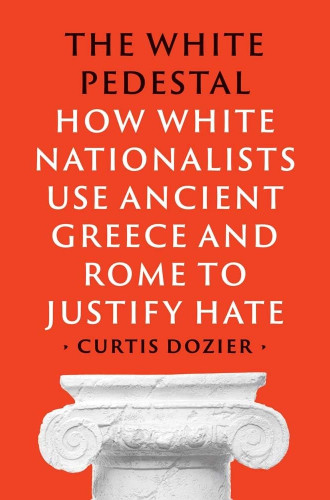
The White Pedestal
How White Nationalists Use Ancient Greece and Rome to Justify Hate
Proponents of White nationalist views have been gaining political power in the United States and advancing, to a shocking degree, their goal of a homogeneous nation run predominantly by White Christian men. The aggressive and dehumanizing mass deportation campaign undertaken by the Trump administration has been one particularly visible manifestation of this reality. But where do White nationalists source their ideas? What exactly are these ideas, and how widespread are they? In The White Pedestal, classics scholar Curtis Dozier shows that White nationalists draw significantly from a perhaps unexpected source: Greco-Roman history.
I grew up associating ancient Greece and Rome with epic heroism and regarding ancient Greece as the bright font of the Western intellectual tradition. I came to think of the Athenians, in particular, as emblematic of philosophical and political innovation. In this, I’m far from alone. As Dozier points out, “the idea that the ancient Greco-Roman world is important, admirable, and foundational is omnipresent in American culture.” Importantly, this isn’t just about what tweedy types think. Greek and Roman history loom large in popular culture as well. Christopher Nolan’s rendition of The Odyssey is sure to be one of the highest-grossing movies of 2026.
Read our latest issue or browse back issues.
But esteem for the ancient Greeks and Romans is also markedly prevalent among White nationalists, who turn to these revered ancients in making their case for the privileging of White people. When he first started to notice this, Dozier supposed that those who use Greco-Roman history to support racist views must be misrepresenting the history, and he wanted to set the record straight. However, the more he studied, the more he realized that White nationalist accounts of these ancients often parallel mainstream scholarly interpretations, that the ideas White nationalists draw from the classics have long been prevalent outside of White nationalist circles, and—most uncomfortably—that he had in fact absorbed some of these ideas himself.
Make no mistake, Dozier insists, White nationalists misuse ancient history when they use it to support their racist agendas. But they often don’t have to misrepresent the history in order to misuse it. Although White nationalists are guilty of distorting history in certain respects, in other respects they “see the ancient world with clearer eyes than those who assume their [White nationalist] interpretations depend on distortion.” One reason White nationalist treatments of classical history often track with those of mainstream scholarship is that scholarship has historically been characterized by the same White supremacist assumptions that today’s White nationalists hold. Another reason is that “the ancient world was anything but a paradise of tolerance and acceptance of difference. Ancient Greek and Roman thinkers articulated many theories of human difference that ranked groups of people as inferior, using different criteria from those employed by modern racism but applying them to the same ends.”
This being the case, what’s needed is a clear-eyed accounting of “just how suitable models from Greco-Roman antiquity are . . . for those who wish to promote abhorrently racist ideas.” By providing this accounting, Dozier gives us an important corrective to the sanitized versions of the ancient Greeks and Romans that have been handed down to so many of us and that encourage the uncritical veneration of these ancients that White nationalists count on to lend respectability to their views.
The racial categories of ancient Greece and Rome were very different from modern racial categories.
Dozier covers an impressive amount of ground. He introduces readers to the “intellectual radical right” and its central conspiracy theory, the “great replacement.” He shows how White nationalists construct an ideal of masculinity characterized by the use of violence to subdue “savagery” and repel perceived foreign invaders by appealing to figures such as Achilles and Odysseus and, especially, the Spartan warriors at the battle of Thermopylae. He examines the historically dubious but persistent notion of “a violent and cataclysmic fall of the Roman Empire” that can be attributed to a particular period or set of causes, encouraging readers to recognize how the fall of Rome functions as a myth (both in ancient times and today) that serves to maintain the status quo.
Dozier points out that the racial categories of ancient Greece and Rome were very different from modern racial categories. That fact renders claims that today’s White people are of the same race as the ancient Greeks and Romans (and, I would add, Elon Musk’s complaint that “Chris Nolan is pissing on Homer’s grave” by casting Lupita Nyong’o as Helen of Troy) anachronistic nonsense fueled by a race essentialism utterly divorced from reality. But Dozier insists that we not let this distract us from the more foundational task of exposing and dismantling “race-thinking”: dividing people into groups on the basis of arbitrarily selected physical characteristics and then assigning traits (e.g., intelligence or servility) to the groups in order to “justify the unequal distribution of resources.”
Dozier shows how the ancient Greeks’ insistence on freedom takes on a new hue when one recognizes that their concept of freedom was rooted in xenophobia and slavery. He demonstrates how notions of the naturalness of hierarchy have undergirded slavery and undercut democracy in both the ancient world and the modern. He examines how White nationalists turn to Greco-Roman history to argue that diversity leads to violence and civilizational decline, and he shows how this belief has led many Americans—from the founders to today—to promote government by and for the few.
The White Pedestal sheds light on today’s White nationalism, but it also encourages readers to look in the mirror. Dozier demonstrates not only how White nationalists’ regard for and interpretations of Greco-Roman history feed their delusional and unjust movement, but also how mainstream classical scholarship and those who are not White nationalists often share that regard and those interpretations. White nationalists are simply less shy about the implications.
I hope that others will follow Dozier’s lead to shed even more light, from other angles, on this movement in which claims of racial superiority intersect with claims of gender superiority and religious superiority. Dozier explores the intersections of White supremacy and patriarchy, but he mentions religion only in passing. Each of these pieces is important, however, because this is a movement for the dominance of White Christian men. It will be up to others to show how Christian nationalists’ regard for and interpretations of Christianity feed their movement, as well as how others who are not Christian nationalists very often share that regard and those interpretations. Christian nationalists, too, are simply less shy about the implications.