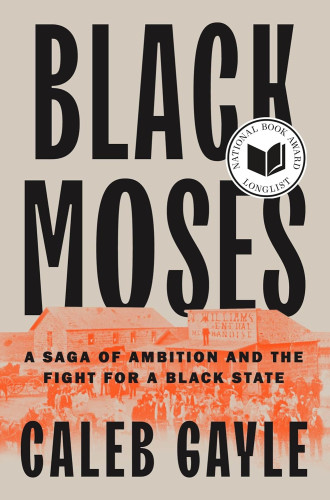
Black Moses
A Sage of Ambition and the Fight for a Black State
Just as the biblical Moses sought a way of liberation for the Hebrew people, historical figures in the United States sought a path of liberation for Black people during the antebellum and Reconstruction eras. Journalist and oral historian Caleb Gayle focuses on one such individual: Edward P. McCabe. A Black man who came into the world “without the scourge of being born into slavery,” McCabe believed in the possibility during the post–Civil War era of a majority-Black state in the Union that would recognize the sovereignty of Black people to lead and make political decisions. More than just land ownership in a place, McCabe sought for himself and others a place to call home and to build a future of abundant living and self-determination. This new world for free Black people would be a promised land, a new Eden, and it would be found in the American West. Or so McCabe and his supporters thought—even as their plans were continually thwarted by politics, conflicting business interests, and racism.
More than just a biography, Black Moses presents McCabe’s life story within a chronological progression of the historical events that impacted Black people in the United States from the pre–Civil War period through the Progressive Era, particularly focusing on the post-Reconstruction period. The end of federal policy around Reconstruction fueled McCabe’s dream of reconstructing a place in the American West for Black settlers. Beginning in Kansas with an emerging Black community in Nicodemus, McCabe and others began to fashion a power base and their own Black nationalism to shape a Black frontier world. As an emerging political official in the state of Kansas after his election as state auditor, McCabe soon became embroiled in controversy around his connection to the political machine operating in the state’s leadership. In reality, the party bosses decided that the “Black man holding state office has overstayed his welcome.”
With his political defeat and the isolation of Nicodemus from the market centers that would allow for economic self-sufficiency and abundance, McCabe turned his sights for creating a Black state to a landscape recently opened by the federal government in Indian territory. This portion of land, now claimed as Oklahoma Territory, had “Unassigned Lands” open to settlers. McCabe and his supporters saw another promised land with the opening of this territory, and they envisioned McCabe taking the helm as Moses to lead Black settlers in his dream of a Black state. In a personal meeting with President Benjamin Harrison, McCabe petitioned for the opportunity to populate Oklahoma as a separate place to demonstrate that Black men and women are capable of self-government.