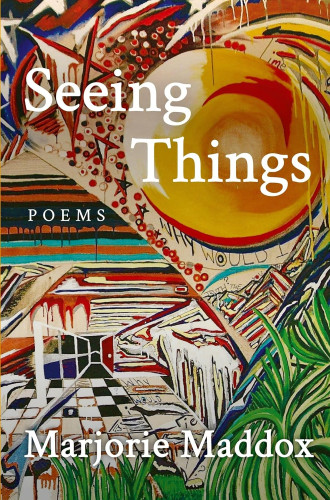
Seeing Things
Seeing Things, Marjorie Maddox’s most recent poetry collection, opens with a poem of ambivalent invocation: “darkness. Guardian, O guardian, with your seraphim- / borrowed slippers, you tiptoe along the corpus callosum / between the mind’s two worlds.” The sense of ambivalence is further complicated by the line break that places the word darkness (which in an earlier line refers to a daughter who is “painting the world’s darkness”) next to Guardian. In so doing, Maddox skillfully introduces themes of duality, illusion, and trust, as well as this question: Are we being accompanied by something benevolent through this life? Or, when we invoke the guardian angel, is it darkness that appears?
Thus begins a collection that weaves stories of intergenerational trauma and survivorship, dancing on the frail and fraying edges of memory and perception by introducing a vital disquiet, a vigilance that things are not really what they seem. By holding this interrogative stance, the poet subtly argues that this approach may ultimately be the only way to see clearly.
Read our latest issue or browse back issues.
Though a collection of poems can be read independently of its real-life context, Maddox offers us details of this herstory by stating that this book functions as a prequel to two other collections, Begin with a Question (2022) and In the Museum of My Daughter’s Mind (2023). In most cases, the I of the poem is both the mother to a daughter who’s struggling with mental illness and the daughter to a mother who is entering the early stages of Alzheimer’s. Inside of these two complex mirrors, the poems’ speaker attempts to gaze unflinchingly at herself. Through this act of contending with and seeking that which is real, she can witness other lives and stories with both horror and tenderness and serve as a witness to the planet itself, a kind of being for which the female body is a metaphor (and vice versa).
Through the act of witnessing, we begin to understand that in perpetrating violence toward one, we do it unto all. Conversely, Maddox also demonstrates that the same is true of kindness and its reverberations. Inside the everyday, there is a call that sounds something like this:
. . . Come, though our visions dim,
we trudge and trip together towards such light
where . . . in all visible things an invisible
fecundity, a dimmed light, a meek name-
lessness, a hidden wholeness.
Perhaps “the ancient revelations dim / beside the bright glare of what we hide / from each other.” In a world predicated on maintaining the status quo, on accepting or even ignoring the quiet sexual violence between the walls of a home, or the untenable reality of mass shootings and preventable ecological disasters, we learn to hide our most intimate truths. However, the confessional nature of these poems invites us to witness such tragedies as summons to passionate righteous action, connection, and, ultimately, self-disclosure. The speaker’s own disclosures, though at times painfully raw, do not read as strictly autobiographical accounts but as skillful weavings in which the details of what happened become generous portals into the human experience, with its fractures and despair, ordinary pleasures, and unabashed joy.
They invite us to enter more deeply into our own experience and to dare to make art of it, which is another way of bringing it to fuller consciousness. “Where shall we hide from the pain that bore us, / from the damaged selves that keep us dying?” If we hide in the caves of our mind, the poet suggests, we may needlessly suffer. But as this collection demonstrates, we might instead draw over ourselves the loving vestments of imagery, metaphor, poetic form—words that lament and sing, cover and beckon our bodies to move, to release.
Seeing Things functions like a variation of an ars poetica, which reflects on the process of creating a poem. In this case, almost all of the poems carry a meta-consciousness of how form and content harmonize or clash, allowing for layers of meaning to emerge. This is meaning-making not as hiding but as simultaneous protection and revelation. We can be known, the poems whisper. It’s not the cheap knowing of an exposé, a story told in lurid detail to titillate, but rather the intentional crafting of a container for our sacred truths. The form might be a sonnet or a terzanelle, a triolet or a mirror ghazal (yes, Maddox is extremely versatile!), but more importantly, it’s the careful attention to language, the astonishing precision of words that both invoke and evoke the invisible and “just like that” (a repeated phrase from her work) shift it to the visible. She is particularly masterful in working with repetition, which in its at times claustrophobic resonances invites us to experience the mind’s obsessive ping-pong while also initiating us into how we can create so much with so little. The poem “What Her Teacher Said about Nagasaki and Hiroshima,” invites us into this incredible vortex:
She said what
she said was “If you look she said was
straight up into the horror of
was she said not sun
she said but bomb was what she said exploding suns,
exploding decimating what she said was us . . .
This poem, like many others, performs its meaning by splicing and riffing off the repeated phrase. In the fragmentation and the confusing reassembling, we can come to know the traumatized mind-body and are asked to construct meaning through a different mechanism than what we’ve used in the past. We have to feel rather than understand, because how else can one make sense of tragedy on such a scale? Our meaning-making apparatus cannot compute such catastrophic loss, but in the intelligence of the body there is space for a different kind of meaning, one that is birthed from metaphor and grief.
This insight is perhaps the beating heart of this exquisitely beautiful book—that if we let ourselves travel the dark and ever deepening circles of this (or our own) inferno of abuse, mental illness, and loss, our grief will morph into a hard-earned joy, expressed not as an erasure of grief but as a unity of polarities. We might just drop into “claiming praise as respite, / holding close each breaking day, dangerous / yet divine in all / its gorgeous glory.”