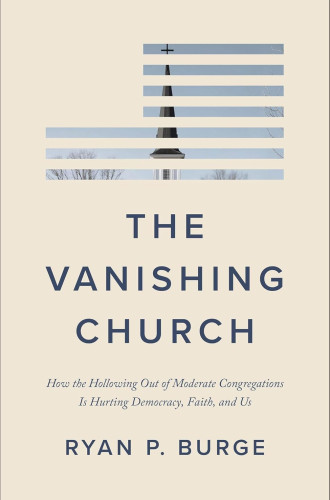
The Vanishing Church
How the Hollowing Out of Moderate Congregations is Hurting Democracy, Faith, and Us
Before Ryan Burge was a demographer and a university professor, he spent 17 years as lead pastor of the First Baptist Church of Mt. Vernon, Illinois—a church that closed during his tenure. It was part of the American Baptist Churches USA, one of the “seven sisters” of mainline Protestantism in the United States. In The Vanishing Church, Burge notes that, in 1987, these denominations reported a combined membership of about 24 million; in 2022, it was just 13.2 million. And that precipitous decline has left “a polarized religious landscape.”
That increased polarization results from what Burge calls the “big church sort,” a major driver of which is that, for increasing numbers of people, church connections reflect their partisan political views more than their specific theological convictions. “Their religious identity is downstream of their partisan affiliations,” writes Burge. One troubling trend is that while an increasing number of people consider themselves to be evangelical, many of them are using the word as a kind of tribal marker, the name for a shared political identity (Republican) more than for a meaningful faith commitment. While the trend is less pronounced among Roman Catholics in the United States, Burge cites data indicating that they, too, are drifting politically and theologically rightward.
Read our latest issue or browse back issues.
Other factors in the sorting are income, education, and family configuration. People who are on the lower rungs of the socioeconomic ladder, who lack education beyond high school, who aren’t married, or who do not have children are all less likely to participate in a church. According to Burge, “the most likely churchgoer is a college-educated, married parent who makes about $80,000 per year.”
The dramatic rise of the nones is another powerful dynamic in the big church sort. Their number “doubled between 2004 and 2021,” writes Burge. “In real numbers, that means the share of Americans with no religious affiliation grew by at least forty million in about seventeen years.” Since 1972, the “share of Americans who report no religious affiliation exploded,” growing from 5 percent to nearly 30 percent. No wonder Burge calls the steep increase in the number of nones “the most significant cultural shift in the United States over the last three decades, becoming the default landing spot for political liberals who can’t find a place in American Christianity.”
One of Burge’s primary convictions is that churches can and should be healers of democracy’s wounds.
The Vanishing Church returns repeatedly to the lament that the sorting and polarizing of US Christianity leaves fewer places for political moderates and progressives, for questioners and doubters, and for people with limited economic resources and education to find community. One strain of the lament comes from the sense that the sorting into political enclaves of sameness is intensified by the most extreme and strident voices on social media, which conceal broader areas of agreement among Americans. Burge says, “The average American tends to be fairly moderate, nuanced, and pragmatic in how they view some of the most talked about and divisive issues in modern society. Said succinctly, the individual level data doesn’t seem to match what is happening at the institutional level of American society.”
The institutional level is subject to the influence of lobbying, social media, and polling data. About polling, Burge notes that individuals sometimes respond to polls in ways which reflect and reinforce a group identity which is important to them but doesn’t necessarily reflect their actual and more nuanced values or their more moderate day-to-day conduct. Still another part of the lament is that most congregations are no longer places where people of differing views and diverse experiences do the hard and glad work of living out their faith in meaningful community. That loss, Burge says, hurts individuals, churches, and democracy.
One of Burge’s primary convictions is that churches can and should be healers of the wounds of democracy. “Exposing ourselves to differences from both the pulpit and the pews is essential for the future of American religion and American democracy,” he writes. “It’s also good for one’s own well-being.” He offers some guiding principles for participating in churches that could contribute to the restoration of frayed and torn community: “learn to spot fringe beliefs”; remember that, in congregations as in the rest of life, “the perfect is the enemy of the good”; and “don’t dehumanize the other.” It’s a good beginning list.
A mark of a good book is that it prompts reflection on matters beyond its immediate purposes. The Vanishing Church is that kind of book. Since reading it, I’ve found myself pondering some other theological perspectives and congregational practices necessary for the kinds of congregations Burge hopes for. They include reverence and humility, grounded in an awareness of God’s vastness and humanity’s limits. Such congregations need a shared covenant of equality, responsibility, and mutual love which binds members together in diversity and across differences. They would benefit from an engaged and energized priesthood of all believers in which each person’s voice and gifts are highly valued and gratefully received. They strive for faithfulness to God’s justice and mercy which overflows in being present with people who have been shoved to the margins of society. These kinds of churches also remember that their desire to help heal American democracy derives from pursuit of a more central and overarching mission: to love God, neighbors, strangers, and enemies; to work for the “healing of the nations”; and to participate in the restoration of all creation.