Books

A Christian case against capitalism

Liberals, writes Phil Christman, accept the political need to keep liberal billionaires happy. Leftists don’t think there should be any billionaires.

Early in his new book, CENTURY columnist Phil Christman recounts a formative, almost mystical episode from a college Bible study. Amped on adolescent anxiety and tormented by the sort of shame in which Christian fundamentalism sadistically specializes, a young Phil gathers with some classmates to read the Sermon on the Mount. This, his younger self muses, is not something a guy with a girlfriend does on a Saturday afternoon. “I am a loser,” he realizes. “We are the losers.”

But then something happens. Reading the Sermon on the Mount together, his perception of his classmates shifts:

A fundamentally other way of thinking about them suddenly appeared to me as an option; a wholly different map of the world abruptly unfolded in my mind, in which—this is as close as I can get to summarizing it—each of these people was a subject that a person could love, and was capable of giving love to others, and was therefore infinitely precious and infinitely interesting. That whole economy of losers and winners, with its implied scarcity of worthiness, had disappeared. Or not disappeared but receded: it didn’t seem inevitable or fully real anymore. It seemed like a lie that needed to be undone by the constant practice of universal, constant, and unvarying love.
I cite this at some length to give you a feel for Christman’s beguiling voice as an essayist. This is also the germ of his conviction and argument: The Sermon on the Mount is a manifesto about the possibility of and call for “universal solidarity,” and the form of political life that best lives out such a call is socialism.

Christman is aware of the heavy burden on such an argument. He also has modest expectations of who this book might convince. This is not the book to give to your Fox-News-watching parents or your libertarian friend. They won’t even get past the title. It is a book you might give to newly disenchanted evangelicals who are deconstructing their former elision of Christianity and conservatism. But this book is aimed most squarely at those who already think of themselves as liberals, maybe even progressives—those Christians who, whether for a lifetime or as a more recent development, see themselves as reliable voters for whoever the Democratic Party puts on the ballot. This audience is not unlike that imagined by Martin Luther King Jr. when he penned his letter from a Birmingham city jail. It probably also overlaps pretty neatly with readers of the CENTURY, where King’s letter was published.

Christman’s pitch to this audience is basically this: That’s not enough. It’s not enough to be anti-Republican or to loathe Trump; it’s not enough to vote Democrat; it’s not enough to be proud liberals or edgy progressives bent on inclusion, anti-racism, and an expanded social safety net. None of these reliable markers of our liberal bona fides will get us to genuine solidarity if, like the Democratic Party, we imagine we can leave some regulated, mildly chastened capitalism in place. This, Christman correctly says, is the line in the sand between liberals and leftists.

If you’re a liberal, you support policies that care for “the least of these.” You want a government that’s attentive to the vulnerability of the widow, the orphan, and the stranger. But if you’re a liberal, you’re also committed to electoral politics in a binary system where, per Citizens United v. FEC, money talks. Both parties in this system “need to have a handful of billionaires on their side,” writes Christman. Which means being a liberal requires keeping just enough billionaires happy. To accept and support this makes one a liberal.

The leftist, by contrast, thinks there probably shouldn’t be any billionaires. The difference between liberals and leftists, then, hinges on this question about capitalism and whether we imagine that Jesus said, “the billionaires you will always have with you.”

At this point, liberals and old-head Democratic Party-types start to cosplay “adults in the room,” talking variously about pragmatism, realism, and compromise. When the leftist envisions a political economy organized by something other than capitalism’s pillars of class, property, and competition, the liberal pats them on the head and says, “You’ll grow out of it.” But this only means that the liberal has inhaled the ideology of Friedrich Hayek & Co., economists who touted capitalism as if it were the natural order of things.

Leftism recognizes the historical contingency of capitalism, diagnoses its ills, and imagines how we could organize society differently. The birth pangs of capitalism from feudalism can be echoed by the emergence of socialism from capitalism. Animated by hope and acquainted with history, the leftist imagines a world in which the vast majority of workers no longer have to play “the ‘rent myself to survive’ sweepstakes.”

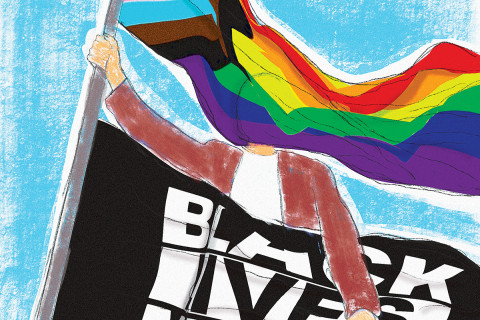
This is why, for the leftist, class is the defining political fight. Whereas for the liberal, feminism and anti-racism and inclusion are “social” issues, for the leftist, the injustices visited on women, queer folk, and people of color are almost all manifestations of economic power doing its best to divide and conquer. Christman echoes Catholic theologian Herbert McCabe on this point, maintaining “that class warfare is something that exists whether or not we approve of it, and that our only choice as Christians is to enlist on the side of the oppressed: the side God has chosen.”

If you’re a liberal and you’re feeling defensive as you read this, blame that on me, not Christman. Because one of the surprising traits of this provocative little book is that it’s not particularly polemical. Christman is generous, open-handed, exploratory. He has not simply traded one fundamentalism for another. Christman’s forte is the wending personal essay, intimate but smart, incisive and, at times, hilarious. (God bless his use of footnotes—they sometimes had me snorting with recognition.) The voice is not that of a zealot but of a witness. There is not a hint of dogmatism here, just hard-won conviction.

This is a timely book that I hope will catalyze serious conversations in our churches, especially in the Protestant mainline. We are at an inflection point in the history of the United States. As Alberto Toscano argues in Late Fascism, fascism arises as a crisis within capitalism. In that sense, fascism lives in the house capitalism built. Toscano cites Max Horkheimer’s famous line from 1939: “whoever is not willing to talk about capitalism should also keep quiet about fascism.”

Phil Christman is talking about capitalism. He urges all Christians to see the resonance between seeking Jesus’ inverted kingdom of the meek and poor and working toward a society that lifts and protects the wretched of the earth. Christman’s book is a fresh articulation of what Gustavo Gutiérrez called a “spirituality of liberation” that revolves around “conversion to the neighbor, the oppressed person, the exploited social class, the despised ethnic group, the dominated country. Our conversion to the Lord implies this conversion to the neighbor.” When Jesus says, “Follow me,” he invites us to imagine the world other than how we find it.

This article was edited on October 6, 2025, to correct a quote and correctly attribute it to Max Horkheimer.

James K. A. Smith

James K.A. Smith teaches philosophy at Calvin University in Grand Rapids, Michigan, and is author of the forthcoming Make Your Home in This Luminous Dark.

All articles »